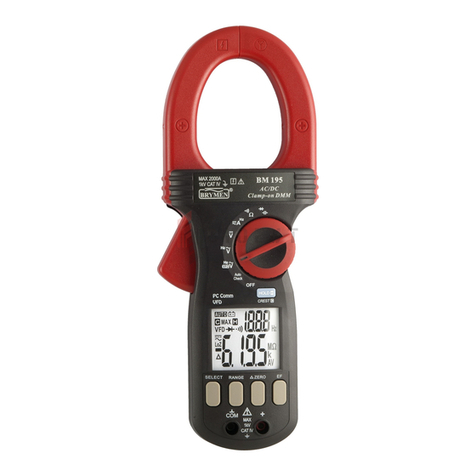
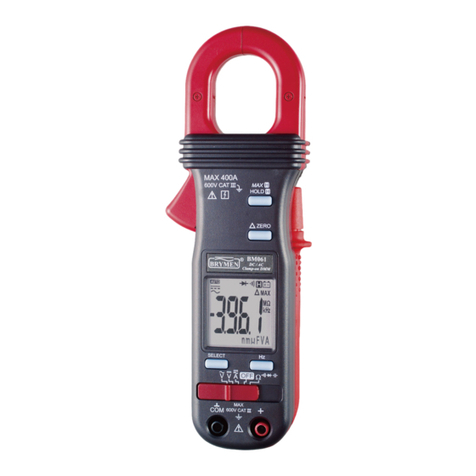
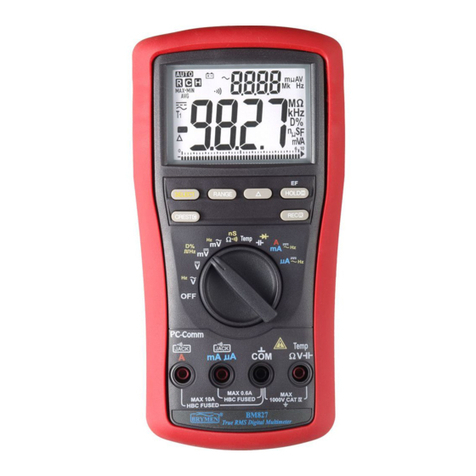
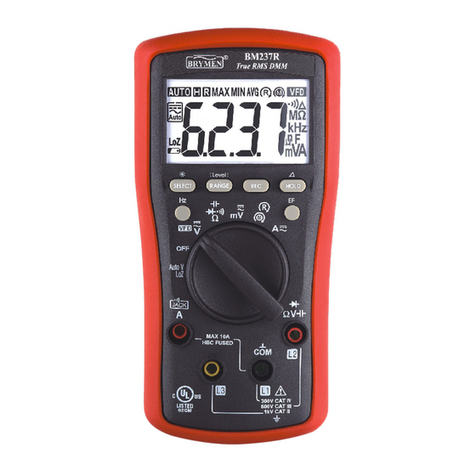
HOLD mode
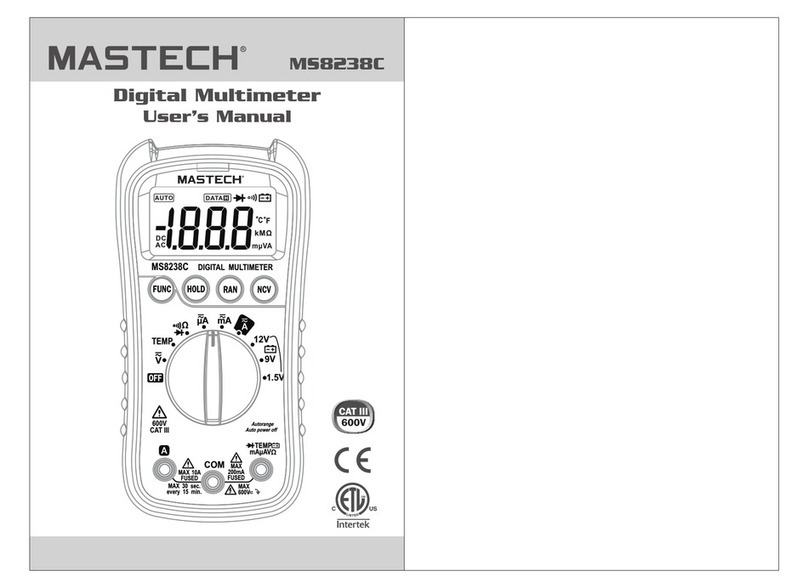
When any function is auto-selected or manual-selected, press HOLD button
momentarily toggles to Hold mode. The annunciator “ ” turns on. Hold mode freezes
the display for later viewing.
Notes on Displacement Power Factor & Total Power Factor
Introduction: Power is the rate of change of energy with respect to time (in terms of
voltage V and current A). Instantaneous (real) power w=vi where vis the
instantaneous voltage and ithe instantaneous current. The average (real) power is the
mean of vi and is given by:
W = /2vi dt , over the interval from 0 to 2/
Displacement Power Factor (more traditional): Assuming V and A are pure
sinusoidal waveforms without harmonics (as in most traditional cases), that is, v=V
sint and i=Isin (t -), the expression can be simplified to:
W = 1/2 x VxIx Coswhere Vand Iare the peak values, is the
displacement power factor angle, and Cosis the displacement power factor. Using
RMS values, it is written as:
W = Vrms x Arms x Cos
Practically, in such cases without harmonics, is also called the phase-shift angle of
the current A to the voltage V. An inductive circuit is said to have a lagging power factor
since current A lags voltage V (phase-shift angle and thus Sinare both “+”),
and a capacitive circuit is said to have a leading power factor since current A leads
voltage V (phase-shift angle and thus Sinare both “-”).
Total Power Factor (encountering harmonics): When encountering distorted
waveforms with the presence of harmonics, however, the simplified power expression
should not be used since substituting the above mentioned pure sinusoidal V and A
functions cannot fulfill the actual conditions. Cosine of phase-shift angle (Cos
), or
the displacement power factor, is no longer the only component constituting the overall
power factor. Harmonics do increase apparent power and thus decrease the overall
power factor. That is, the Total Power Factor is actually affected by both phase-shift
angle and harmonics, and is given by the expression:
Total Power Factor (PF) = Real Power (W) / Apparent Power (VA)
In order to improve overall system power factor, nowadays power-system engineer
needs to address both phase-shift and harmonics problems. Practically, harmonics
should be dealt with (e.g. filtering out) before phase-shift to be corrected (e.g. installing
capacitors in parallel with inductive loads).