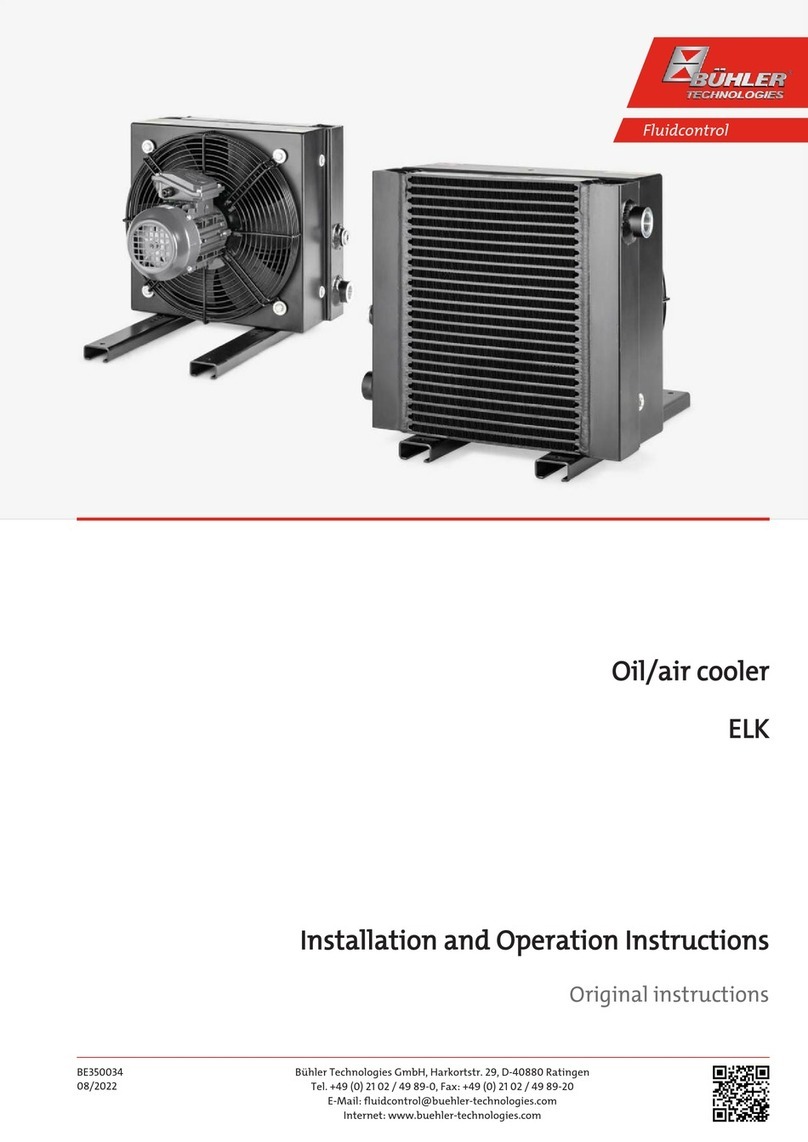
Buhler EGK 4S User manual

Analysentechnik
Installation and Operation Instructions
Original instructions
Sample gas cooler
EGK 4S
BE450004
10/2018
Bühler Technologies GmbH, Harkortstr. 29, D-40880 Ratingen
Tel. +49 (0) 21 02 / 49 89-0, Fax: +49 (0) 21 02 / 49 89-20
E-Mail: [email protected]
Internet: www.buehler-technologies.com

Bühler Technologies GmbH, Harkortstr. 29, D-40880 Ratingen
Tel. +49 (0) 21 02 / 49 89-0, Fax: +49 (0) 21 02 / 49 89-20
Internet: www.buehler-technologies.com
E-Mail: [email protected]
Read this instruction carefully prior to installation and/or use. Pay at-
tention particularly to all advises and safety instructions to prevent in-
juries. Bühler Technologies can not be held responsible for misusing
the product or unreliable function due to unauthorised modifications.
All rights reserved. Bühler Technologies GmbH 2018
Document information
Document No......................................................... BE450004
Version..........................................................................10/2018

EGK 4S
Contents
1 Introduction..................................................................................................................................................................................................................... 2
1.1 Intended use .........................................................................................................................................................................................................2
1.2 Types .......................................................................................................................................................................................................................2
1.3 Scope of delivery..................................................................................................................................................................................................2
1.4 Ordering instructions ........................................................................................................................................................................................ 3
2 Safety instructions.........................................................................................................................................................................................................4
2.1 Important advice.................................................................................................................................................................................................4
2.2 General hazard warnings ................................................................................................................................................................................. 5
3 Transport and storage ..................................................................................................................................................................................................6
4 Installation and connection ........................................................................................................................................................................................ 7
4.1 Installation site requirements......................................................................................................................................................................... 7
4.2 Installation ............................................................................................................................................................................................................ 7
4.2.1 Connecting the heat exchanger...................................................................................................................................................... 8
4.3 Electrical connections ........................................................................................................................................................................................8
5 Operation and control ................................................................................................................................................................................................ 10
5.1 Use of menu functions ....................................................................................................................................................................................10
5.1.1 Overview of the menu items............................................................................................................................................................11
5.1.2 Detailed description of the operational principle .....................................................................................................................11
5.2 Description of menu functions ..................................................................................................................................................................... 12
5.2.1 Main menu........................................................................................................................................................................................... 12
5.2.2 Submenu............................................................................................................................................................................................... 12
6 Maintenance...................................................................................................................................................................................................................13
7 Service and repair......................................................................................................................................................................................................... 14
7.1 Troubleshooting ................................................................................................................................................................................................ 14
7.2 Safety instructions.............................................................................................................................................................................................15
7.3 Cleaning and removal of the heat exchanger............................................................................................................................................15
7.4 Replacing the fuse of the cooler.................................................................................................................................................................... 16
7.5 Replacing the hoses of the peristaltic pump (option) ............................................................................................................................ 16
7.6 Spare parts and accessories ........................................................................................................................................................................... 16
7.6.1 Spare Parts and Accessories ............................................................................................................................................................16
8 Disposal............................................................................................................................................................................................................................17
9 Appendices..................................................................................................................................................................................................................... 18
9.1 Technical Data.................................................................................................................................................................................................... 18
9.2 Performance Data ............................................................................................................................................................................................. 18
9.3 Diagram typical installation .......................................................................................................................................................................... 19
9.4 Heat exchanger.................................................................................................................................................................................................. 19
9.4.1 Heat exchanger description ............................................................................................................................................................19
9.4.2 Heat exchanger overview.................................................................................................................................................................19
9.5 Dimensions (mm)............................................................................................................................................................................................. 20
10 Attached documents....................................................................................................................................................................................................21
iBühler Technologies GmbHBE450004 ◦ 10/2018

EGK 4S
1 Introduction
1.1 Intended use
This unit is intended for industrial use in gas analysis systems. It's an essential component for conditioning the sample gas to
protect the analysis instrument from residual moisture in the sample gas.
Please note the specifications in the data sheet on the specific intended use, existing material combinations, as well as pressure
and temperature limits.
1.2 Types
The device is delivered with different configurations. The part number given on the type plate informs you about the specific
configuration of your device.
1.3 Scope of delivery
– Cooler
– Product documentation
– Connection-/mounting accessories (optional)
2 Bühler Technologies GmbH BE450004 ◦ 10/2018

EGK 4S
1.4 Ordering instructions
The item number is a code for the configuration of your unit. Please use the following model key:
457 X X X X X 0 0 0 X Product Characteristics
Gas cooler models
0 Wall mounting
1 19" rack installation
Supply voltage
1 115 V metric screw connections
2 230 V metric screw connections
3 115 V US screw connections
4 230 V US screw connections
Gas paths 1)
0 without heat exchanger
1 1 gas path
2 2 gas paths
3 3 gas paths
4 4 gas paths
Heat exchanger
0 0 without heat exchanger
1 0 Single stainless steel heat exchanger/ (TS or TS-I)
2 0 Single glass heat exchanger/ (TG)
3 0 Single PVDF heat exchanger/ (TV or TV-I)
Condensate drain 2)
0 without condensate drain
Mounting Accessories
0 without mounting accessories
1 with mounting brackets
2 with feet
3 with mounting brackets and feet
4 with handles
5 with mounting brackets and handles
6 with feet and handles
7 with all mounting accessories
1) up to 8 gas paths upon request.
2) Peristaltic pumps must be installed separately or can be mounted to the cooler using a mounting angle. The supply voltage
corresponds with that of the main unit. Automatic condensate drains are installed separately.
3Bühler Technologies GmbHBE450004 ◦ 10/2018

EGK 4S
2 Safety instructions
2.1 Important advice
Operation of the device is only valid if:
– the product is used under the conditions described in the installation- and operation instruction, the intended application
according to the type plate and the intended use. In case of unauthorized modifications done by the user Bühler Technolo-
gies GmbH can not be held responsible for any damage,
– when complying with the specifications and markings on the nameplates.
– the performance limits given in the datasheets and in the installation- and operation instruction are obeyed,
– monitoring devices and safety devices are installed properly,
– service and repair is carried out by Bühler Technologies GmbH,
– only original spare parts are used.
This manual is part of the equipment. The manufacturer keeps the right to modify specifications without advanced notice. Keep
this manual for later use.
Signal words for warnings
DANGER
Signal word for an imminent danger with high risk, resulting in severe injuries or death if not avoided.
WARNING
Signal word for a hazardous situation with medium risk, possibly resulting in severe injuries or death if not
avoided.
CAUTION
Signal word for a hazardous situation with low risk, resulting in damaged to the device or the property or
minor or medium injuries if not avoided.
NOTICE
Signal word for important information to the product.
Warning signs
These instructions use the following warning signs:
Warns of a general hazard General information
Warns of voltage Unplug from mains
Warns not to inhale toxic gasses Wear respiratory equipment
Warns of corrosive liquids Wear a safety mask
Warns of explosive areas Wear gloves
4 Bühler Technologies GmbH BE450004 ◦ 10/2018

EGK 4S
2.2 General hazard warnings
The equipment must be installed by a professional familiar with the safety requirements and risks.
Be sure to observe the safety regulations and generally applicable rules of technology relevant for the installation site. Prevent
malfunctions and avoid personal injuries and property damage.
The operator of the system must ensure:
– Safety notices and operating instructions are available and observed,
– The respective national accident prevention regulations are observed,
– The permissible data and operational conditions are maintained,
– Safety guards are used and mandatory maintenance is performed,
– Legal regulations are observed during disposal.
– the device is protected from mechanical loads.
Maintenance, Repair
Please note during maintenance and repairs:
– Repairs to the unit must be performed by Bühler authorised personnel.
– Only perform conversion-, maintenance or installation work described in these operating and installation instructions.
– Always use genuine spare parts.
Always observe the applicable safety and operating regulations in the respective country of use when performing any type of
maintenance.
DANGER Electrical voltage
Electrocution hazard.
a) Disconnect the device from power supply.
b) Make sure that the equipment cannot be reconnected to mains unintentionally.
c) The device must be opened by trained staff only.
d) Regard correct mains voltage.
DANGER Toxic, corrosive gas/condensate
Sample gas/condensate may be hazardous to health.
a) If necessary, ensure a safe gas/condensate discharge.
b) Always disconnect the gas supply when performing maintenance or repairs.
c) Protect yourself from toxic/corrosive gasses/condensate when performing mainten-
ance. Wear appropriate protective equipment.
DANGER Potentially explosive atmosphere
Explosion hazard if used in hazardous areas.
The device is not suitable for operation in hazardous areas with potentially explosive at-
mospheres.
Do not expose the device to combustible or explosive gas mixtures.
5Bühler Technologies GmbHBE450004 ◦ 10/2018

EGK 4S
3 Transport and storage
Only transport the product inside the original packaging or a suitable alternative.
The equipment must be protected from moisture and heat when not in use. It must be stored in a covered, dry and dust-free
room at a temperature of -20 °C to 60 °C (-4 °F to 140 °F).
6 Bühler Technologies GmbH BE450004 ◦ 10/2018

EGK 4S
4 Installation and connection
4.1 Installation site requirements
The unit is intended for use in enclosed areas in a 19” rack, wall-mounting, or as a table-top unit. Adequate protection from the
weather must be provided when used outdoors.
Install the unit leaving enough room below the cooler to discharge the condensate. Leave room above for the gas supply.
Be sure to maintain the approved ambient temperature. Do not obstruct the convection of the cooler. The vents must have
enough room to the next obstacle. The distance must especially be a minimum of 10 cm on the air outlet side.
Ensure adequate ventilation when installing in enclosed housings, e.g. analyser cabinets. If the convection is inadequate, we re-
commend aerating the cabinet or installing a fan to lower the inside temperature.
4.2 Installation
Run the gas supply to the cooler with a downward slope. The gas inputs are marked in red and additionally labelled "IN".
If a large amount of condensate accumulates, we recommend using a condensate trap with automatic condensate drain. Our
condensate drains, 11 LD spec., AK 20 V, or model 165 SS, are suitable.
Glass vessels and automatic condensate drains are available for draining condensate for external mounting below the unit.
When using automatic condensate drains, the sample gas pump must be installed upstream of the cooler (pressure operation)
to ensure proper function of the condensate drain.
If the sample gas pump is located at the cooler outlet (suction operation), we recommend using glass condensate traps or peri-
staltic pumps.
Connecting the condensate drains
Depending on the material, build a connecting line with fittings and tubing or hose between the heat exchanger and condens-
ate drain. For stainless steel the condensate drain can be suspended directly to the connecting tube, for hoses the condensate
drain must be secured separately using a clamp.
The condensate drain can be mounted directly to the heat exchanger.
Condensate lines must always be installed with a slope and a minimum inside diameter of DN 8/10 (5/16”).
The DTV heat exchanger cannot be operated in conjunction with an automatic condensate drain.
Peristaltic pump (optional)
A peristaltic pump may also be installed a little away from the cooler. A mounting angle is available for installing up to 4 pumps
directly below the cooler. Two M8 rivet nuts in the cooler bottom are designated for mounting the angle.
NOTICE
Installing peristaltic pumps CPsingle / CPdouble limits the maximum permissible oper-
ating pressure in the system!
Operating pressure ≤ 1 bar
7Bühler Technologies GmbHBE450004 ◦ 10/2018

EGK 4S
4.2.1 Connecting the heat exchanger
The gas inputs are marked in red.
On glass heat exchangers the correct position of the seal is important when connecting the gas lines (see image). The seal con-
sists of a silicone ring with a PTFE sleeve. The PTFE side must face the glass thread.
Glass PTFE
4.3 Electrical connections
The operator must install an external separator for the device which is clearly assigned to this device.
This separator
– must be located near the device,
– must be easy for the operator to reach,
– must comply with IEC 60947-1 and IEC 60947-3,
– must separate all live conductors and the status output, and
– must not be attached to the power feed.
WARNING Hazardous electrical voltage
The device must be installed by trained staff only.
CAUTION Wrong mains voltage
Wrong mains voltage may damage the device.
Regard the correct mains voltage as given on the type plate.
WARNING High voltage
Damage to the device in case of insulation testing
Do not proceed insulation tests with high voltage to the device as a whole!
Insulation test
The device is equipped with extensive EMC protection. If insulation tests are carried out the electronic filter devices will be dam-
aged. All necessary tests have been carried out for all concerned groups of components at the factory (test voltage 1 kV or 1.5 kV
respectively, depending on the device).
If you wish to carry out the insulation test by yourself, please test only separate groups of components.
Disconnect the compressor, the fan, the heating or the peristaltic pumps, respectively, and then carry out the insulation tests.
8 Bühler Technologies GmbH BE450004 ◦ 10/2018
Table of contents
Other Buhler Accessories manuals