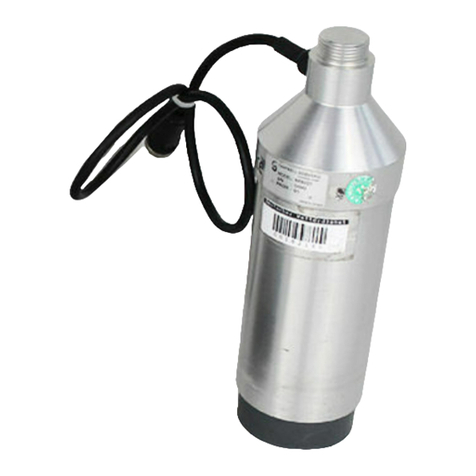
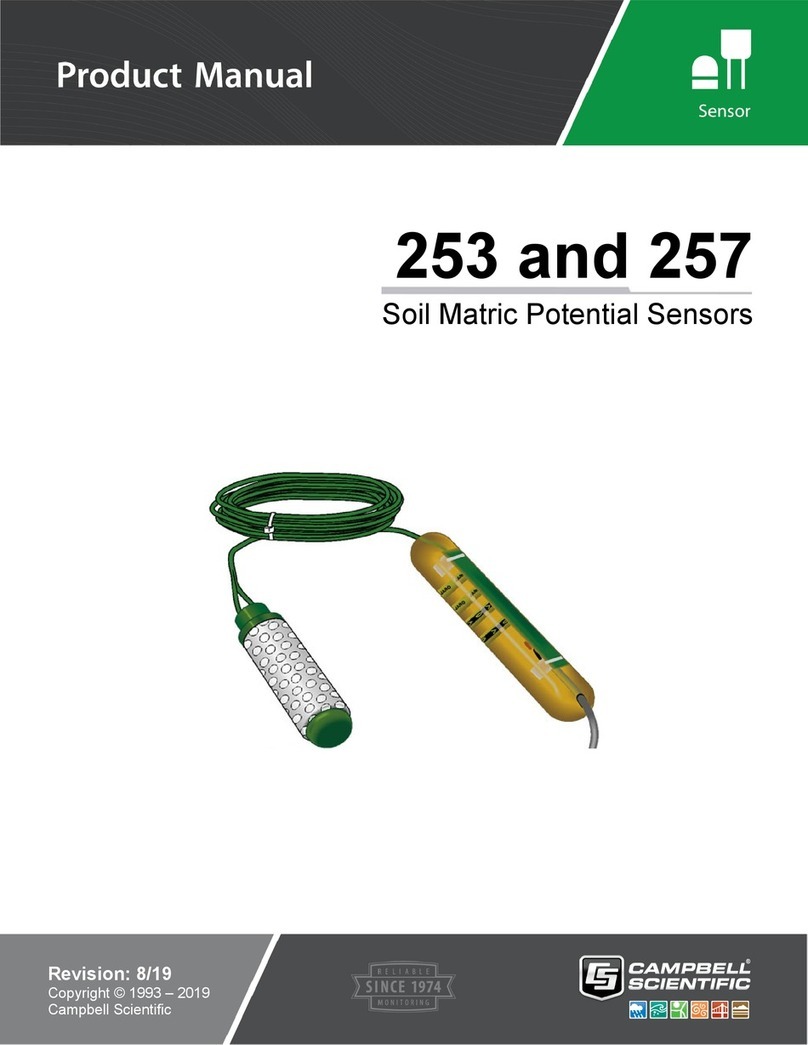
229 Heat Dissipation Matric Water Potential Sensor
2
The –L option on the model 229 Heat Dissipation Matric Water Potential Sensor
(229-L) indicates that the cable length is user specified. This manual refers to the
sensor as the 229.
Figure 1-2. CE4 and CE8 Current Excitation Modules
1.1 Compatibility
Compatible dataloggers include our 21X, CR7, CR10(X), CR23X, CR800,
CR850, CR1000, and CR3000. The 229 is not compatible with our CR200-series,
CR500, or CR510 dataloggers. The 229 can be connected with a multiplexer.
Compatible multiplexers include our AM16/32, AM16/32A, and AM16/32B.
When using multiplexers, the user should be aware that switching
currents of greater than 30 mA will degrade the contact surfaces of
the mechanical relays. This degradation will adversely affect the
suitability of these relays to multiplex low voltage signals.
Although a relay used in this manner no longer qualifies for low
voltage measurements, it continues to be useful for switching
currents in excess of 30 mA. Therefore, the user is advised to
record which multiplexer channels are used to multiplex the 50 mA
excitation for the 229-L sensors in order to avoid using those
channels for low voltage measurements in future applications.
1.2 Measurement Principle
Movement of water between the 229 ceramic matrix and the surrounding soil
occurs when a water potential gradient exists. When the water potential of the soil
surrounding a 229 sensor changes, a water flux with the ceramic matrix will occur.
The time required for hydraulic equilibration of the water in the soil and ceramic
depends on both the magnitude of the water potential gradient and the hydraulic
conductivity. Typically this equilibration time is on the order of minutes or tens
of minutes.
A change in the water potential and water content of the ceramic matrix causes a
corresponding change in the thermal conductivity of the ceramic/water complex.
As the water content in the ceramic increases, the thermal conductivity of the
complex also increases. At very low water contents, the ceramic material controls
the thermal conductivity. As water content in the ceramic increases, water films
are established between the solid particles, resulting in a rapid increase in thermal
conductivity. As the pores in the ceramic continue to fill, the thermal conductivity
becomes increasingly controlled by the continuous water and the increase in
thermal conductivity of the ceramic/water complex approaches a constant value.
When a constant power is dissipated from the line heat source, the temperature
increase near the heat source will depend on the thermal conductivity of the
ceramic/water complex surrounding the heater. A temperature increase is caused
by heat that is not dissipated. As the water content and thermal conductivity of the
ceramic increases, the temperature increase as measured by the thermocouple will
NOTE