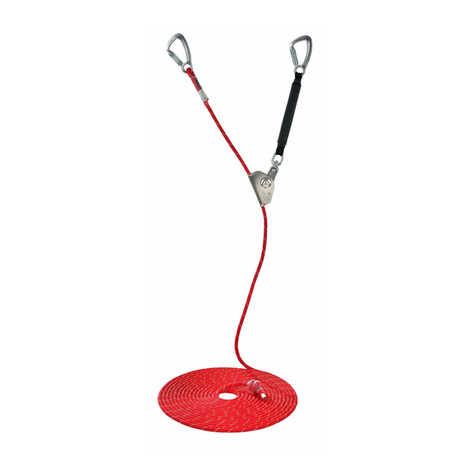
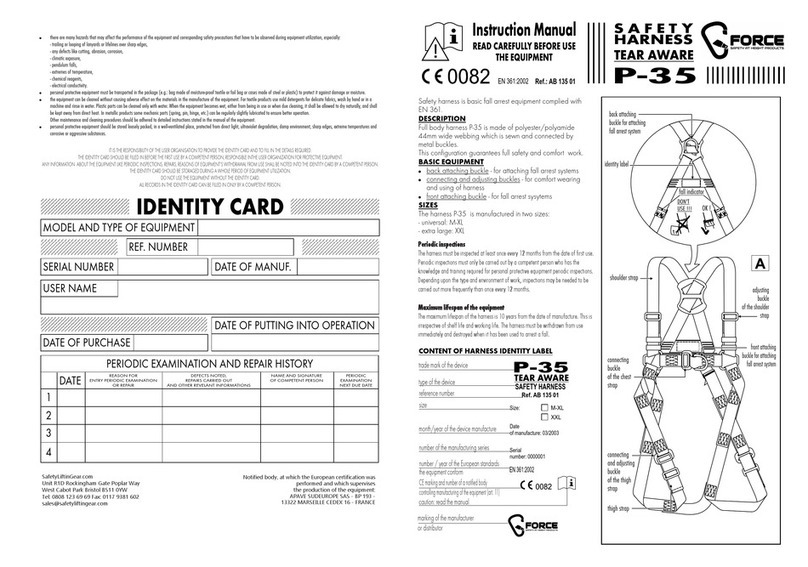
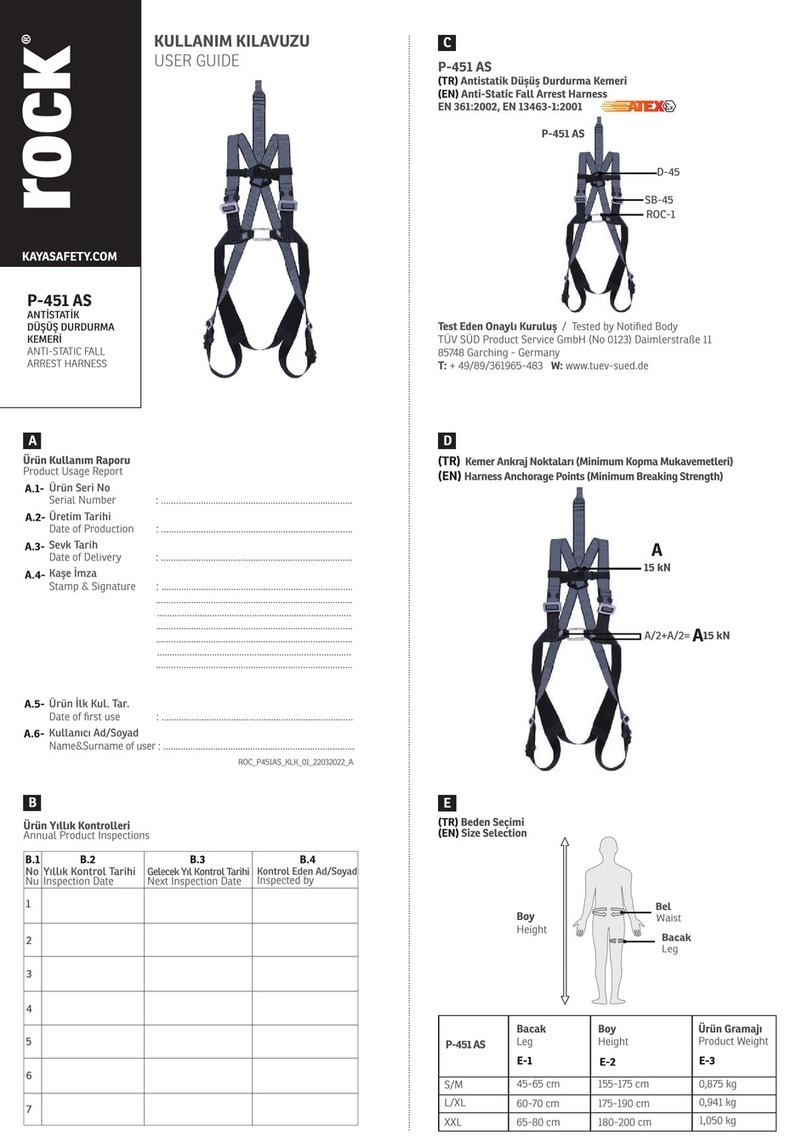
CLIMAX 30-C FALL ARREST WORK HARNESS
The Climax 30-C fall arrest work harness has been
designed in accordance with EN 361 and safety
requirements of Royal Decree 1407/1992 of Spain.
Notified Body involved in the design phase: SATRA
Technology Centre Ltd,SATRA House.
IMPORTANT
This technical notice illustrates ways of using this
product.Only the techniques shown are advised,all
other uses are excluded: danger of death. In case
of doubt or problem of understanding the use of this
product,please contact Productos Climax,S.A.
Activities at height are dangerous activities which
may lead to severe injury or even death.Gaining an
adequate apprenticeship in appropriate techniques
and methods of safety is your own responsibility.
You personally assume all risks and responsibilities
for all damage, injury or death which may occur
during or following wrong use of our products in any
manner whatsoever. If you are not able, or not in a
position to assume this responsibility or to take this
risk, do not use this equipment.
VERIFICATION
Before each use, check the webbing at the
attachment points, at the adjustment buckles and
at the safety stitching. Look for cuts, wear and
damage due to use, to heat, and to contact with
chemical products, etc… (check for cut or worn
threads). Check that the buckles operate correctly.
Make sure the body, gate, and locking sleeve are
free of any cracks; deformation, corrosion, etc. open
the gate and verify that it closes itself automatically
when released.Verify that the locking sleeve operates
properly.
It is important to regularly inspect the condition of
the product. Check its connection with the other
equipment in the system and make sure that the
various pieces of equipment in the system are
correctly positioned with respect to each other.
INSTRUCTIONS FOR USE
Full body harness for fall arrest: component of a fall
arrest system in accordance with EN 363 standard
(personal fall arrest systems). It must be used in
conjunction with EN 795 anchors, EN 362 locking
carabineers, EN 355 energy absorber, etc.
Before using the equipment, you need to take the
necessary measures to rescue the user, in a safe
manner, if necessary.
Verify the compatibility of the harness with the others
components of your equipment,see the instructions
specific to the products.
1. Putting on the harness
a. Hold harness by back D-Ring. Shake harness
to allow straps to fall in place
b. If chest, leg and/or waist straps are buckled,
release straps and unbuckle at this time
c. slip straps over shoulders so D-ring is located
in middle of back between shoulder blades.
d. Pull legs straps between legs and connect to
opposite end. Repeat with second leg strap. If
belted harness, connect waist strap after leg
straps.
e. connect chest strap and position in midchest
area.Tighten to keep shoulder straps taut.
f. after all straps have been buckled, tighten all
buckles so that harness fits snug but allows full
range of movement. Pass excess strap through
loop keepers.
The user must carry out movements and a test
suspension in the equipment to ensure that is
correctly sized and gives the required level of comfort
for the intended use.
2a. Rear fall arrest attachment
2b. Sternal fall arrest attachment loops (Attach the
sternal ring using a connector EN 362)
Use only these points to attach a fall arrest system
(for example a mobile fall arrester, an energy
absorber, or other systems described in the EN 363
standard).For ease of identification,these points are
marked with the letter “A”.
Clearance: amount of free space below the user
The clearance below the user must be sufficient to
prevent the user from striking any obstacle in case of
a fall. Specific details on calculating clearance are
found in the technical notices for the other components
(energy absorbers, mobile fall arrester, etc.).
3. Compatibility attachment points/connectors
An incompatible connection can cause accidental
disconnection,breakage,or affect the safety function
of another piece of equipment. The attachment
points of your harness can produce a leverage effect
on the gate of the connector.
When a sudden tension comes onto the rope and/or
an external pressure on the locking system, and the
connector is poorly positioned, the locking sleeve
can break and the gate can open itself. To reduce
the risk, take care that connectors are positioned
correctly each time that the system is put under
tension (lanyard, descender…). Check also that
connectors used are compatible with the
attachment points (shapes, dimensions…).