6
(I/0), unplug the unit from the power socket, and fill the
water tank (3) with clean water, as instructed above.
Washing and disinfecting the floor
Thanks to the special design of the hinge, the mop attach-
ment (1) has a large rotation angle so it can clean corners as
well as low spaces under furniture.
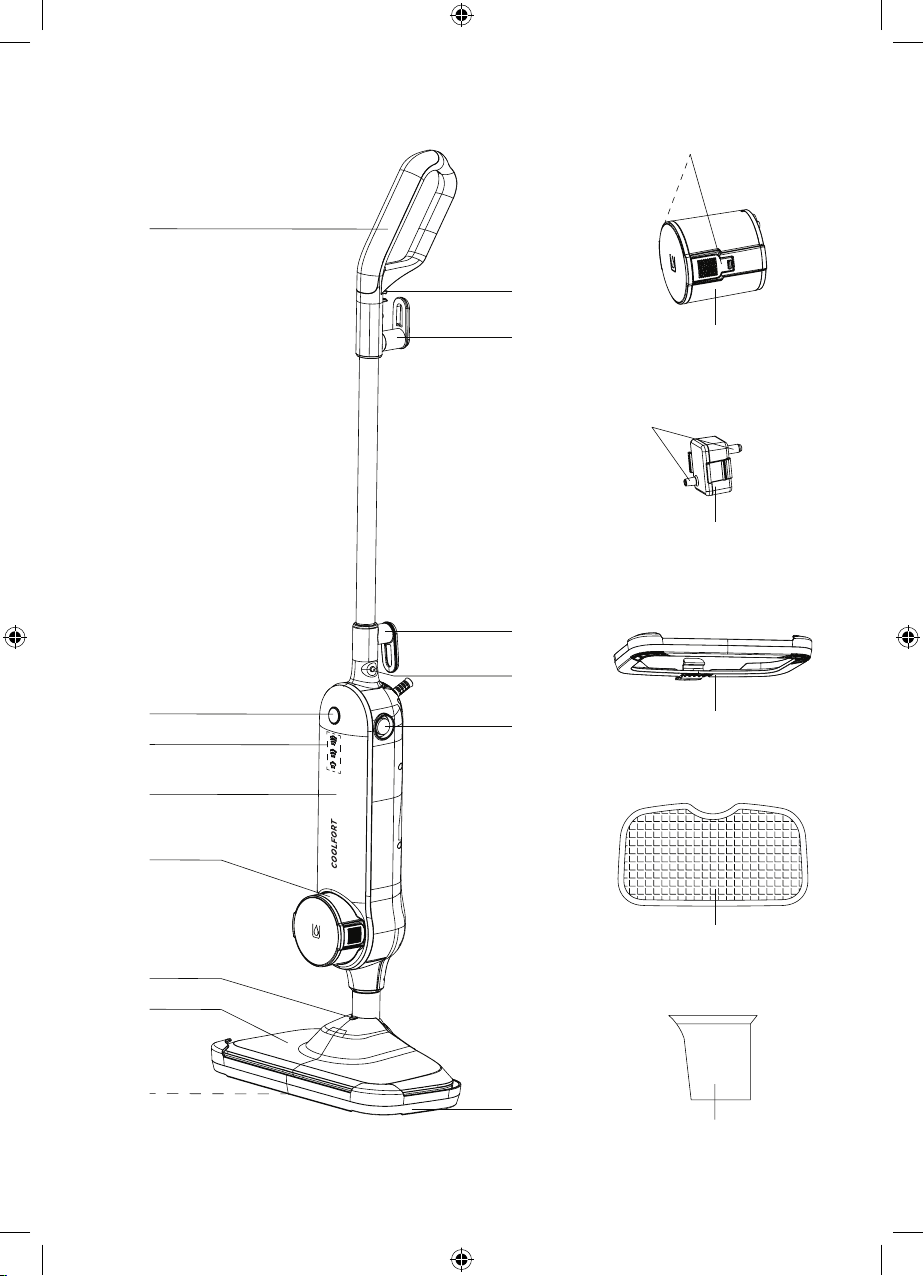
• Attach the microfiber pad (17) to the mop attachment (1)
(fig. 6). Press the attachment against the pad, so that the
touch fasteners securely attach to the locking bars on the
mop attachment.
• Plug the unit into the power socket and press the On/Off
button (15) (I/0) - the upper steam indicator (8) will
start flashing blue. When the indicator (8) is on stati-
cally, the steam mop will be ready for use.
• Tap the steam supply button (9) to select the desired
steam supply level.
• To keep the power cord out of the way during cleaning,
pass it through the upper hook (10) or secure it on the
lock (11).
Cleaning the carpets
• Install the carpet glider (16) on top of the cloth mop
attachment (1) with the pad (17) inserted. To do this,
position the mop attachment on the glider and press it
until it locks.
• The glider (16) eases the mop attachment gliding (1) on
carpets, preventing the pad (17) from sticking up.
• Plug the unit into the power socket and press the On/Off
button (15) (I/0) - the upper steam indicator (8) will
start flashing blue. When the indicator (8) is on stati-
cally, the steam mop will be ready for use.
• Tap the steam supply button (9) to select the desired
steam supply level.
• To keep the power cord out of the way during cleaning, pass
it through the upper hook (10) or secure it on the lock (11).
Water level
The water level is always visible thanks to the transparent
water tank (3).
When the water is used up, steam will no longer be generated.
To resume operation, refill the water tank with water as de-
scribed above.
WARNING: this operation should always be performed after
disconnecting the unit from the mains.
RECOMMENDATIONS ON USING
• Before cleaning the floor, it is recommended to sweep or
vacuum it to remove dust and dirt particles.
• When washing the floor, move the unit in an even back
and forth motion, pushing it away from you and pulling it
back. Move backwards to avoid stepping on the already
washed floor.
• The microfiber cloth (18) collects water when washing the
floor. However, depending on the characteristics of the
floor surface and the set steam intensity, some moisture
may remain on the floor. In this case, it is recommended
to let the floor dry naturally. Drying can be accelerated by
using a fan directed to the desired area.
• After room cleaning remove the pad (17) from the mop
attachment (1). This will prevent the floor from soaking
off a damp pad.
• The mop attachment (1) with the glider (16) inserted can
be used to clean carpets. To freshen the carpet, try the
following: dilute carpet shampoo with water in a 1:1 ratio.
Spray the resulting solution on the carpet and leave it for
2 hours. When the 2 hours expire, clean the carpet with
the steam mop. The carpet will be wet after this proce-
dure, so you'll have to dry it.
• It is recommended to fully change the water in the tank
(3) from time to time to avoid stagnation of water and the
appearance of an extraneous smell.
• The water hardness level is different for every region. Water
can contain hardness salts and other dissolved minerals.
Water evaporates in the boiler and the residue remains.
• If water is soft and does not contain a lot of salts, the
scale flakes will from time to time fall off the boiler walls
and go out with the steam. If the water contains a lot of
salts, including the hardness salts, then mineral deposits
will accumulate in the boiler in a significant amount. It will
hinder steam generation and may cause damage. Scale
flakes can clog valves and connections. Therefore, it is
recommended to use demineralized or distilled water to
reduce limescale and salt deposits.
• Regular jug filters do not remove minerals and salts from
water. Special demineralizing filters are used for this
purpose.
• If you want to use bottled drinking water, find out its total
mineralization (usually indicated on the label) and com-
pare it with indicators for tap water (they can be found on
the water supply company’s website or by the Internet
search). Typically, bottled water salinity is 100-400 mg / l.
It may turn out that the water from the tap has salinity
several times lower, so that the use of bottled water will
increase the formation of scale.
Attention! Scale deposits and salts can be removed from
the boiler only in the service center. This procedure is not
covered by warranty and requires payment.
CLEANING AND MAINTENANCE
• Switch the unit off and unplug it.
• Drain the remaining water from the tank (3).
• Wipe the steam mop body with a damp cloth.
• Before removing the pad (17) from the mop attachment
(1), wait several minutes for it to cool down.
• You can wash the microfiber cloth in a washing machine,
using a delicate cycle and at temperature not exceed-
ing 60°C.
• Do not use bleachers, fabric softeners or rinses, so the
cloth can absorb dirt. You can dry the cloth in a dryer.
• For hand wash, use a mild detergent and dry the cloth in
horizontal position.
Cleaning the water tank
• Perform a routine washing of the water tank. Avoid stag-
nation of water in the tank.
• To remove lime deposits built up inside the water tank,
add 1-2 tablespoons of white vinegar into the full water
tank, close the lid and shake the tank, drain it, and wash
with clean water.
CLEANING THE STEAM RELEASE OPENINGS
• Make sure that the unit is unplugged from the mains and
has cooled down. Remove the mop attachment (1). To
detach the body from the attachment, slightly press the
attachment against the floor with your foot, press the
lock (2), and pull the body upwards. Rotate and move the
cleaning needle with a fitting diameter in and out to clean
the steam release opening on the unit body (7) (fig. 7).
Attention! Perform a test cleaning of a suitable isolated
area after each descaling to make sure that no scale or dirt
is left inside the unit.