OPERATION - CLECOMATIC Models
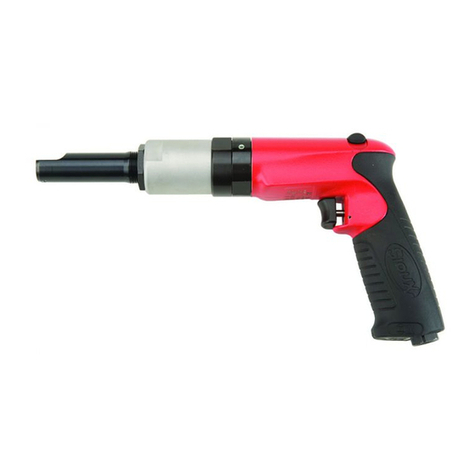
No. 5 Series CLECOMATIC CCW screwdrivers are designed for the
clutch to shut-off in reverse. Accurate torque is achieved by setting the
CLECOMATIC clutch to the desired torque. The tool will automatically
shut off at this preset torque. The RSATP model is designed to start when
the trigger is pulled and stops when the clutch reaches the set torque or
the trigger is released. Releasing the trigger will reset the tool for the next
cycle.
CLUTCH ADJUSTMENT
Clutches are adjusted through the slot provided in the clutch housing. The
slot cover must be rotated to expose the adjustment slot. Rotate the clutch
housing until the hole in the adjustment lock plate is visible. Insert a No.
1 Phillips screwdriver and rotate in a clockwise direction to increase the
torque setting or a counterclockwise direction to decrease the setting.
After each adjustment, the slot cover should be rotated back to its locked
position.
If the clutch is adjusted over the maximum power
output of the tool, the clutch will not function and
the tool will operate like a stall-type tool. Also, if the tool is being operated
at its upper torque limits, a drop in air pressure could cause the clutch not
to function due to a loss of motor power and the tool will function like a stall-
type tool. If tool stalls operator must resist stall torque until he releases
throttle.
Operational check: Grip tool securely and be prepared to counteract
stall torque in case clutch is improperly adjusted.
AIR SUPPLY
The tool is designed to operate at 90 psig (6.2 bar) air pressure. The air
pressure should be checked at the tool's air inlet while the tool is running.
The use of an automatic in-line filter-regulator-lubricator is highly recom-
mended. This will supply the tool with clean, lubricated air, keep it in
sustained operation, and increase tool life. For maximum performance,
use a 1/4" (6.5mm) I.D. air hose up to 8 feet in length. If additional length
is required, a 3/8" (9.5mm) I.D. or larger hose should be connected to the
1/4" (6.5mm) I.D. hose. The air hose should be cleared of accumulated
dirt and moisture, then one-quarter (1/4) (6.5cc) teaspoon of 10W
machine oil should be poured into the tool's air inlet before connecting the
hose to the tool.
LUBRICATION
The in-line lubricator should be checked regularly and filled with a good
grade of 10W machine oil. In the event a line lubricator is not used, tools
should be disconnected from the air supply several times daily and
several drops of oil poured into the tool's inlet bushing. Application of the
tool should govern how frequently it is greased. It is recommended that
the idler gears receive a generous amount of NLGI 2-EP grease after
every 40 hours of operation. The clutch housing (left hand threads) and
clutch must be removed and the grease applied through the hex in the
spider.
DISASSEMBLY - GENERAL (All Models)
Clamp the air inlet bushing in a soft-jawed vise and unscrew (left hand
threads) the clutch housing and remove the clutch assembly. Use strap
wrenches to remove the gear case from the backhead. The throttle valve
rod and motor unit may now be removed from the front of the backhead.
See the following paragraphs for complete disassembly instructions on
the various subassemblies.
CLUTCH DISASSEMBLY - CLECOMATIC Clutch
Unscrew (left hand threads) the adjustment nut 869123, and remove the
adjustment lock ring 869140. The torque spring, spring sleeve, bearing
races 863455, thrust bearing 847104, ball retainer, 203573, and four (4)
steel balls 842161, may now be removed from the clutch spindle.
Washing the remaining spindle assembly in a solvent at this time will aid
in disassembly. Remove the ball retainer ring 203574, and ball retainer
plug 869149, from the clutch cam 204597. Rotate the clutch spindle to
allow the thirteen (13) steel balls 842980 to drop out of the ball loading
hole located in the clutch cam. Separate the clutch spindle and clutch
cam, being careful not to lose the reset pin 869112, reset spring 203585,
reset pin stop 869424, trip slide 203612, trip slide reset spring 203613,
and dowel pin 617226.
CAUTION!
GEAR TRAIN DISASSEMBLY — -174 Gear Train
When pressing the spider assembly out of the rear of the gear case
869162, be sure the idler gears 869163, are in line with the pockets
machined in the gear case. Press the idler gear pins 833862 out the rear
of the spider 869155 for inspection of the idler gear pins and idler gears
869163. Remove the bearing retainer ring 619017 and press the front
spider bearing 847595 out the front of the gear case.
MOTOR DISASSEMBLY
Slip the front bearing 842768 and front bearing plate 203641, off the front
of the rotor and remove the cylinder 203504, and four (4) rotor blades
203615. Set the rear bearing plate on the vise jaws with the rotor hanging
down. Use a 3/16" (4.8mm) punch to drive the rotor out of the rear rotor
bearing 842768.
BACKHEAD DISASSEMBLY
For inspection or replacement of the throttle valve or related parts, roll
down grip sleeve and drive throttle valve bushing retainer pin out and
remove bushing. Remove the valve cap 203559 and remove the shut-off
valve and seal for inspection. The reversing valve may be removed by
first unscrewing the reversing valve screw out of the reversing valve knob.
Then reversing valve may be removed from the front of the handle. On
reassembly make sure the reversing valve screw aligns with the threaded
hole in reversing valve.
REASSEMBLY — GENERAL
All parts should be washed in a solvent and inspected for damage or wear.
Particular attention should be given to all bearings, gears, gear pins, and
rotor blades as failure of these parts could cause damage to more
expensive parts. Rotor
bladesshouldbereplaced
if they measure less than
1/8"(3.2mm)on either end.
Inspect and replace any "O"-rings or seals that show signs of wear of
deterioration. All gears, gear pins, and open bearings should receive a
generous amount of NLGI 2-EP grease during reassembly. Reassembly
of all of the various subassemblies is in reverse order of disassembly:
however, the following paragraphs list some of the more important
reassembly procedures.
CLUTCH REASSEMBLY — Clecomatic Clutch
During reassembly of the clutch, all parts should receive a thin coating of
10W machine oil. In addition, the ball retainer 203573, should receive a
generous amount of NLGI 2-EP grease. When installing the dowel pin
617226, the tapered end goes into the clutch cam first. The trip slide
203612, goes into the clutch cam cupped-end first. All parts installed into
the clutch spindle 203625, and clutch cam 204597, should be checked for
smooth operation before complete assembly of the clutch.
MOTOR REASSEMBLY
Install the rear rotor bearing into the rear bearing plate 203506. Press the
bearing plate assembly (press on the bearing's inner race) onto the rear
rotor shaft until there is approximately .0015" (.038mm) clearance be-
tween the rear bearing plate and motor.
TRIP ROD SIZING
The trip rod No. 203586, should be sized to allow approximately 1/8"
(3.2mm) throttle valve opening.
IMPORTANT: During reassembly of the complete tool, the gear case
should be tightened to handle to 20 ft. lbs. (27Nm). Wrenches shown
below can be ordered to tighten the gear case and clutch housing.
SAFETY CHECK
After repair or replacement of parts, tools should be tested to verify that
they are functioning properly.
34 204 - ARMSTRONG U.S.A.
203803-2
GEAR CASE WRENCH
C 471 3/4 - 2
203804-0
CLUTCH HOUSING WRENCH
Replace blade if less
than 1/8"(3.2mm)
on either end.