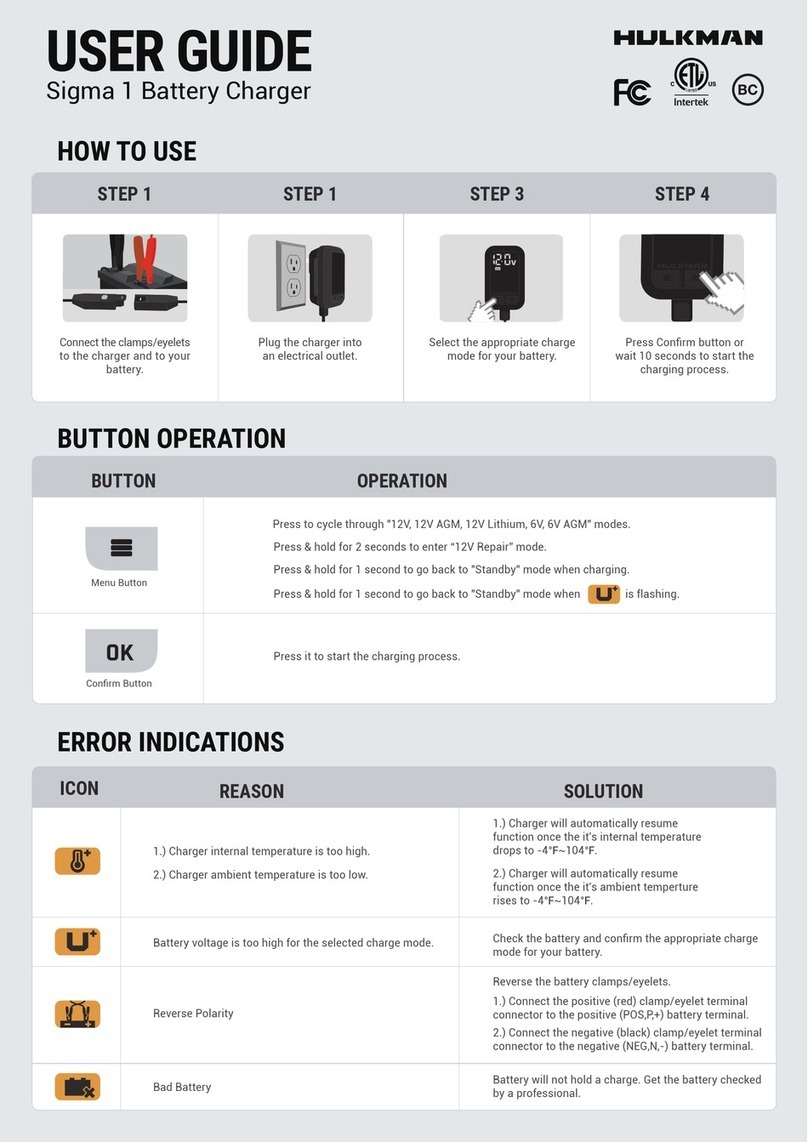
PRECAUCIONES DE SEGURIDAD PARA
UTILIZAR EL CARGADOR
1. NO coloque el cargador en el compartimiento del motor
o cerca de partes móviles o cerca de la batería; colóquelo
tan lejos de ellos como lo permita el cable de CC. NUNCA
coloque un cargador directamente sobre la batería que se
está cargando; los gases o fluidos de la batería corroerán y
dañarán el cargador.
2. NO cubra el cargador mientras se carga.
3. NO exponer a la lluvia ni a condiciones de humedad.
4. Conecte y desconecte la salida de CC solo después de
colocar el cable de CA del tomacorriente.
5. El uso de un accesorio no recomendado o vendido por el
fabricante puede provocar un riesgo de incendio, descarga
eléctrica o lesiones personales.
6. Para reducir el riesgo de dañar el enchufe y el cable
eléctrico, tire del enchufe en lugar del cable cuando
desconecte el cargador.
7. Para reducir el riesgo de descarga eléctrica, desenchufe
el cargador del tomacorriente antes de intentar cualquier
mantenimiento o limpieza.
8. Opere con precaución si el cargador ha recibido un golpe
directo de fuerza o se ha caído. Hágalo revisar y reparar si
está dañado.
9. Toda reparación debe ser realizada por el fabricante o un
reparador autorizado para evitar peligros.
CONEXIÓN A LA BATERÍA
1. Identifique la polaridad de los postes de la batería. El
terminal positivo de la batería suele estar marcado con
estas letras o símbolos (POS,P,+). El terminal negativo de la
batería suele estar marcado con estas letras o símbolos
(NEG,N,-).
2. No realice ninguna conexión al carburador, a las líneas de
combustible ni a piezas metálicas delgadas.
3. Identifique si tiene un vehículo conectado a tierra
negativo o positivo. Esto se puede hacer identificando qué
poste de batería (NEG o POS) está conectado al chasis.
4. Para un vehículo con conexión a tierra negativa (más
común): conecte la abrazadera POSITIVA ROJA primero a la
terminal positiva de la batería, luego conecte la abrazadera
NEGATIVA NEGRA al chasis del vehículo o a la terminal
negativa de la batería (el chasis del vehículo es una mejor
opción).
5. Para un vehículo con conexión a tierra positiva (muy poco
común): conecte la abrazadera NEGRA NEGATIVA primero
al terminal negativo de la batería, luego conecte la
abrazadera POSITIVA ROJA al chasis del vehículo o a la
terminal positiva de la batería (el chasis del vehículo es una
mejor opción).
SAFETY PRECAUTIONS FOR USING
THE CHARGER
1. Do NOT place the charger in the engine compartment or
near moving parts or near the battery; place as far away
from them as DC cable permit s. NEVER place a charger
directly above a battery being charged; gases or fluids
from battery will corrode and damage charger.
2. Do NOT cover the charger while charging.
3. Do NOT expose to rain or wet conditions.
4. Connect and disconnect DC output only after setting AC
cord from electric outlet.
5. Use of an attachment not recommended or sold by the
manufacturer may result in a risk of fire, electric shock or
injury to persons.
6. To reduce the risk of damage to electric plug and cord,
pull by the plug rather than the cord when disconnecting
charger.
7. To reduce risk of electric shock, unplug charger from
outlet before attempting any maintenance or cleaning.
8. Operate with caution if the charger has received direct
hit of force or been dropped. Have it checked and repaired
if damaged.
9. Any repair must be carried out by the manufacturer or
an authorized repair agent in order to avoid danger.
CONNECTING TO THE BATTERY
1. Identify polarity of battery posts. The positive battery
terminal is typically marked by these letters or symbol
(POS,P,+). The negative battery terminal is typically
marked by these letters or symbol (NEG,N,-)
2. Do not make any connections to the carburetor, fuel
lines, or thin metal parts.
3. Identify if you have a negative or positive grounded
vehicle. This can be done by identifying which battery post
(NEG or POS) is connected to the chassis.
4. For a negative grounded vehicle (most common):
connect the RED POSITIVE jumper clamp first to the
positive battery terminal, then connect the BLACK
NEGATIVE jumper clamp to the vehicle chassis or negative
battery terminal (vehicle chassis is a better choice).
5. For a positive grounded vehicle (very uncommon):
connect the BLACK NEGATIVE jumper clamp first to the
negative battery terminal, then connect the NEGATIVE
jumper clamp first to the negative battery terminal, then
connect the RED POSITIVE jumper clamp to the vehicle
chassis or positive battery terminal RED POSITIVE jumper
clamp to the vehicle chassis or positive battery terminal
(vehicle chassis is a better choice).
ACERCA DE INF-SBC15A
1. El INF-SBC15A está diseñado para cargar todo tipo de
plomo-ácido de 12V y LITIO de 12V (FeLiPO4 de 4 celdas) y
plomo-ácido de 6V, incluidos HÚMEDO (inundado), GEL, MF
(sin mantenimiento), EFB ( Batería inundada mejorada),
baterías AGM (esterilla de fibra de vidrio absorbida). Es
adecuado para cargar capacidades de batería de 2 a 400
amperios por hora para plomo-ácido de 12V (2 a 150
amperios por hora para 6V de plomo-ácido) y mantener
baterías de todos los tamaños.
2. El microprocesador inteligente incorporado hace que la
carga sea más rápida, fácil y segura.
3. Este cargador tiene características de seguridad,
que incluyen a prueba de chispas, protección contra
polaridad inversa, cortocircuito, sobrecorriente, sobrecarga
y sobrecalentamiento.
4. La corriente de carga inicial es 12V/2A o 6V/2A por
defecto. Debe presionar el botón "CURRENT" para elegir la
corriente de carga adecuada para su batería.
5. Cuando una batería está conectada correctamente, el
tubo digital mostrará el tipo de voltaje (12V o 6V o LI).
Presione el botón "(BAT.TYPE)" y seleccione el tipo de
voltaje correcto en 5 segundos.
6. Muestra el tipo de voltaje actual (12V o 6V o LI) y la
corriente de carga a su vez durante el proceso de carga
normal.
7. Muestra el voltaje actual de la batería (por ejemplo,
12,1V) durante el proceso de carga normal cuando se
presiona el botón "(BAT.TYPE)".
8. Cuando se inicia la carga, al presionar el botón "ON/OFF"
se apagará el cargador, y el cargador se reiniciará
presionando el botón "ON/OFF" nuevamente.
9. Cuando la luz “CHARGE” está encendida, está cargando;
cuando la luz “CHARGE” está apagada y la luz FULL está
encendida, la carga está completa. Pero NO rompa la
conexión inmediatamente. Cambiará automáticamente
de carga completa a mantenimiento para mantener
las baterías durante períodos prolongados de
almacenamiento.
ABOUT INF-SBC15A
1. The INF-SBC15A is designed for charging all types of
12V lead acid and 12V LITHIUM (4 cell FeLiPO4) and 6V
lead acid, including WET (Flooded), GEL , MF (Maintenance
Free), EFB (Enhanced Flooded Battery), AGM (Absorbed
Glass Mat) batteries. It is suitable for charging battery
capacities from 2 to 400 Amp Hours for 12V lead acid (2 to
150 Amp Hours for 6V lead acid and maintaining all
battery sizes.
2. Built in intelligent microprocessor makes charging
faster, easier and safer.
3. This charger has safety features, including spark proof
protection for reverse polarity, short circuit, overcurrent,
overcharge and overheat.
4. The starting charge current is 12V/2A or 6V/2A by
default. You need press CURRENT button to choose the
appropriate charge current for your battery.
5. When a battery is connected correctly, the digital tube
will show voltage type (12V or 6V or LI). Press (BAT.TYPE)
button and select the correct voltage type in 5 seconds.
6. It shows present voltage type (12V or 6V or LI ) and
charge current in turn during normal charging process.
7. It shows present battery voltage (e.g. 12.1 during
normal charging process when (BAT.TYPE) button
is pressed.
8. When charging is started, pressing “ ON/OFF ” button
will cause the charger to turn off , and the charger will be
restarted by pressing ON/OFF button again.
9. When the CHARGE light is on, it is on charging; when
the CHARGE light is off and FULL light is on, the charging
is completed. But do NOT break the connection
immediately. It will automatically switches from full
charge to maintenance status to maintain batteries
during prolonged periods of storage maintenance status
to maintain batteries during prolonged periods of storage.
6. When disconnecting, disconnect in the reverse
sequence, removing the negative first (or positive first for
positive ground systems).
NOTICE: If battery clamps are reversely connected to
battery terminals, the If battery clamps are reversely
connected to battery terminals, the ERROR light will be on.
Exchange the battery clamps to solve this problem.
6. Al desconectar, desconecte en la secuencia inversa,
quitando primero el negativo (o primero el positivo para
sistemas de tierra positivos).
AVISO: Si las pinzas de la batería se conectan al revés a los
terminales de la batería, la luz de ERROR se encenderá.
Cambie las pinzas de la batería para solucionar este
problema.
4