TM-051 PN 35903 EC Series Models 38105, 38100, 38110
Rev 04/16/08 4
SAFETY
DYMAX ultraviolet curing technology has been used successfully for over 25 years. The fast cure, one component nature
of our UV curing technology has made it the process of choice for many manufacturers requiring a Cure on Demand™
assembly process. The purpose of this document is to provide information relating to the use of DYMAX UV curing
systems. There are four common questions/concerns related to UV curing systems: UV exposure, high temperature
surfaces, ozone, and bright visible light.
UV EXPOSURE
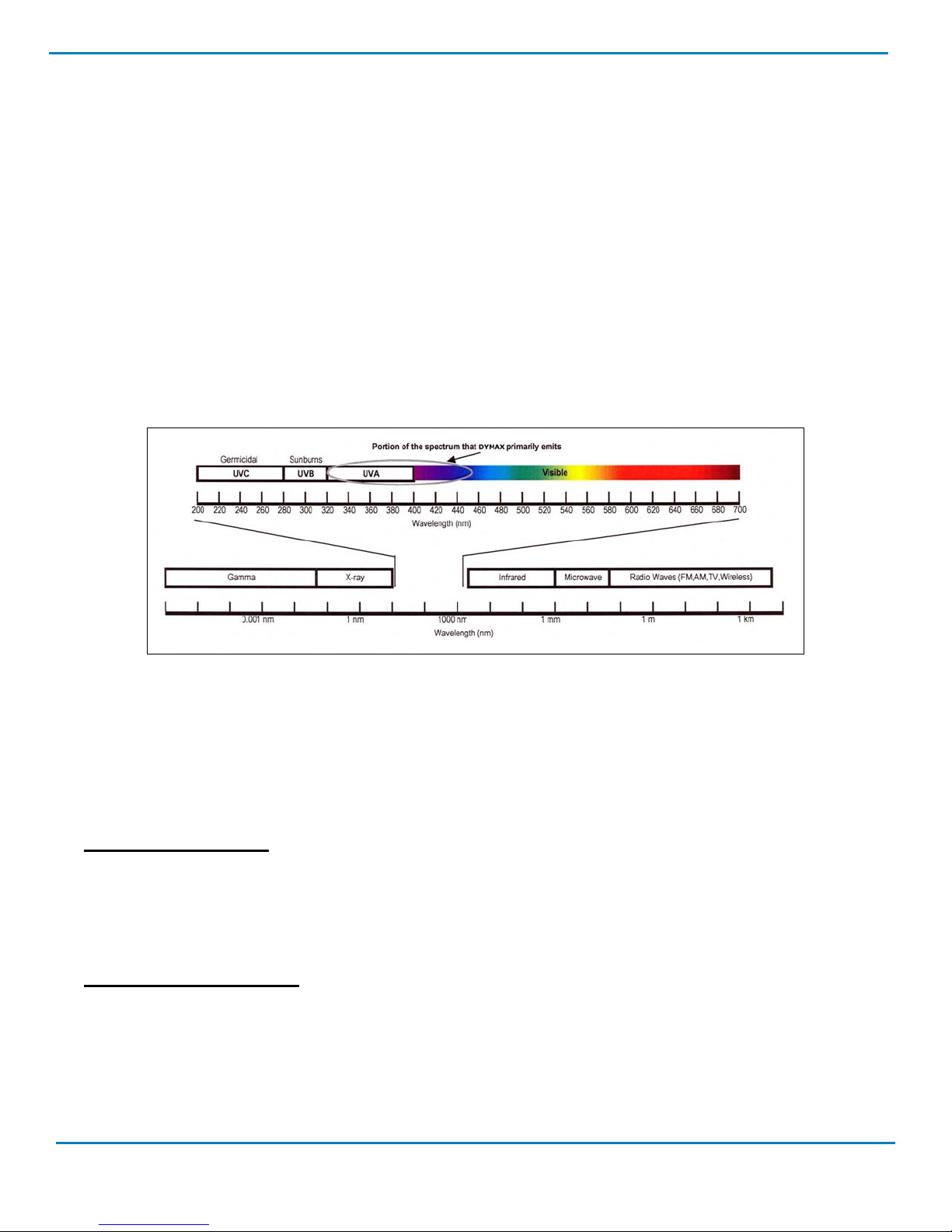
Standard DYMAX UV curing systems and bulbs have been designed to primarily emit UVA light3 (as shown in Chart 1).
UVA light is generally considered the safest of the three UV ranges: UVA, UVB, and UVC. Although OSHA does not
currently regulate ultraviolet light exposure in the workplace, the American Conference of Governmental Industrial
Hygienists (ACGIH) does recommend Threshold Limit Values (TLV′s) for ultraviolet light. The strictest interpretation of the
TLV (over the UVA range) for workers’ eyes and skin is 1 mW/cm2(intensity), continuous exposure. Unless workers are
placing bare hands into the curing area, it is unusual to exceed these limits. To put 1 mW/cm2limit into perspective,
cloudless summer days in Connecticut regularly exceed 3 mW/cm2of UVA light and also include the more dangerous
UVB light (primarily responsible for sun tans, sun burns and skin cancer) as well.
The human eye can not detect “pure” UV light, only visible light. A radiometer should be used to measure stray UV light
to confirm the safety of a UV curing process. A workstation that exposes an operator to more than 1 mW/cm2of UVA
continuously should be redesigned.
UV adhesive curing can be a regulatory compliant, “worker-friendly” manufacturing process when the proper safety
equipment and operator training is utilized. There are two ways to protect operators from UV exposure: shield the
operator and/or shield the source.
SHIELD THE OPERATOR
UV-Blocking Eye Protection – UV-blocking eye protection is recommended when operating UV curing
systems. Both clear and tinted UV-blocking eye protection is available from DYMAX (see Table 1).
UV-Blocking Skin Protection – Where the potential exists for UV exposure upon skin, opaque, UV-blocking
clothing, gloves, and full-face shields are recommended.
SHIELD THE SOURCE OF UV
Any substrate that blocks UV light can be used as a shield to protect workers from stray UV light. The following
materials can be used to create simple shielding structures or blind corners:
Sheet Metal – Aluminum, steel, stainless steel, etc. Sheet metal should be coated black or black anodized
to minimize reflection of UV and visible light toward operators.
Rigid Plastic Film – Transparent, UV-blocking plastics (typically polycarbonate or acrylic) are commonly
used to create shielding where transparency is also desired. These rigid plastic films are available either
water-clear or tinted.
Artisan Technology Group - Quality Instrumentation ... Guaranteed | (888) 88-SOURCE | www.artisantg.com