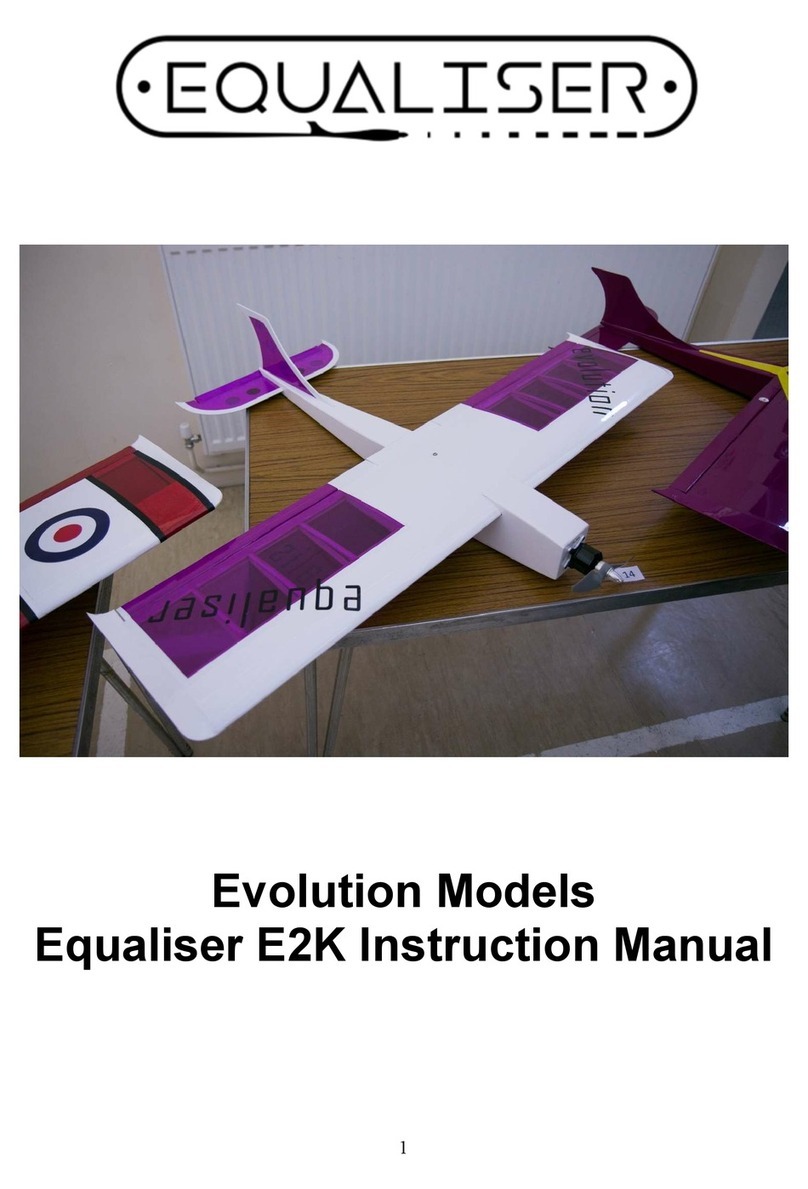
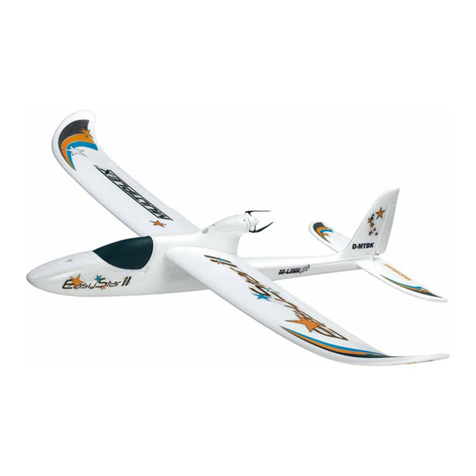
Evolution Fusion II User manual

0
Glow and Electric Instruction
Manual
FEATURES
Precision Laser Cut Parts
Lightweight Strong Airframe
Excellent Low Speed Stability
Comprehensive Instruction Manual
High Quality Balsa Ply and Depron parts
Excellent Precise Handling Characteristics
High Quality Comprehensive Hardware Pack

1
Introduction
The New Fusion has takes those comments made by our customers and develops them into the Fusion
package. These comments along with hours of testing and development we have improved the strength,
durability and overall performance of the model. For those who owned the original Fusion you will note the
changes, some of them are only minor, such as the length of Tail moment and others like the battery hatch
provide a better all round model. We listen to our customers to improve our products, so if you have
anything you wish to share please let us know.
The Evolution Fusion has been designed predominantly for the Fun Fly enthusiast and the club flyer. The
Fusion will loop on the spot, roll in the blink of an eye and inspire confidence as it remains rock solid and
stable. This model that has been designed to be highly manoeuvrable, but also to be attractive with style
and flair.
The laser cut parts simply slot together to provide a lightweight structure without compromising strength.
The Fusion is simple and satisfying to build for the amateur and experienced builder.
Each kit contains a comprehensive hardware pack that includes the fuel tank (glow version), metal clevises,
closed loop systems, hinges, hatch latch, and horns to name but a few.
The Evolution Fusion has been designed to meet the needs of the Fun Fly competition pilot in an attractive
package. We hope that you have as much fun building and flying it as we have had developing it!
Building Recommendations
Check all parts from the box to ensure that they are present, if not then please contact us at the e-mail
address at the back of the instructions. We do from time to time make mistakes!!
Ensure that you use a completely flat base on which to build the model, this should be large enough the build
the wing 50” (1270mm) x 16” (400mm) as a minimum.
Read through the instructions before starting to build, understand each step before applying glue.
The glue detailed in the instructions is for a guide only, this is what we used for the prototypes, it is at the
builder discretion which glue is used, but ensure that it is suitable for the intended purpose. Always read the
application instructions to ensure you achieve a strong joint. Depron is a foam material; Standard Cyano will
attack and melt it, always use foam safe glue or wood glue. Always read the safety instructions supplied
with the glue.
Take your time building the model, build a straight and strong model, this will ensure the model will fly well!
Enjoy. Building is part of aero modelling!
This radio-controlled model is not a toy. It can cause serious injury to the operator, public and property if
misused or abused. Ensure that you read all the instructions supplied with this kit and instructions provided
with the engine and radio control system or any other components purchased separately carefully. Also,
make sure that any parts bought separately are suitable for their application.
The kit contains small and potentially sharp parts, keep away from children.
Additional Materials Required
Recommended Tools
Standard Thin or Medium Cyano
Aliphatic White Wood Glue
Epoxy Resin
Tinned Copper Wire (For Undercarriage)
Solder
Heat Shrink Covering Material
Engine Mount
Radio Gear
Modelling Knife
Razor Plane
Set Square
Shaping Paper
Shaping Block
Blow Torch
Drill
Drill Bits
Building Board – Completely flat 1300 x 400mm Min
Bradawl

2
Fusion Part List
Wood Pack
Hardware Pack
Description
Sheet S
ize
Quantity
Metric
Imperial
Webbing Shee
t
1
.5 x 100 x 9
15mm
1/16 x 4 x 36”
1
Leading
and Trailing
Edge Sheet
1.5 x
100
x 1220mm
1/16 x
4
x 48”
2
Leading Edge 6 x 25 x 1220mm ¼ x 1 x 48” 1
Wing Spars and Trailing Edge Spar
6 x 6 x 1220mm
¼ x ¼ x 48”
3
Wing Centre Section Sheet 1.5 x 75 x 915mm 1/16 x 3 x 36” 1
Fuselage
Bottom and Front Deck Sheet
3 x 75 x 915mm
1/8 x 3 x 36”
1
Rib Capping Strips 1.5 x 6 x 915mm 1/16 x ¼ x 36”
6
Aileron/
Rudder
/
Elevator
/
Tail
Plane
Strip
9.5 x 6 x 915mm
3/8 x ¼ x 36
”
3
Fuselage
Triangular Fillet
9.5 x 9.5 x 9
15m
m
3/8 x 3/8
x 36”
4
Description
Quantity
Metal Clevis (M2) 6
Metal Control Rod (M2)
2
Snap links
2
Control Horns 6
Sing
le Saddle Clamp 10 swg
4
Hatch Latch 1
Closed Loop
Kit
1
Mylar 1
Servo Mount Spruce 6 x 6 x 25m
m (
¼ x ¼ x 1”
)
2
Wing Dowels 8 x 90 and 8 x110mm
2

3
Fusion Part List
Laser Cut Sheets
Due to the balsa supply issues some parts may be relocated on sheets, please make sure
you locate each part carefully
1
1
2
3
2
4
5
4
6
7
8
10
9
9
11
12
13
14
15
17
16
18
19
20
21
22
23
24
25
26
27
27
W1 x 4
W2 x 2
W3 x 2
W4 x 6
W5 x 2
29
30
31
32
31
34
33
28
35
35

4
Part No. Description Sheet Material
1 Left and Right Fuselage Sides (2) 3mm (1/8”) Balsa
2 Left and Right Fuselage Sides Top (2) 3mm (1/8”) Balsa
3 UC centre spacer Plate 3mm (1/8”) Balsa
4 Tail Plane Tips (2) 6mm (1/4) Balsa
5 Rudder Leading Edge 6mm (1/4) Balsa
6 Elevator Tips (2) 6mm (1/4) Balsa
7 Aileron Outer Tips (2) 6mm (1/4) Balsa
8 Rudder Top Frame 6mm (1/4) Balsa
9 Wing tips (2) 6mm (1/4) Balsa
10 Rudder Bottom Frame 6mm (1/4) Balsa
11 Fin Front Section 6mm (1/4) Balsa
12 Aileron Leading Edge (2) 6mm (1/4) Balsa
13 Rudder trailing Edge 6mm (1/4) Balsa
14 Tail Plane Centre Section 6mm (1/4) Balsa
15 Aileron Horn Supports (2) 6mm (1/4) Balsa
16 Aileron Trailing Edge (2) 6mm (1/4) Balsa
17 Aileron Inner Tips (2) 6mm (1/4) Balsa
18 Fin Main Section 6mm (1/4) Balsa
19 Elevator trailing Edge 6mm (1/4) Balsa
20 Tail Plane Leading Edge 6mm (1/4) Balsa
21 Top Rear Deck (Back Section) 6mm (1/4) Balsa
22 Tail Plane Trailing Edge 6mm (1/4) Balsa
23 Elevator Leading Edge 6mm (1/4) Balsa
24 Top Rear Deck (Front Section) 6mm (1/4) Balsa
25 Elevator Centre Section 6mm (1/4) Balsa
26 Wing Band Support 1mm (1/32) Ply
27 Fuselage Doublers (2) 1mm (1/32) Ply
28 Hatch Floor 3mm (1/8) Ply
29 U/C Front Mount 3mm (1/8) Ply
30 U/C Rear Mount 3mm (1/8) Ply
31 Wing Aileron Servo Mounts (2) 3mm (1/8) Ply
32 F2 – Servo Tray 3mm (1/8) Ply
33 F1 - Firewall 3mm (1/8) Ply
34 Tail Skid 3mm (1/8) Ply
35 Fuselage Reinforcement Runners 3mm (1/8) Ply
W1 Centre Section Ribs 6mm (1/4) Depron
W2 Servo Mounting Rib 6mm (1/4) Depron
W3 Servo Mounting Rib 6mm (1/4) Depron
W4 Main Rib 6mm (1/4) Depron
W5 Wing Tip Rib 6mm (1/4) Depron

5
Description
Quantity
Undercarriage Front Leg 1
Undercarriage Rear Leg 1
Undercarriage Support 2
Tail Skid 1
Front Leg 10 swg
Rear Leg 10 swg
Piano Wire U/C
Fusion Parts List
Supports 10 swg
Tail Skid 16 swg

6
Building Instructions
The laser is set to the minimum setting to minimise any ‘V’ cut in the balsa, please check and run a
knife through any areas that require releasing and the tabs that hold the part in the sheet.
Fin and Rudder
Take the three parts that form the Fin and Rudder (Parts 5, 8, 10, 11, 13 and 18), trial fit before gluing
together using Cyano or white wood glue, ensure that the Fin leading edge and Fin top are at 90°. With the
supplied strip of 6 x 9.5mm (1/4” x 3/8”) cut to length to form the centre ribbing pieces. Mark a centre line on
the Rudder leading edge and chamfer to a 45° angle with a razor Plane.
Place the parts on a bench like so Glue together Add the two ribbing pieces
With a sharp knife cut the slots for two hinges 10mm (3/8”) from the top and bottom. This gap should be
parallel for the full length of the Rudder. Cut 10mm (3/8”) strips from the supplied Mylar hinge material and
insert into the hinge slots; 50% in the Rudder and 50% into the Fin. Ensure that you get at least 45° free
movement either way. Do not glue the hinges in at this stage! Cover both parts with your chosen covering
first.
Shaping all parts to a smooth Finish and round off the leading edge of the Fin ready for covering. !!!
Warning. Ensure that you are wearing an appropriate mask for shaping balsa and are in a well-ventilated
area. We recommend shaping in free air (outside).!!!
Tail Plane and Elevator
Take the five pre-cut parts (Parts 4(2), 6(2), 14, 19, 20, 22, 23 and 25) which form the Tail Plane and
Elevator, trial fit, ensure the tips are at 90° to the leading and trailing edge before gluing with Cyano or white
wood glue. With the supplied strip of 6 x 9.5mm (1/4” x 3/8”) cut to length to form the eight ribbing pieces,
glue in place with Cyano or white wood glue. Do not glue the Elevator to the Tail Plane; theses should be 2
separate pieces!
With a pencil mark the centre line of the leading edge of the Elevator and chamfer to a 45° angle with a razor
Plane ready to receive the hinges.
Tail Plane parts laid out Glue Tail Plane and Elevator parts separately.
Rib pieces inserted

7
With a sharp knife cut the slots for four hinges 10mm in from either end and evenly spaced, ensure that the
Elevator sits centrally on the Tail Plane. Cut 3/8” (10mm) strips from the supplied Mylar hinge material and
insert into the hinge slots, 50% in the Elevator and 50% into the Tail Plane. Ensure that you get at least 45°
free movement either way. Do not glue the hinges in at this stage! Cover both parts with your chosen
covering first.
Shaping all parts to a smooth Finish and round off the leading edge of the Tail Plane ready for covering.
!!! Warning. Ensure that you are wearing an appropriate mask for shaping balsa and are in a well-ventilated
area. We recommend shaping in free air (outside).!!!
Fuselage
Lay the two Fuselage sides (Parts 1(2) and 2(2)) on the work bench ensuring that you have a left and right
hand side. With a thin layer of epoxy or white wood glue attach the 1mm (1/32”) ply doubler (Part 27(2)).
Weigh down to ensure that the parts cannot ‘curl’ and to allow dry. Glue the reinforcement rails (Part 35 (2))
to the ply doublers, ensuring there is a 3mm gap to allow F1 to fit between the sides
3mm gap for F1
Using the 9.5mm (3/8”) triangular fillet, glue with Cyano or white wood glue to the outer edge of the Fuselage
shown hatched below, including over the ply reinforcement runners. Make cuts in the fillet to allow it to
follow the bottom curve of the Fuselage.
Cut servo holes in F2 (Part 32) to suit the servos you have chosen for this model, note the small 9g hole is
only required for the glow version, cut this area off for the electric. Carefully mark the position of F2 in the
Fuselage to ensure that your chosen servos have the depth to fit, and the higher (front) servo fits below the
wing seat. The rear of F2 lines up with the rear of the wing seat. The front servo sits on the two pieces of 6
x 6mm (¼ x ¼) spruce supplied in the hardware pack. These can be glued in place now or when fitting the
servo later.

8
Glue the excess triangular fillet to the underside of F2 and dry fit between the Fuselage sides, ensure that F1
fits in the 3mm (1/8”) recess left at the front. If you are building the electric version carefully drill holes at the
top and the bottom of the former to allow air to enter the Fuselage for cooling.
F1 should be placed with the pre-cut hole set towards the bottom of the Fuselage, once glued in place
chamfer the top and bottom to follow the Fuselage sides.
With F1 and F2 in place the Fuselage sides should taper back so that the triangular fillet at the rear just
touches. Once satisfied that the part fits correctly glue in place using epoxy. We have found this easier by
gluing F2 to one side of the Fuselage first and allowing to dry before offering the other side and inserting F1.
Ensure that F1 is 90° to the centre line of the Fuselage.
We have shown standard servos fitted in the Fuselage, but recommend that you use a good quality
mini/micro servo to reduce weight. Ensure the mini/micro servo is of the same or better specification as a
standard servo.
Once the epoxy has set, glue top two top decking parts together (Parts 21 and 24) and then to the Fuselage,
ensuring the rear Fuselage remains square and the cut out for the Fin remains along the Fuselage centre
line.
With epoxy glue the front ply (Part 29), centre balsa (Part 3) and rear ply (Part 30) undercarriage plates into
position.
With the supplied the sheet of 3mm (1/8”) balsa plank the front top deck of the Fuselage. If you are building
the glow version continue to plank the whole of the bottom. The planking grain should run from side to side
to provide maximum strength.
If you are building the electric version take the battery hatch floor (Part 28) and place the tab under the ply
U/C mount and mark the ends as shown below.
CL
F1 F2
F1 set flush with front of
fuselage, triangular fillet set
back 3mm to allow this.
3mm
Draw line here

9
Remove the section of triangular balsa, leaving the ply reinforcement runners in place, and plank with the
3mm (1/8”) sheet from this point to the back of the Fuselage.
Fit Hatch Latch Here
Plank the bottom of the hatch floor with 3mm (1/8”) balsa except for the tab that fits under the U/C
mount. Test fit the hatch latch by drilling a hole in the rear edge of the U/C plate as shown above.
Cut the inner bush to allow the latch to swing with resistance once the screw is fully seated.
Shaping the Fuselage to shape rounding off the top and bottom decking and shaping the top deck at the
front down to 1mm (1/16”) where it meets the wing. !!! Warning. Ensure that you are wearing an appropriate
mask for shaping balsa and are in a well-ventilated area!!!
Lay the Tail skid (Part 34) on the bottom of the Fuselage and mark the distance from the rear, cut a slot
3mm (1/8”) wide to accept the skid along the centre line of the Fuselage. Slot the Fin in from the top and
ensure that the parts mate within the Fuselage. Glue scrap pieces of ply either side of the Tail skid slot to
prevent the Tail skid wire rotating as in the picture below. Ensure that they are not too large to slide into the
Fuselage.
Remove triangular strip
Table of contents
Other Evolution Toy manuals