S90-020 M FRICK® QUANTUM™ LX COMPRESSOR CONTROL PANEL
Page 8 MAINTENANCE
that the new board can be setup the same as the old one.
It is suggested that the operator first record all control
setpoints prior to board replacement. Factory Setup
settings will also be lost. The setpoint data sheets are
useful for recording this information. A Maintenance
Flashcard may also be purchased that will allow these
setpoints to be saved electronically, and may be
downloaded at a later time. Make sure that the operator
can access Factory Setup to restore all compressor
specific settings.
The procedure to replace the Quantum™ is outlined
below:
1. Shut off control power.
2. Remove the old board from the machine and the
new board from its packing and place both on an
anti-static surface.
3. Ensure that the jumpers on the new board are set
the same as those on the old board.
4. Install the modified replacement board into the
panel.
5. If program changes are necessary through a
Flash Card download, then follow the directions
in the Software Maintenance section of this
manual for the procedure to reload a program
Flash Card.
WHAT SHOULD OCCUR WHEN APPLYING POWER
The first thing that should be checked when
troubleshooting the Quantum™ LX is it’s powering up
sequence.
When powering up the Quantum™ LX, the following
sequence of events are indicative of a properly working
main processor board:
•Green PWR (Power) LED will turn on solid (upper
right corner of main PCB).
•Red FLASH LED will begin to intermittently
during the Boot process. It will then go out once
the Operating Status screen appears.
•LED D8 (on the smaller board) will start to blink
at the rate of about once per second. It will
continue to blink after the Quantum™ LX has
booted.
•Once the screen displays Loading…, LED's D4,
D5, D7 and D8 will be on solid.
•The Operating Status screen will appear.
•Once actual data has been displayed on this
screen, LED D13 will come on solid and D10,
D11, and D12 will start to flash at a quick rate.
After the Quantum™ LX has properly powered up, the
following sequence of events is indicative of proper
communication to the analog and digital boards:
•The TX/RX LED’s near the white connector will
begin to blink.
•The Analog and Digital I/O boards TX/RX lights
should be blinking.
•Each I/O board should have the power LED (next
to the white connector) lighted and the Active
LED (next to the blue Dipswitch) should be
blinking.
WHAT IF THE OPERATING STATUS SCREEN IS NOT
SHOWN
If the Operating Status screen is not shown, check the
following items:
1. If no LED’s are lighted, then check power AC and
DC.
2. Check if the lighting of the LED’s is occurring as
described in the What Should Occur When
Appying Powering section.
•If the powering up sequence continues to
repeat without displaying the Operating
Status screen, then there is a booting
problem.
3. Check if an error message is displayed when
booting.
•Be sure to write down any error messages
exactly as they appear.
4. Check that the software is OK:
•Is the correct software installed?
•Did you just install new software?
•If you need to clear the numerical setpoint
and calibration areas of memory for any
reason, clear the memory as described in
the Software Maintenance section of this
manual. NOTE: This information will be
replaced by factory default values, so any
setpoint and calibration data values that
need to be customized must be
reentered.
5. Check for bad connections.
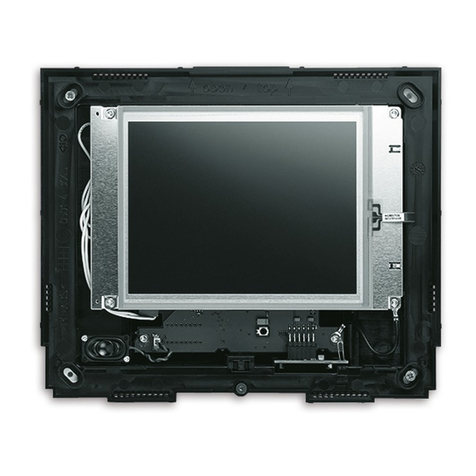
6. Check the display. If the CPU board is booting
but you have no display, check the following:
•Check the LCD backlight tube. Look very
closely at the display to see if anything is
visible in the dark screen. Using a beam type
source of good lighting, such as a flashlight,
look for any ghost type image. If it appears
that there is something on the screen but
very dark, the problem maybe the LCD
backlight tube. On the LG Philips, NEC and
Sharp displays this tube is field replaceable.
On the Samsung LCD display it is not
available and the display will have to be
replaced. There may be a sticker on the
display mounting plate. If there is, it will have
a part number that describes the type of
display. If there is no sticker, you must take
the display apart to identify the display
manufacturer.
•Verify that both the display cable and the
inverter cable are firmly seated. These
cables both originate from the same
connector on the Quantum™ LX. It may be
necessary to remove the video cable from
the back of the LCD display and reseat it to
be sure it is connected properly. Note: This
is a small connector and caution should
be observed so that it is not damaged
due to excessive force.
•Refer to the Display Assembly Component
Replacement Guide at the end of this
section, and check that the LCD, LCD cable,
and software versions are matched correctly.