6
SECTION 3:
PREVENTING ACCIDENTAL ALARMS
Your security system is engineered with advanced
technology that reduces the chance of an acciden-
tal alarm caused by a technical problem. In wireless
systems, this technology prevents other devices,
such as garage door openers, ham radios, television
remote controls, and cellular phones, from interfer-
ing with your security system.
Most accidental alarms occur when leaving the
house after arming the system, or upon returning,
before disarming the system.
If, for example, you arm the system, then run
upstairs for something you forgot, the Exit Delay
time may expire. Once the Exit Delay expires,
opening an armed door or moving in front of a
motion detector will cause an alarm.
Cancelling Accidental Alarms
Your system can be set up with the opportunity to
cancel an accidental intrusion, Police or Auxiliary
alarm. (Fire alarms cannot be cancelled.)
If the Dialer Abort feature is turned on, cancelling
the alarm within a specified period will silence the
siren and prevent the alarm from being reported to
the central monitoring station.
Cancelling a fire alarm will silence the siren, but fire
alarms are always reported. If an accidental fire
alarm has sounded, follow the procedures of your
central monitoring station to prevent a false dis-
patch.
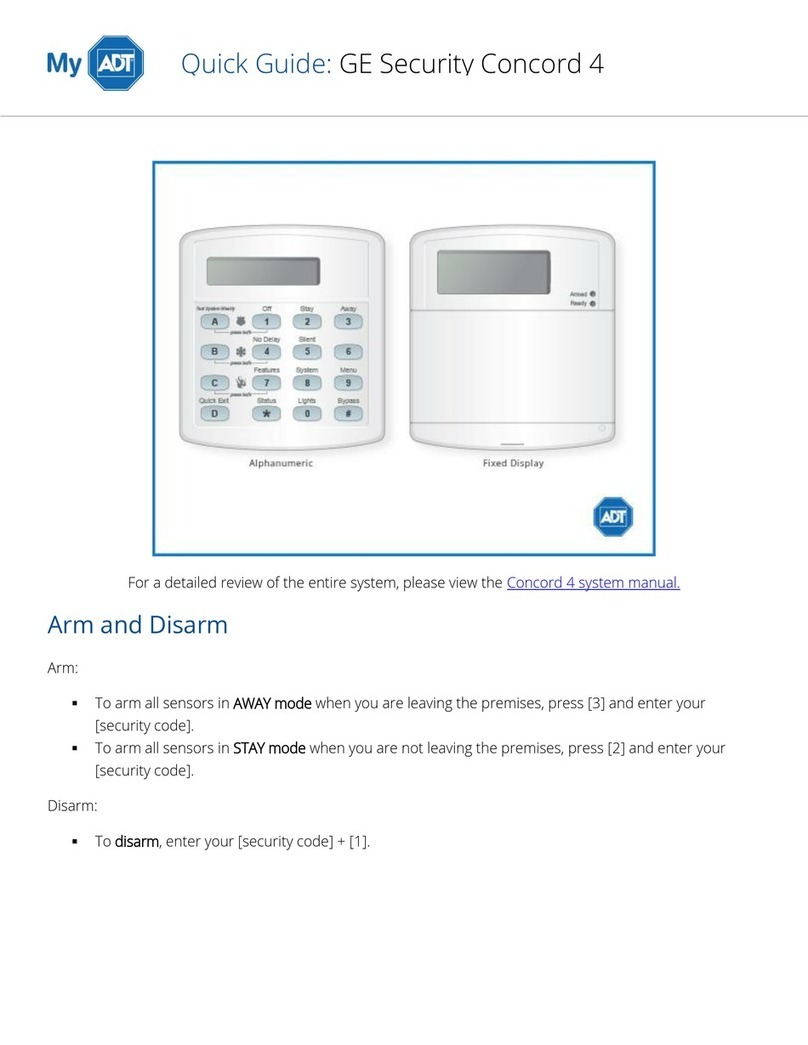
To cancel an alarm:
1. Press 1—OFF at any touchpad.
• Alphanumeric touchpads display,
“ENTER CODE.”
• On LED touchpads, the Enter Code light
blinks.
2. Enter your access code.
• Alphanumeric touchpads display
date and time, or programmed text.
• On LED touchpads, the Enter Code light
stops blinking.
The system sounds one long beep.
If you’re using a Touchtone phone, see “Using a
Touchtone Phone to Operate Your System” on
page 30.
G u id e lin e s fo r P re v e n tin g
A ccidentalA larm s
Follow ing these guidelines w illgo a long
w ay tow ard preventing accidentalalarm s.
þ
C lose doorsand w indow sbefore you leave
your ho use.
þ
W hen getting ready to leave the house,gather
the things you w antto take w ith you so you
can exitim m ediately afterarm ing the system .
þ
A lw ays enterand exitw ithin the program m ed
delay tim es.
þ
M ake sure you leave through a doorthathas
a d e la y tim e s e t fo r it. If y o u a rm y o u r s y s te m ,
th e n le a v e th ro u g h a d o o r w ith o u t a d e la y tim e ,
an alarm w illim m ediately sound.
þ
W h e n y o u re tu rn , im m e d ia te ly d isa rm y o u r sy ste m .
þ
B e aw are o f th e d e v ic e s in y o u r se cu rity syste m
and learn how each one operates.
þ
L iste n to sy ste m b e e p s a n d vo ice a n n o u n ce m e n ts.
T a k e n o te o f in d ic a to r lig h ts a n d to u c h p a d m e ssa g e s
w hich indicate the system s currentstatus.
þ
Ifyou have pets,ask yourinstaller ifyou need pet
le n s e s in y o u r m o tio n d e te c to rs. P e ts c lim b h ig h e r
than you m ay guess,causing alarm s w hen
you are aw ay.
þ
C heck the location ofyoursm oke detectors.
Sm oke detectorsnearbathroom scan
be tripped by steam from a show er.
S m o k e d e te c to rs n e a r th e k itc h e n
can be tripped by cooking sm oke.
R e fe r to th e U se r S h e e t in A p p e n d ix A
to determ ine w hatthe specific
settin g s are fo r yo u r system .