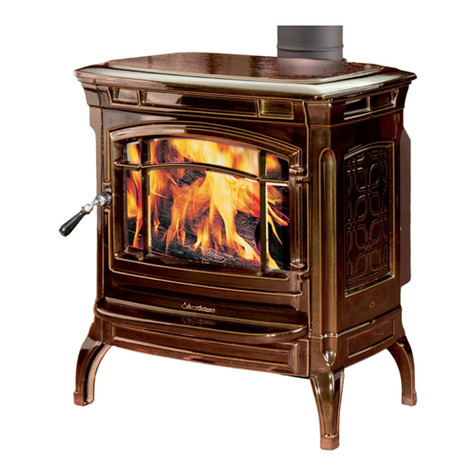
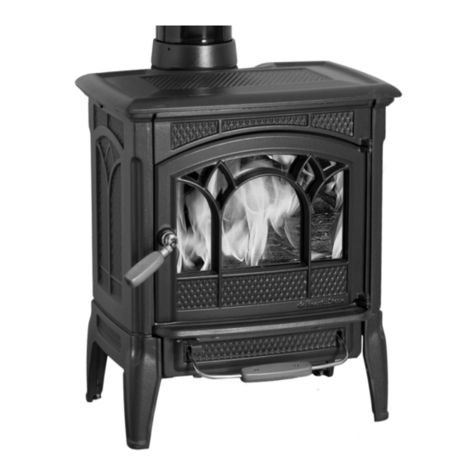
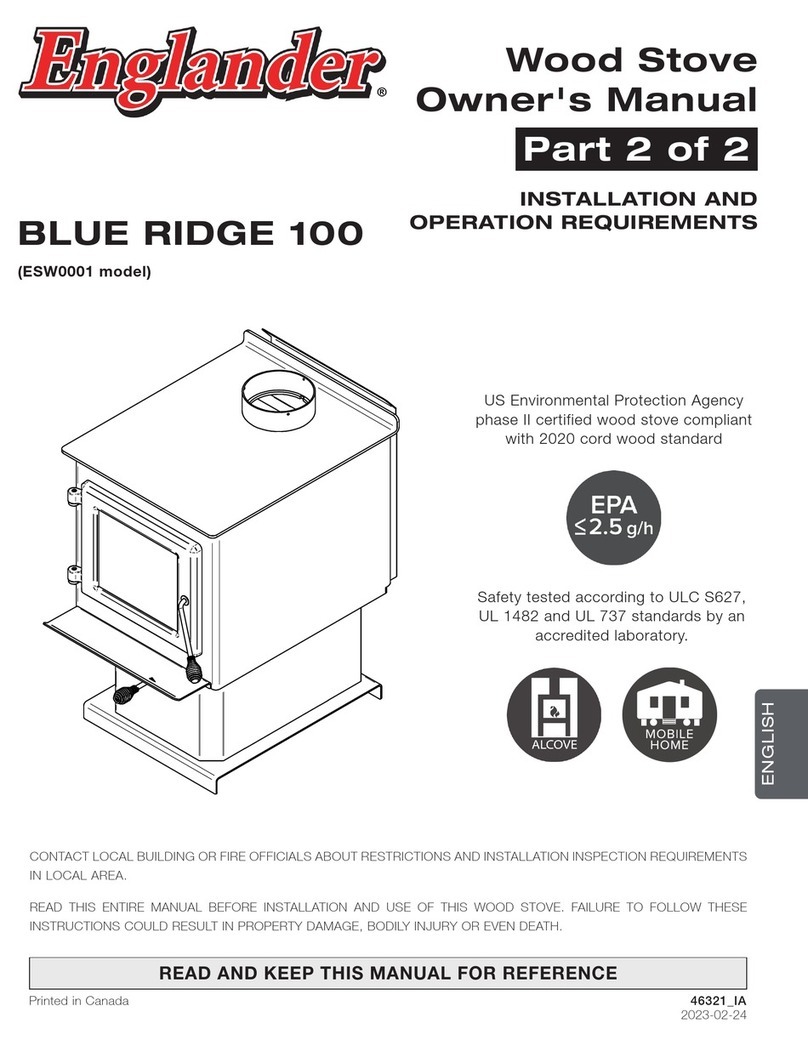
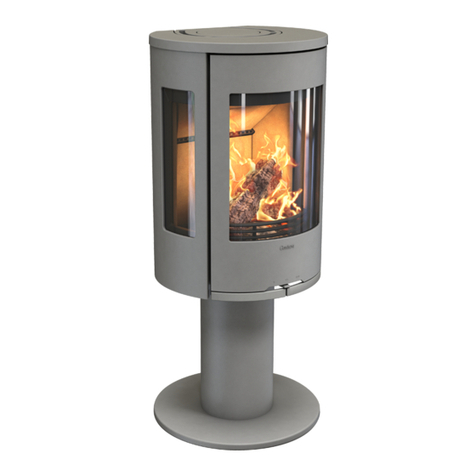
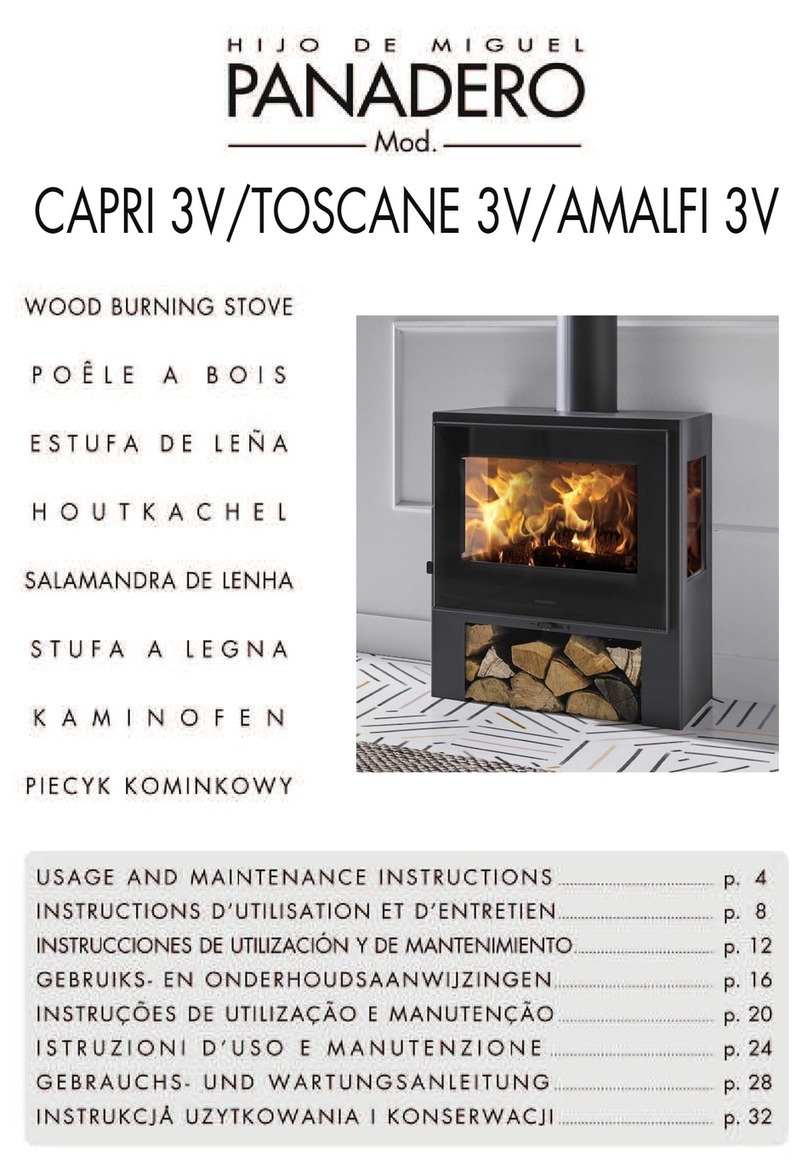
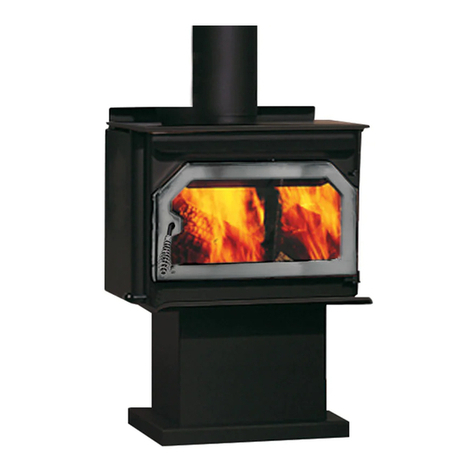
Hearthstone Quality Home Heating Products, Inc ®Manchester Model 8361
Never burn garbage or trash, colored or glossy
paper, solvents, plywood, artificial logs, cardboard,
or driftwood, in this stove.
Never burn coal in this stove.
Never use gasoline, kerosene, charcoal lighter
fluid, or other flammable fluids to start or invigorate
the fire. These fuels will cause dangerous burning
conditions in the stove. Keep all such materials
away from the stove.
Never use the stove if the ash pan is damaged, or
not present.
Never use a wood grate or other device to elevate
the fire.
Never allow logs in the firebox to hit the glass
when the door is closed.
Never slam the door or use the door to force wood
in to the stove.
Never over-fire your stove. (See page 21)
Never put articles of clothing or candles on a hot
stove.
Never connect the stove to a flue used by another
appliance.
Other safety guidelines:
Keep all combustible items such as furniture,
drapes, clothing, and other items, at least 36" (0.92
m) from the stove (See page 7)
Install a smoke detector, preferably in an area
away from your wood stove.
Keep a fire extinguisher handy. We recommend
the type rated "A B C."
Dispose of ashes properly. (See page 21)
Keep children and pets away from the stove when
it is burning; they could be seriously injured by
touching a hot stove.
Clean your chimney system as needed. (See page
22)
Outside combustion air may be required if:
1. This solid-fuel-fired appliance does not draw
steadily, smoke rollout occurs, fuel burns
poorly, or back-drafts occur whether or not
there is combustion present.
2. Existing fuel-fired equipment in the house, such
as fireplaces or other heating appliances, smell,
do not operate properly, suffer smoke roll-out
when opened, or back-draft whether or not
there is combustion present.
3. Opening a window slightly on a calm (windless)
day alleviates any of the above symptoms.
4. The house is equipped with a well-sealed vapor
barrier and tight fitting windows and/or has any
powered devices that exhaust house air.
5. There is excessive condensation on windows in
the winter.
6. A ventilation system is installed in the house.
If these or other indications suggest that infiltration air
is inadequate, additional combustion air should be
provided from the outdoors. Outside combustion air
can be provided to the appliance by using the optional
outside air kit #93-53500
PERIODIC CHECKLIST
Perform each of these tasks at the specified intervals.
At the End of Every Week:
Empty ashes from the firebox and ash pan, sooner
if the firebox or the ash pan is full.
At the Beginning of Every Other Month:
Depending upon your use of the stove, visually
inspect the chimney connector and chimney for
creosote. (see page 22)
Check door seals using the "dollar bill test." - When
the stove is cool, shut the door on a dollar bill. If
the bill pulls out without any resistance, then your
stove’s door is not sealing properly. To tighten the
seal, adjust the door latch mechanism or change
the door gasket. (Refer to page 23.)
At the End of Every Season:
Dismantle the chimney connector and clean it
thoroughly. Replace any pieces that show signs of
rust or deterioration.
Inspect and, if necessary, clean your chimney.
Clean out the inside of the stove thoroughly.
Inspect all door gasket material and replace if
worn, frayed, cracked or extremely hard.
EMERGENCY PROCEDURES
If you have a stovepipe or chimney fire, follow these
instructions:
1. If the fire is too threatening, leave the area and
call the fire department immediately! If not,
perform the next three steps.
2. Close the primary air control.
3. Close the stovepipe damper (if present).
4. Keep the stove front door closed!
WARNING: DO NOT ATTEMPT TO PUT OUT A
STOVEPIPE OR CHIMNEY FIRE BY THROWING WATER
ONTO THE STOVE, STOVEPIPE, OR CHIMNEY. THE
EXTREMELY HIGH TEMPERATURE OF SUCH FIRES
CAN CAUSE INSTANTANEOUS STEAM AND SERIOUS
BODILY HARM.
Once the chimney fire expires, leave the primary air
control closed and let the fire in the stove die out
completely. Inspect the stove, stovepipe, and chimney
thoroughly for any sign of damage before firing the
stove again. You must correct any damage before
using your stove again.