manuals.online logo
Brands
  1. Home
  2. •
  3. Brands
  4. •
  5. IV Produkt
  6. •
  7. Fan
  8. •
  9. IV Produkt Flexomix EXP Installation guide

IV Produkt Flexomix EXP Installation guide

Other IV Produkt Fan manuals

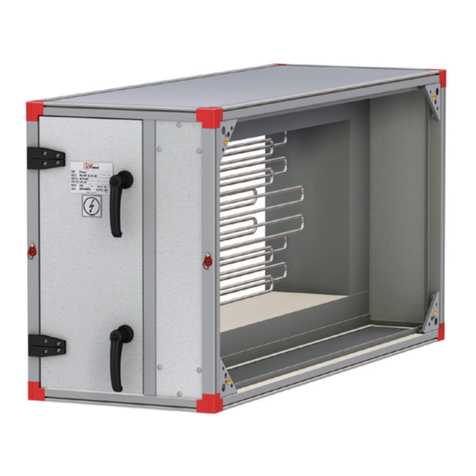
IV Produkt Flexomix MIE-EL Installation guide

IV Produkt

IV Produkt Flexomix MIE-EL Installation guide

IV Produkt Flexomix 060 Troubleshooting guide

IV Produkt

IV Produkt Flexomix 060 Troubleshooting guide

IV Produkt Flexomix MIE-ID Installation guide

IV Produkt

IV Produkt Flexomix MIE-ID Installation guide

IV Produkt Flexomix MIE-FD User manual

IV Produkt

IV Produkt Flexomix MIE-FD User manual

IV Produkt Envistar Top Series Installation guide

IV Produkt

IV Produkt Envistar Top Series Installation guide

IV Produkt Flexomix MIE-EF Installation guide

IV Produkt

IV Produkt Flexomix MIE-EF Installation guide

Popular Fan manuals by other brands

Minka Group minkaAire Wave F843 instruction manual

Minka Group

Minka Group minkaAire Wave F843 instruction manual

Airflow Adroit DV50 instruction manual

Airflow

Airflow Adroit DV50 instruction manual

Vornado 270 Series owner's guide

Vornado

Vornado 270 Series owner's guide

comfort air TH-10D instruction manual

comfort air

comfort air TH-10D instruction manual

Livoo DOM386 instruction manual

Livoo

Livoo DOM386 instruction manual

Holmes BLIZZARD HAOF-90 owner's guide

Holmes

Holmes BLIZZARD HAOF-90 owner's guide

Taurus GRECO 16 ELEGANCE manual

Taurus

Taurus GRECO 16 ELEGANCE manual

Quorum PINNACLE installation instructions

Quorum

Quorum PINNACLE installation instructions

Monte Carlo Fan Company 3DIR58RBD-V1 Owner's guide and installation manual

Monte Carlo Fan Company

Monte Carlo Fan Company 3DIR58RBD-V1 Owner's guide and installation manual

Craftmade UH52 installation guide

Craftmade

Craftmade UH52 installation guide

Jocel JVA030658 instruction manual

Jocel

Jocel JVA030658 instruction manual

MIKA MFB1211/GR user manual

MIKA

MIKA MFB1211/GR user manual

Harbor Breeze RLG52NWZ5L manual

Harbor Breeze

Harbor Breeze RLG52NWZ5L manual

Allen + Roth L1405 instruction manual

Allen + Roth

Allen + Roth L1405 instruction manual

ViM KUBAIR F400 ECOWATT Technical manual

ViM

ViM KUBAIR F400 ECOWATT Technical manual

HIDRIA R10R-56LPS-ES50B-04C10 user guide

HIDRIA

HIDRIA R10R-56LPS-ES50B-04C10 user guide

BLAUBERG Ventilatoren CENTRO-M 100 L user manual

BLAUBERG Ventilatoren

BLAUBERG Ventilatoren CENTRO-M 100 L user manual

Triangle Engineering HEAT BUSTER SPL Series owner's manual

Triangle Engineering

Triangle Engineering HEAT BUSTER SPL Series owner's manual

manuals.online logo
manuals.online logoBrands
  • About & Mission
  • Contact us
  • Privacy Policy
  • Terms and Conditions

Copyright 2025 Manuals.Online. All Rights Reserved.

Product sheet
Operation and MaintenanceFlexomix EXP
2015-01-07 IV Produkt’s continuous product development may give rise to specification changes without prior notice. 1 (2)
Integral attenuation (dB)
Octave band
intermediate
frequency (Hz) 63 125 250 500 1,000 2,000 4,000 8,000
Damping (dB) 6 7 6 5 7 10 15 18
Plate heat exchanger (code EXP)
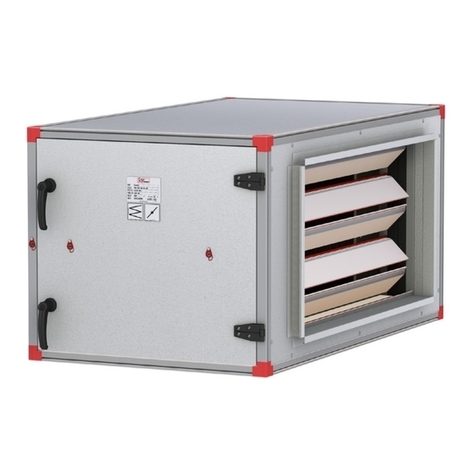
The EXP plate heat exchanger is a complete unit with a
plate exchanger which uses heat transfer according to
the air-air principle.
The purpose of the heat exchanger is to recover heat
from the extract air and transfer this heat to the supply
air.
This reduces the output required and the energy use.
The heat exchanger is a cross-flow unit constructed
from aluminium plates which are also available with an
epoxy finish. Smooth ducts in the direction of airflow
provide a low pressure drop and minimal risk of dust
building up.
A faulty heat recovery function through reduced recov-
ery efficiency entails increased energy use. This also
means that the planned supply air temperature will not
be attained when outdoor temperatures are low.
Possible reasons for reduced recovery efficiency could
be the fouling of the heat-exchanging surfaces, the
bypass damper not closing completely, or the extract
air filter being dirty.
At low temperatures the extract air humidity is precipi-
tated. The condensate is collected in a drip tray with a
drainage connection. The humidity precipitation also
means there is a risk of ice forming in the exchanger.
The formation of ice is counteracted by some of the
outdoor air flow being bypassed past the exchanger.
Particular attention should be paid to any ice forming
in the extract air section of the heat recovery unit. If
operation problems caused by ice forming occur, the
function of the frost protection equipment on the heat
recovery unit should be checked.
The bypass and shut-off dampers are of KJS type in
tightness class 2 in accordance with SS-EN1751 (VVS
AMA-98) and corrosion class C4 in accordance with
SS-EN ISO 12944-2.
Technical data, sizes 060–600
Configuration
Drainage
Connection = Ø 20 mm
Damper
1 damper motors are required (damper shaft 12×12 mm).
Size Required torque (Nm)
060, 100 3
150 4
190, 240, 300 5
360 6
480, 600 10

Product sheet
Operation and MaintenanceFlexomix EXP
2015-01-072 (2) IV Produkt’s continuous product development may give rise to specification changes without prior notice.
Heat exchanger, operation and
maintenance instructions
Inspection
1. Inspect the fins for fouling. Inspection can be
carried out through e.g. an inspection door to the
filter section.
2. Check the auto defrosting function and make sure
that the bypass damper closes securely when
defrosting is not in progress.
3. Check the drip tray, drainage and water trap
function. A water trap without a non-return value
should be filled with water.
Cleaning
If cleaning is required this can be done with a vac-
uum cleaner, blowing with compressed air or by using
detergent suitable for aluminium and rinsing off with
hot water.
Cleaning is best done by flushing water through every
single air duct (possibly adding ordinary detergent that
does not corrode aluminium) across the entire length
of the heat exchanger.
At operating temperatures below 0°C the heat
exchanger assembly must be dry before being
commissioned.
Damper, operation and maintenance
instructions
Inspection
1. Check the function of the damper actuator.
2. Check the dampers for tightness when they are
closed. If they are not sealed, adjust the damper
actuator to make the damper tight.
3. Check the sealing strips.
Cleaning
Clean the damper blades with a cloth. If they are severely
fouled, an environmentally friendly degreasing agent
can be used.