3FA Flow Control
2. Preconditions for use
Before you can use the system correctly and safely, you
must fully understand all of the following precautions.
• Oxygen concentration in the surrounding area must
not drop under 17%.
• Type and concentration of the contaminants in the
working place must be known to the user.
• The FA respiratory system must not be used in
unventilated areas such as tanks, pipes, channels etc.
• The FA respiratory system must not be used in areas
with danger of explosion.
• The respiratory system must only be used with the
blower unit switched on.
• The air ow must be checked before use.
• If the blower unit stops working for any reason, the
user must leave the contaminated area immediately.
• If the blower unit is switched o, the respiratory
system gives little or no respiratory protection. There
is also a risk of high concentration of carbon dioxide
(CO₂) and of oxygen reduction inside the headpiece.
During a period of really hard work when user’s
breathing becomes very intense, pressure may
decrease inside the hood and thus the protective
eect can decrease.
• The headpiece must t the user´s face perfectly, only
then the eciency of the system is sucient. The
protective eect of the complete system is reduced,
if the seal of the headpiece is not tted properly, for
example, due to beards or long hair breaking the
seal.
• It must be ensured that the air hose does not make
a loop and does not get caught or trapped in the
surroundings.
• Respiratory system FA Flow Control is restricted for
protection against solid and liquid particles only. Do
not use it against toxic gases and vapours.
• The unit does not protect the user against gases.
• It is essential to choose the correct type of lter
according to the type of contamination.
• Immediately replace the lter(s) as soon as the
contaminant can be smelt.
• When using lters protecting against contaminants,
which are dicult to identify by smell or other senses,
special rules depending on the current conditions
must be followed.
• Use only original lters certied for the particular
respiratory system.
Note! If the recommendations stated in this
manual are ignored, the warranty is automatically
invalidated and the level of personal protection may
not meet the designated standards.
1. Introduction
1.1 General
Congratulations on choosing the FA Flow Control respira-
tory system.
This operating manual contains important information on
the use, maintenance and safety of your FA Flow Control
respiratory system. The technical specications of the
equipment can be found at the end of the manual.
Please read the operating manual and other instructions
carefully before using the equipment for the rst time.
Important notes
Items in the manual that require particular attention in
order to minimise damage and personal harm are indicated
with the ’NOTE!’ notation. Read these sections carefully
and follow their instructions.
Disclaimer
While every eort has been made to ensure that the
information contained in this guide is accurate and
complete, no liability can be accepted for any errors
or omissions. Kemppi reserves the right to change the
specication of the product described at any time without
prior notice. Do not copy, record, reproduce or transmit
the contents of this guide without prior written permission
from Kemppi.
1.2 About FA Flow Control system
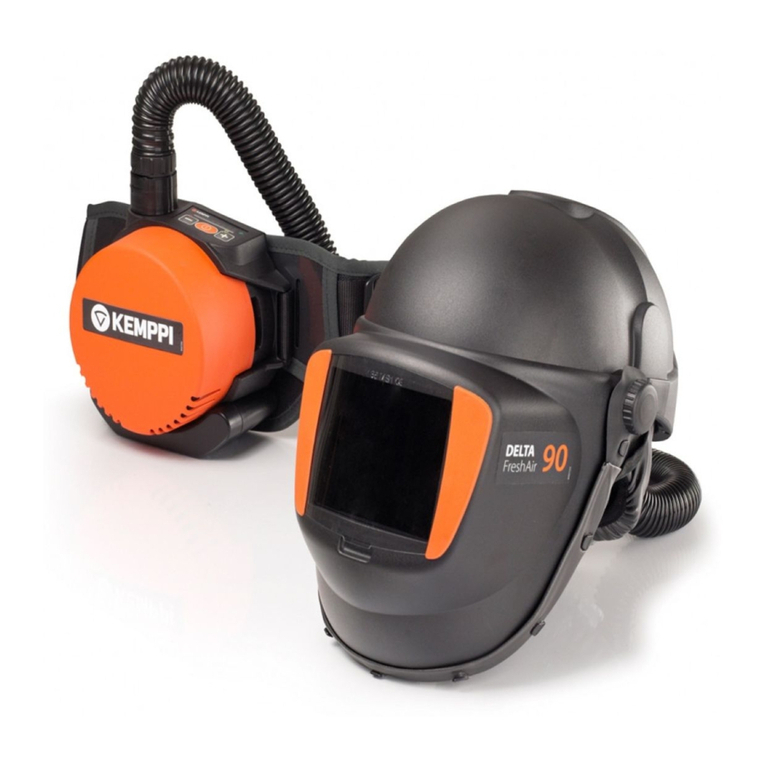
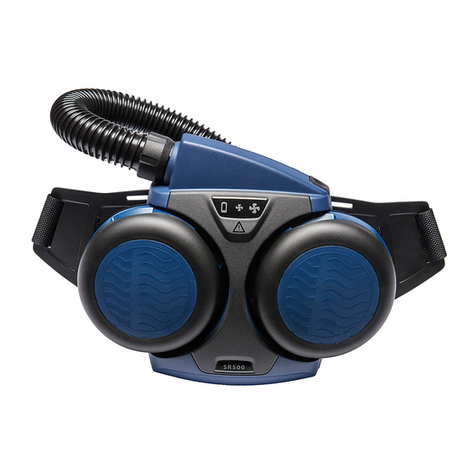
FA Flow Control is a battery powered air purifying respirator
unit for Kemppi's respiratory protective system, which is
based on the principle of circulated pressurized air in the
hood. The belt-mounted blower unit delivers air through
a lter and via an air hose into a headpiece. The supply of
ltered air creates positive pressure inside the headpiece,
which prevents the external contaminated air from
entering the user’s breathing zone.
FA Flow Control unit meets the European standard EN
12941, when used with Delta 90/Delta+ 90 SFA and XFA
helmets.
FA Flow Control respiratory system can be used for
protection against solid and liquid particles in breathing
air in welding and similar processes. It is not to be used for
protection against toxic gases and vapours.
ENGLISH