Page 9
13− The vent pipe shall not be connected to a chimney
vent serving a solid fuel appliance or any mechanical
draft system.
14− All unused chimney openings should be closed.
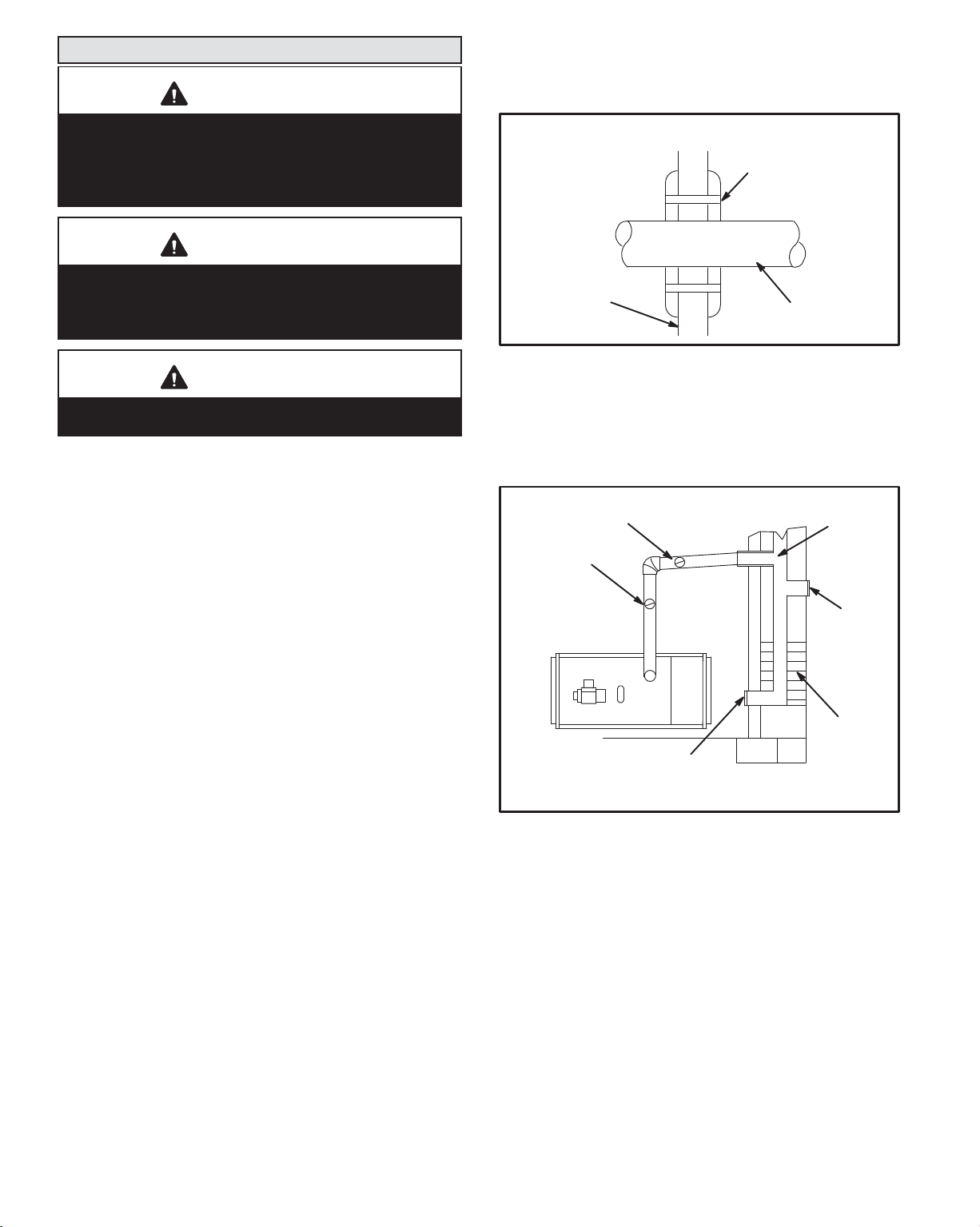
15− All vent pipe run through unconditioned areas or out-
side shall be constructed of factory built chimney sec-
tions. See figure 9.
16− Where condensation of vent gas is apparent, the vent
should be repaired or replaced. Accumulation of con-
densation in the vent is unacceptable.
17− Vent connectors serving this appliance shall not be
connected into any portion of mechanical draft sys-
tems operating under positive pressure.
18− Keep the area around the vent terminal free of snow,
ice and debris.
Factory-Built Chimney
BAROMETRIC
CONTROL*
(IN EITHER LOCATION)
DRAIN FOR
CONDENSATE
FACTORY
BUILT
CHIMNEY
Figure 9
*Barometric control may be installed in either vertical or hori-
zontal section of flue pipe within 18" of flue outlet of furnace.
horizontal
application
shown
Combustion and Ventilation Air
(Confined and Unconfined Spaces)
In the past, there was no problem in bringing in sufficient
amounts of outdoor air for combustion −− infiltration pro-
vided all the air that was needed and then some. In today’s
homes built with energy conservation in mind, tight
construction practices make it necessary to bring in air
from outside for combustion. Consideration must also be
given to the use of exhaust fans, appliance vents, chim-
neys and fireplaces because they force additional air that
could be used for combustion out of the house. Unless out-
side air is brought into the home for combustion, negative
pressure (pressure outside is greater than inside pressure)
will build to the point that a down draft can occur in the fur-
nace vent pipe or chimney. Combustion gases enter the liv-
ing space creating a potentially dangerous situation.
The importance of the previous paragraph cannot be
overstated. Users may inadvertently block fresh air in-
takes after installation.
In the absence of local codes concerning air for combus-
tion and ventilation, the following section outlines guide-
lines and recommends procedures for operating oil fur-
naces in a manner that ensures efficient and safe
operation. Special consideration must be given to com-
bustion air needs as well as requirements for exhaust vents
and oil piping.
Combustion Air Requirements
CAUTION
Insufficient combustion air can cause headaches,
nausea, dizziness or asphyxiation. It will also cause
excess water in the heat exchanger resulting in rust-
ing and premature heat exchanger failure. It can also
cause property damage.
All oil-fired appliances require air to be used for the com-
bustion process. If sufficient amounts of combustion air are
not available, the furnace or other appliance will operate in
an inefficient and unsafe manner. Enough air must be pro-
vided to meet the needs of all fuel-burning appliances, as
well as appliances such as exhaust fans which force air out
of the home. When fireplaces, exhaust fans, or clothes dry-
ers are used at the same time as the furnace, much more
air is required to ensure proper combustion and to prevent
a down-draft situation. Insufficient amounts of air also
cause incomplete combustion which can result in sooting.
Requirements for providing air for combustion and ventila-
tion depend largely on whether the furnace is installed in an
unconfined or confined space.
Unconfined Space
An unconfined space is an area such as a basement or
large equipment room with a volume greater than 50 cubic
feet (1.4 cubic meters) per 1,000 Btu (293 W) per hour of
the combined input rating of all appliances installed in that
space. This space also includes adjacent rooms which are
not separated by a door. Though an area may appear to be
unconfined, it might be necessary to bring in outdoor air for
combustion if the structure does not provide enough air by
infiltration. If the furnace is located in a building of tight
construction with weather stripping and caulking around
the windows and doors, follow the procedures outlined for
using air from the outside for combustion and ventilation.
Confined Space
A confined space is an area with volume less than 50 cubic
feet (1.4 cubic meters) per 1,000 Btu (293 W) per hour of
the combined input rating of all appliances installed in that
space. This definition includes furnace closets or small
equipment rooms.
When the furnace is installed so that supply ducts carry air
circulated by the furnace to areas outside the space con-
taining the furnace, the return air must be handled by ducts
which are sealed to the furnace casing and which terminate
outside the space containing the furnace. This is especially
important when the furnace is mounted on a platform in a
confined space such as a closet or small equipment room.
Even a small leak around the base of the unit at the platform