4) Power tool use and care
a) Do not force the power tool. Use the correct power tool for your application. The correct power tool will do the
job better and safer at the rate for which it was designed.
b) Do not use the power tool if the switch does not turn it on and off. Any power tool that cannot be controlled with
the switch is dangerous and must be repaired.
c) Disconnect the plug from the power source before making any adjustments, changing accessories, or storing
power tools. Such preventive safety measures reduce the risk of starting the power tool accidentally.
d) Store idle power tools out of the reach of children and do not allow persons unfamiliar with the power tool or
these instructions to operate the power tool. Power tools are dangerous in the hands of untrained users.
e) Maintain power tools. Check for misalignment or binding of moving parts, breakage of parts and any other
condition that may affect the power tools operation. If damaged, have the power tool repaired before use. Many accidents
are caused by poorly maintained power tools.
f) Keep cutting tools sharp and clean. Properly maintained cutting tools with sharp cutting edges are less likely to
bind and are easier to control.
g) Use the power tool, accessories and tool bits etc., in accordance with these instructions and in the manner
intended for the particular type of power tool, taking into account the working conditions and the work to be
performed. Use of the power tool for operations different from intended could result in a hazardous situation.
5) Service
a) Have your power tool serviced by a qualified repair person using only identical replacement parts. This will
ensure that the safety of the power tool is maintained.
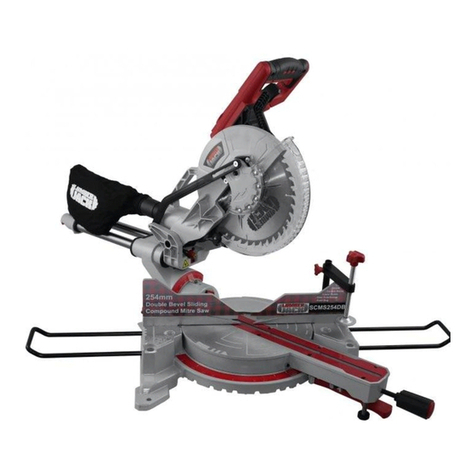
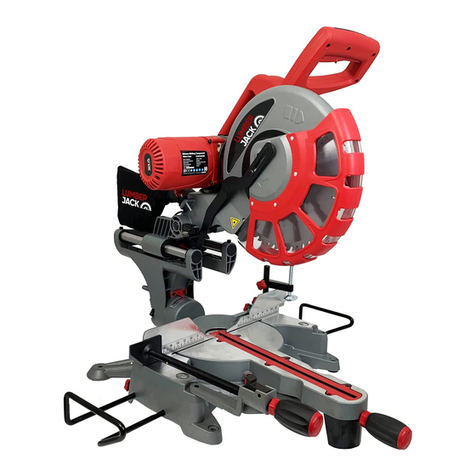
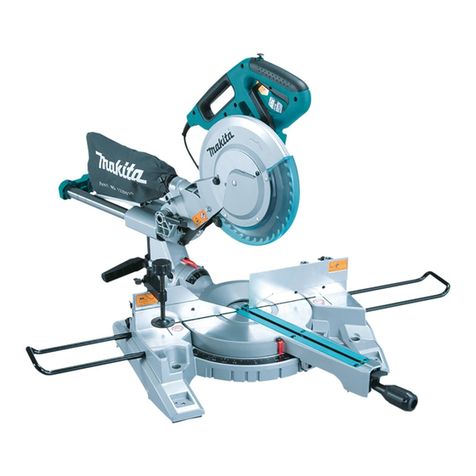
SAFETY REGULATIONS CONCERNING MITRE SAW
a) Mitre saws are intended to cut wood or wood-like products, they cannot be used with abrasive cut-off wheels
for cutting ferrous material such as bars, rods, studs, etc. Abrasive dust causes moving parts such as the lower
guard to jam. Sparks from abrasive cutting will burn the lower guard, the kerf insert and other plastic parts.
b) Use clamps to support the workpiece whenever possible. If supporting the workpiece by hand, you must
always keep your hand at least 100 mm from either side of the saw blade. Do not use this
saw to cut pieces that are too small to be securely clamped or held by hand. If your hand is placed too close to
the saw blade, there is an increased risk of injury from blade contact.
c) The workpiece must be stationary and clamped or held against both the fence and the table. Do not feed the
workpiece into the blade or cut “freehand” in any way. Unrestrained or moving workpieces could be thrown at
high speeds, causing injury.
d) Push the saw through the workpiece. Do not pull the saw through the workpiece. To make a cut, raise the
saw head and pull it out over the workpiece without cutting, start the motor, press the saw head down and
push the saw through the workpiece. Cutting on the pull stroke is likely to cause the saw blade to climb on top of
the workpiece and violently throw the blade assembly towards the operator.
e) Never cross your hand over the intended line of cutting either in front or behind the saw blade. Supporting
the workpiece “cross handed” i.e., holding the workpiece to the right of the saw blade with your left hand or vice
versa is very dangerous.