Page 9
6.5
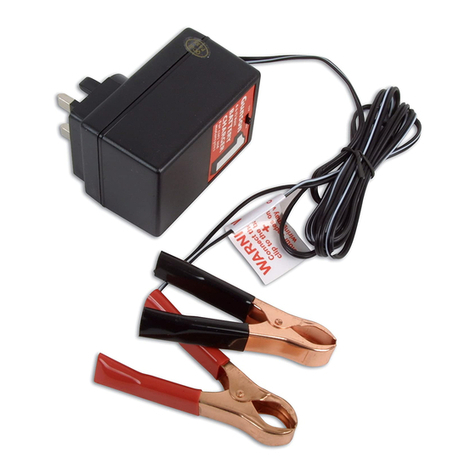
For negative-grounded vehicle, connect POSITIVE (RED) termi-
nal from battery charger to POSITIVE (POS, P, +) ungrounded
post of battery. Connect NEGATIVE (BLACK) terminal to vehicle
chassis or engine block away from battery. Do not connect termi-
nal to carburetor, fuel lines, or sheet-metal body parts. Connect
to a heavy gauge metal part of the frame or engine block.
6.6
For positive-grounded vehicle, connect NEGATIVE (BLACK) ter-
minal from battery charger to NEGATIVE (NEG, N, –) ungrounded
post of battery. Connect POSITIVE (RED) terminal to vehicle
chassis or engine block away from battery. Do not connect termi-
nal to carburetor, fuel lines, or sheet-metal body parts. Connect
to a heavy gauge metal part of the frame or engine block.
6.7
When disconnecting charger, turn switches to off, disconnect AC
cord, remove terminal from vehicle chassis, and then remove ter-
minal from battery post.
6.8
See Operating Instructions for length of charge information.
7. FOLLOW THESE STEPS WHEN BATTERY IS OUTSIDE VEHICLE
A SPARK NEAR THE BATTERY MAY CAUSE A BATTERY EXPLOSION.
TO REDUCE THE RISK OF A SPARK NEAR THE BATTERY:
7.1
Check polarity of battery posts. POSITIVE (POS, P, +) battery post
usually has a larger diameter than NEGATIVE (NEG, N, –) post.
7.2
Attach at least a 24-inch-long 6-gauge (AWG) insulated battery
cable to NEGATIVE (NEG, N, –) battery post.
7.3
Connect POSITIVE (RED) charger terminal to POSITIVE (POS, P, +)
post of battery.
7.4
Position yourself and free end of cable as far away from battery
as possible – then connect NEGATIVE (BLACK) charger terminal
to free end of cable.
7.5
Do not face battery when making final connection.