1
SECTION 1
GENERAL DESCRIPTION
1.1 INTRODUCTION
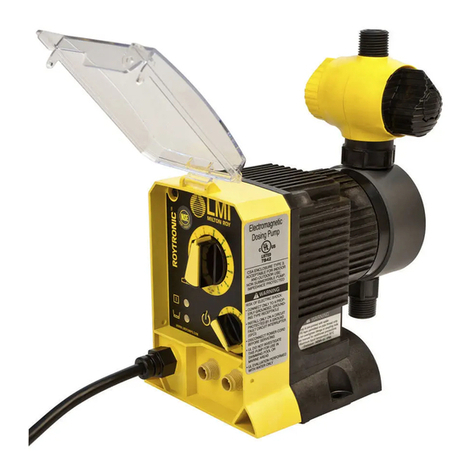
The mRoy pump is a highly reliable controlled volume
pump of hydraulically actuated diaphragm design. The
family of mRoy “A” and “B” frame pumps are further
broken down into Model Codes. For ease of discus-
sion, this manual will refer to either frame size as mRoy
A and mRoy B rather than the specific Model Code (RA
or RS). The new product codes for the mRoy A are
given in Figures 4 through 6. The product codes for the
mRoy B are shown in Figure 12.
Historical Model Codes are found in Appendix A.
1.2 GENERAL INFORMATION
Pump capacity is adjustable while the pump is running
or stopped. Capacity adjustment can be made manu-
ally or automatically by a signal from remote control
instruments.
Repetitive accuracy of the metered discharge volume
is maintained within a ±l% range at constant conditions
of pressure, temperature and pump capacity adjust-
ment setting.
The mRoy pump is a reliable, compact, controlled vol-
ume diaphragm pump for normal corrosive or toxic
chemicals and light slurries with viscosities up to 200
S.S.U. (40 cps). For higher viscosities, the mRoy “P”
series pump is available (to 12,200 cps).
A plunger, reciprocating at a fixed stroke, displaces a
fixed volume of hydraulic fluid, which actuates a flexi-
ble, chemically inert PTFE diaphragm to create pump-
ing action. Double ball check valves are used on the
suction and discharge to insure consistent metering
accuracy. Capacity control is established by adjusting
the volume of hydraulic fluid, which bypasses the dia-
phragm cavity.
Metering with repetitive accuracy is possible only if the
volume of the hydraulic oil in the displacement cham-
ber is maintained constant for each stroke. This is
accomplished by mechanically opening the displace-
ment chamber to the oil reservoir for a short period at
the end of every suction stroke and the beginning of
each pressure stroke. During this period air or vapor is
bled from the system, lost oil is replenished, and allow-
ances are made for the expansion or contraction of the
oil due to temperature change. For more information,
refer to Principle of Operation.
1.3 PUMP CHARACTERISTICS
For a general description of the mRoy pump you have
purchased, compare the model number and product
code printed on the pump’s data plate (shown in Figure
3) to the appropriate model number and product code
shown in Figures 4 through 6 and Figure 12.
1.4 PUMP PERFORMANCE
The charts in Figures 8 through 10 show the perfor-
mance ranges for all mRoy A & B frame pumps. If
appropriate, refer also to the derating table shown in
Figure 11.
1.5 PRINCIPLE OF OPERATION
Pumping action is developed and controlled by four
basic components as follows (Figures 1 & 2):
1. The pump plunger “A” reciprocates with a
constant stroke length and displaces oil into and
out of the diaphragm chamber “C”.
2. The flexible diaphragm “X” is a movable partition
between the plunger oil and fluid being pumped.
3. An oil bypass circuit from the diaphragm
chamber “C” to the reservoir “D” through
passage “E” bypass port “H” and control spool
(valve) “F.”
4. A bypass control plunger “G” which moves with
and is directly coupled to the pump plunger to
correlate bypass shut off at port “H” to pump
plunger position.
In operation, as the pump plunger and bypass control
plunger move forward as shown in Figure 1, the dis-
placed oil is bypassed to the oil reservoir until the con-
trol plunger “G” closes the bypass port “H” as shown in
Figure 2. Then the balance of the plunger displacement
is imposed on the flexible diaphragm that moves and
displaces the fluid being pumped through the dis-
charge ball checks.
On the suction stroke, the pump plunger pulls oil out of
the diaphragm cavity, which moves the flexible dia-
phragm and pulls fluid through the suction ball checks.
When the control plunger “G” opens the bypass port
“H” the balance of the plunger oil displacement can be
supplied from the reservoir through the bypass pas-
sages.