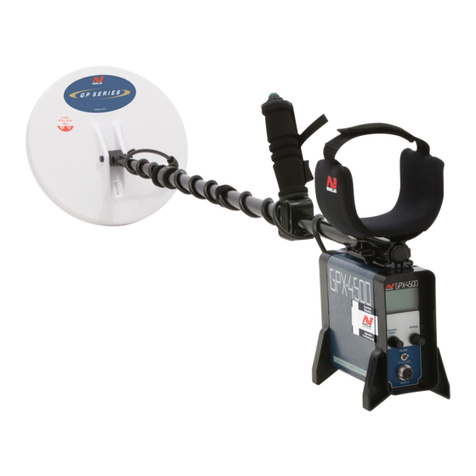
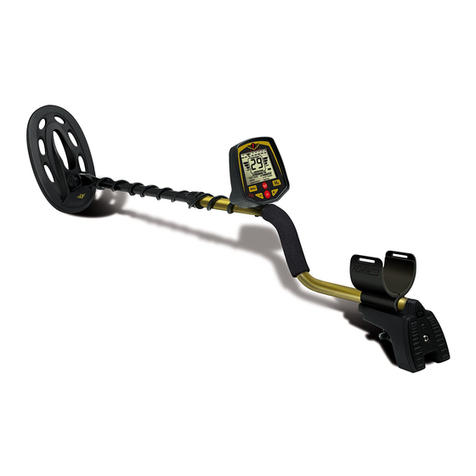
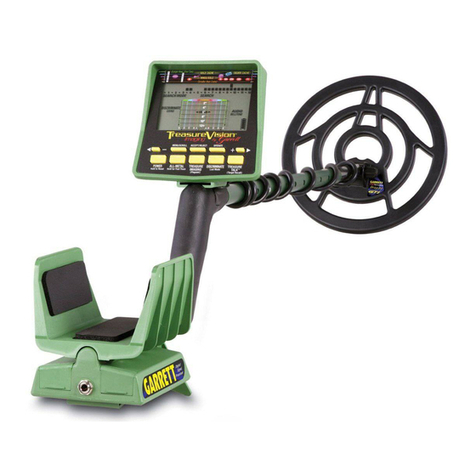
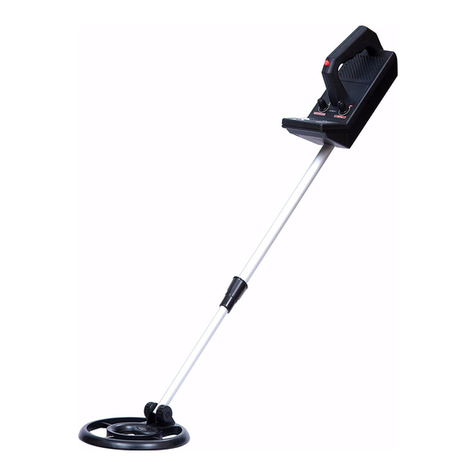
THE MINELAB ‘GP 3000’THE MINELAB ‘GP 3000’
www.minelab.com
ABOUT THIS MANUAL
This manual is designed to introduce the detector’s features. It gives you step-by-step
directions for everything from assembling and adjusting your detector, to basic and
advanced detector use.
1. INTRODUCTION
Basicoverview ofthe ‘GP3000’ and
thisUser’sManual.
2. ASSEMBLY
This chapter provides details and
instructions on assembling and
adjustingthe‘GP 3000’.
3.BATTERY
The ‘GP 3000’ is powered by a
rechargeable battery pack. This
chapter provides details on battery
installation, use and performance.
4. CONTROLS
This chapter is designed to
familiarize you with the various
featuresofthe ‘GP3000’control
panel.Afew minutesspent reading
thischapterwillbea worthwhile
preliminaryto basicor advanced
detecting.
5. DETECTOR OPERATION
However experienced you are at
using a metal detector, it is important
that you read this.
6. DETECTOR TECHNIQUES
Once you are comfortable with the
basic detector use, there are a few
techniques you should be aware of.
7. USER INFORMATION
This chapter provides a glossary of
terminology, user guides, technical
specifications, warranty and repair
details and troubleshooting tips.
ABOUT THIS MANUAL
!
2
INTRODUCTION
1
GLOSSARY OF COMMON TERMS
Control Box The control box encloses the electronic circuitry of the detector.The
control box originates the TX (transmit) signals sent by the coil and
interprets the RX (receive) signals detected by the coil. All user
selectable functions (knobs & switches) are located on the front and
rear panels of the control box.
Discrimination Theabilityofametaldetectortoestimateifalocatedtargetismade
fromferrousmetal (iron or steel) or non-ferrous metal (non-magnetic).
Double D Coils Double D coils are coils that have two windings of wire that overlap
in the shape of two D's (one reversed). The characteristics of a
Double D coil are stability, especially in heavily mineralised ground,
good depth and sensitivity and a very thorough search pattern.
Electromagnetic Field Commonly called the 'signal from the coil'. An electromagnetic field is
generated within the wire windings of the search coil and this field is
pulsed or sent into the ground. The presence of a metal target in the
ground will disturb the pattern of this field and this disturbance is
registered by the receive system of the detector and indicated to the
operator by an audible target signal "beep".
False Signal False signals are signals, which sound similar to target signals but
are caused by other factors. Common causes for false signals are
incorrect ground balance, hot rocks, signals caused by knocking the
coil on obstacles, etc. With experience, the operator will learn
methods to minimise false signals and to hear subtle differences
between target signals and false signals.
Ferrous Metals Metals composed of or containing iron.A ferrous item is one which is
attractedtoamagnetandispredominantlyorcompletelymadeofironor
steel.
Ground Balance Theabilityofthemetaldetectortocompensatefortheeffectsof
groundmineralisation.The‘GP3000’has"automaticgroundbalance".
WhenitisusedinTrackingmodeitcontinuallycompensatesfor
changesinthegroundmineralisation.
GLOSSARY OF COMMON TERMS
55
USER INFO
7