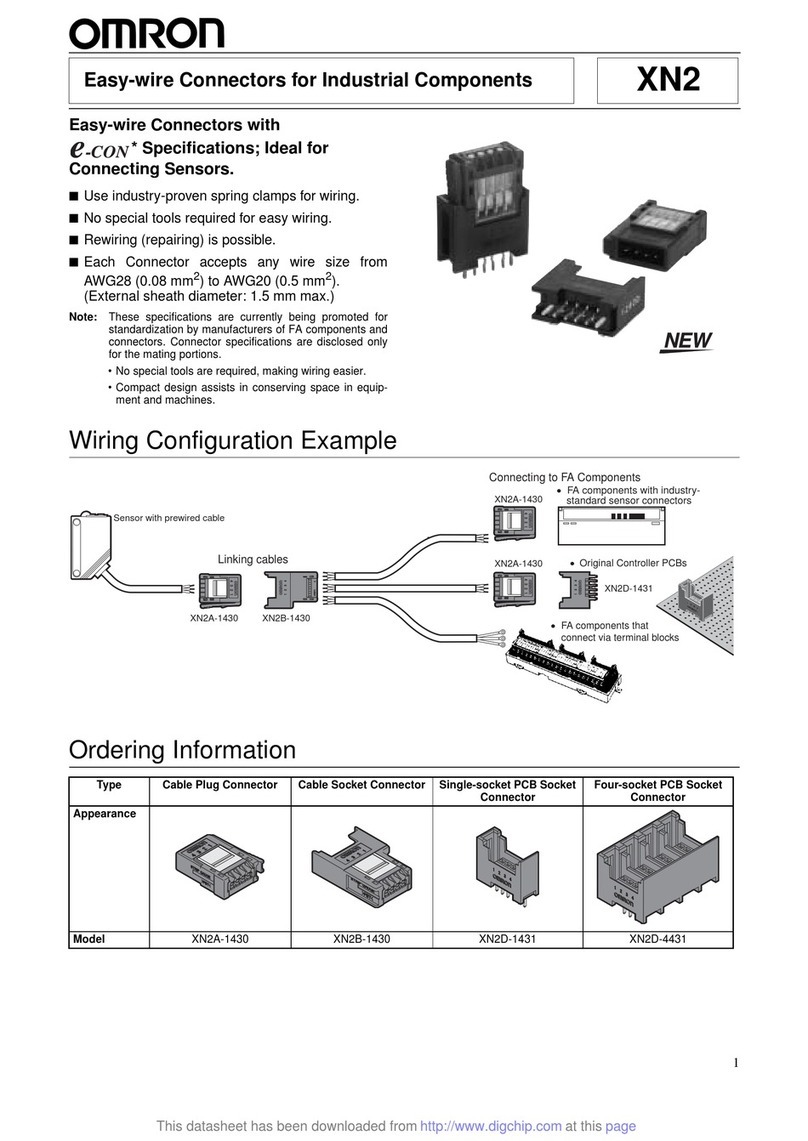
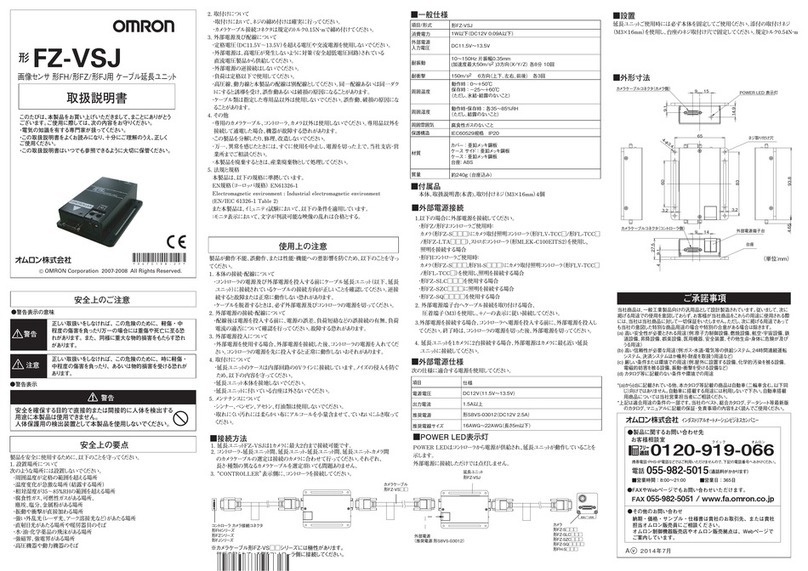
XN2
5
Assembly Instructions
Preparing the Cable
Align the cable with the guide
marked STRIP GAUGE on the side
of the Connector, strip 7 to 8 mm of
the cable sheath, and then twist the
wires several times.
Connecting the Cable to the Connector
(1) Use a flat-blade
screw-driver to push
down the operating
lever inside the
operation slot until it
locks.
(2) Insert the wire fully to
the back of the wire
insertion hole. Make sure that the cable sheath is inserted into the
hole, and that the end of the wire has passed through the contact
section.
(3) Insert the screwdriver into the
release slot, and gently pull
back the lever until a click is
heard by resetting the lever.
Removing Cables from the
Connector
(1) Press down on the operating lever to
lock the lever before removing the
cable.
(2) After removing the cable from the
Connector, always reset the operating
lever, except when rewiring the
Connector. The Connector can be
rewired without resetting the operating
lever.
Safety Precautions
•Do not pull on the Connectors or cables. Doing so may cause
damage to the Connectors or cause the cables to disconnect.
•Install the Connectors in a location where they will not be stepped
on, to prevent disconnection of the cables or damage to the
Connectors. If the Connectors have to be installed in such a
location, use a protective cover.
•Make sure that the Connectors are mated in the correct direction.
Mating the Connectors incorrectly will damage to the Connectors.
•Do not use the Connectors if the lock lever is bent or broken. Doing
so may cause the Connector to become loose or the device to
malfunction.
•Before mounting Connectors to a PCB, make sure that the
Connectors are positioned in the correct direction.
•Before bending a cable to connect it to a Connector, check the
bending specifications of the cable to be used.
•Do not exceed the rated current of the cable. Always check the
rated current of each cable to be used.
•Do not use pliers or other tools to remove the Connectors.
•Hold the Connectors firmly by hand when handling them. Do not
use excessive force to push the Connectors. Forcing the
Connectors may result in injury.
•These Connectors do not resist water. Do not use Connectors in
places where water or oil may be sprayed onto the Connectors.
Do not use the product in atmospheres or environments that exceed
product ratings.
Wiring
•Insert one wire into each insertion hole. Inserting two or more wires
into a single hole may cause unexpected problems.
•Make sure that no power is being supplied to a Connector before
wiring, inserting, or removing the Connector. Doing so may result in
electric shock.
•Follow the wiring diagrams for the device being used when wiring
the cables.
•Strip the cables according to the instructions in the applicable
operation manual, making sure not to damage the wires.
•Do not use a screwdriver with a tip larger than the specified width
when wiring the Connectors.
•Make sure short-circuits are not created, e.g., by protruding wires.
Inserting and Removing Connectors
•When connecting or disconnecting Connectors, always hold the
case of the Connector.
•When mating Connectors, insert the Connector fully into the back
of the socket, and then make sure that the Connector will not
become loose by lightly pulling it in the opposite direction.
Recommended Screwdriver
•Use a flat-blade screwdriver with a tip of 2 mm max. Do not use
screwdrivers that gradually widen towards the base of the
screwdriver.
•Using other screwdrivers may cause damage to the adjacent poles.
Flat-blade screwdriver
Operation slot
Wire
insertion hole
Cable sheath
Contact section
Release slot
Operating lever
(white)
(4) Make sure that the following operations
have been performed.
•Check that the operating lever is reset.
•Check that the procedure in step 2 has been
followed. (Pull gently on the cable to make
sure that there is resistance, indicating that
the Connectors are wired correctly.)
Operating lever
(white)
Precautions for Safe Use Precautions for Correct Use