manuals.online logo
Brands
  1. Home
  2. •
  3. Brands
  4. •
  5. OrienTek
  6. •
  7. Measuring Instrument
  8. •
  9. OrienTek TFI-40 User manual

OrienTek TFI-40 User manual

Other OrienTek Measuring Instrument manuals

OrienTek TPM-25m User manual

OrienTek

OrienTek TPM-25m User manual

OrienTek TPV-53 User manual

OrienTek

OrienTek TPV-53 User manual

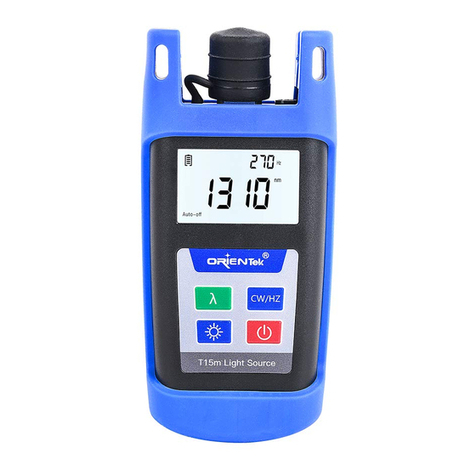
OrienTek T15M User manual

OrienTek

OrienTek T15M User manual

OrienTek TPN-35 PON User manual

OrienTek

OrienTek TPN-35 PON User manual

OrienTek TPM-35m User manual

OrienTek

OrienTek TPM-35m User manual

OrienTek TFI-35 User manual

OrienTek

OrienTek TFI-35 User manual

OrienTek T11P User manual

OrienTek

OrienTek T11P User manual

Popular Measuring Instrument manuals by other brands

Powerfix Profi 278296 Operation and safety notes

Powerfix Profi

Powerfix Profi 278296 Operation and safety notes

Test Equipment Depot GVT-427B user manual

Test Equipment Depot

Test Equipment Depot GVT-427B user manual

Fieldpiece ACH Operator's manual

Fieldpiece

Fieldpiece ACH Operator's manual

FLYSURFER VIRON3 user manual

FLYSURFER

FLYSURFER VIRON3 user manual

GMW TG uni 1 operating manual

GMW

GMW TG uni 1 operating manual

Downeaster Wind & Weather Medallion Series instruction manual

Downeaster

Downeaster Wind & Weather Medallion Series instruction manual

Hanna Instruments HI96725C instruction manual

Hanna Instruments

Hanna Instruments HI96725C instruction manual

Nokeval KMR260 quick guide

Nokeval

Nokeval KMR260 quick guide

HOKUYO AUTOMATIC UBG-05LN instruction manual

HOKUYO AUTOMATIC

HOKUYO AUTOMATIC UBG-05LN instruction manual

Fluke 96000 Series Operator's manual

Fluke

Fluke 96000 Series Operator's manual

Test Products International SP565 user manual

Test Products International

Test Products International SP565 user manual

General Sleep Zmachine Insight+ DT-200 Service manual

General Sleep

General Sleep Zmachine Insight+ DT-200 Service manual

Sensa Core Lacto Spark user manual

Sensa Core

Sensa Core Lacto Spark user manual

VOLTCRAFT UTS-1980 operating instructions

VOLTCRAFT

VOLTCRAFT UTS-1980 operating instructions

EBCHQ 94915 Operation manual

EBCHQ

EBCHQ 94915 Operation manual

Balluff BIP LD2-T017-01-EP-S4 Series user guide

Balluff

Balluff BIP LD2-T017-01-EP-S4 Series user guide

Pulsar IMP Lite Series instruction manual

Pulsar

Pulsar IMP Lite Series instruction manual

ETCR 6800 user manual

ETCR

ETCR 6800 user manual

manuals.online logo
manuals.online logoBrands
  • About & Mission
  • Contact us
  • Privacy Policy
  • Terms and Conditions

Copyright 2025 Manuals.Online. All Rights Reserved.

TFI-40 Fiber Identifier User Manual
Products introduction

Panel features open

Fiber signal recognition
The fiber identification instrument is an essential tool for
fiber maintenance. It is used for non-destructive fiber
identification. It can be detected at any position of
single-mode and multi-mode fiber. During maintenance,
installation, wiring and recovery, it is often necessary to
continue without interruption. In the case of business, find
and separate a specific optical fiber, by injecting a
1310nm or 1550nm band modulation (270Hz, 1KHz, 2KHz)
signal into the optical fiber at one end, and use the
recognizer to identify it on the line, and it can also indi-
cate the signal direction. This product integrates VFL red
light function and LED lighting function. The VFL uses a
2.5mm universal interface with an output power of up to
1mW, which can detect fiber breaks or corners within
5KM. The VFL red light source supports pulse and contin-
uous wave operation. Equipped with LED lighting function,
convenient for construction in the dark.
1
2
3
5
2
4
dB
Hz
5.9
270
Fixture cover
Plunger detachable, use on the
front and back, choose the cor-
responding surface according to
the thickness of the fiber
Optical components
Fiber groove
battery cover
6Fixing screws
72*1.5V alkaline battery
8Dust cover: built-in VFL interface
(2.5mm universal interface) and
LED lighting
9Lock button
dB
Hz
5.9
270
Note: This product does not specify power accuracy
and should not be used to determine the actual signal
strength in the fiber.
2.If there is a signal in the optical fiber, the left and
right direction lights show the signal direction.
3.If there is no signal in the optical fiber, the LCD
display shows LO, and the direction indicator light
may flicker left and right. When the fiber is not
clamped, the direction light may also flicker left and
right
4.When the signal frequency is 2KHz, 1KHz, 270Hz,
the corresponding indicator light is on, accompanied
by a buzzing sound (when the signal is too weak, it
will not be correctly identified).
1.Put the fiber to be tested into the groove of the
fixture, push the button to lock the fixture, and
install the fixture cover .
dB
Hz
5.9
270
2mm/3mm
250/900μm
1
2
3
4
5
6
7
5
86
9
4
front
back
1
2
3
4
5
1LCD display-display power value, frequency.
2 Direction indicator-indicating the direction
of the optical fiber light source under test.
3 Power-power on/off.
4 Backlight-Switch the backlight function [On] or [Off].
5 VFL key-- turn on/off the VFL function.
VFL red light test

VFL red light test

LED lighting



Products features
Products Specification
Operating environment altitude:
areas below 2000m above sea level
Use environment
Standard configuration
Contact us
NANJING ORIENTEK OPTICAL COMMUNICATION LTD
Mail: [email protected]
Add: Jianshan Industry Park, Liuhe District, Nanjing, Jiangsu, China
Web: www.orientekot.com
Tips

TEL: +86 17312230635
Please read all instructions and warnings before
using this product. Irregular use will cause.It will
damage the product or personal safety.
Turn on the power, open the dust cover, and insert the fiber
interface under test into the laser connector.Press the VFL button,
the laser will output continuous wave, press the VFL button again,
the laser pulse. Rush output, short press again to turn off the VFL
function.
Turn on the power, open the dust cover, and insert the fiber
interface under test into the laser connector.Press the VFL button,
the laser will output continuous wave, press the VFL button again,
the laser pulse. Rush output, short press again to turn off the VFL
function.
Turn on the power, open the dust cover, click the " "
button to turn on the flashlight, which is convenient to
use in a dark environment and realize the lighting function;
short press the " " button to turn off the flashlight.
Wavelength recognition range
VFL wavelength range 650nm
VFL laser type LD
LED flashlight Support
800nm to 1700nm
Signal recognition type CW,270 Hz ± 5%,1 kHz ± 5%,2 kHz ± 5%
Detector type φ1mm InGaAs 2 pcs
Adapter fiber type universal φ0.25mm (fiber), φ0.9mm,
φ2.0mm, φ3.0mm optical fiber sheath
Optical power
reading range -40 dBm to 10 dBm
Signal frequency range
Power type
range of working temperature -10℃ to 60℃
Product size/weight
Storage temperature range
219mm*45mm*28mm/235g
VFL power range
VFL test distance
1mW
3-5km
-25℃ to 70℃
AA*2
270Hz,1kHz,2kHz
The three-in-one universal fixture design is suitable for a
variety of optical fibers. Mechanical damping design to
ensure no harm to light
LED backlight display, suitable for various environments
without auxiliary lighting.
Recognize 270Hz, 1Hz, 2KHz modulation signal.
Online testing, no need to interrupt the business, one-
touch operation mode, simple and convenient.
Be equipped with LED light,more convenient to work
in the dark.
Integrated VFL function, 2.5mm universal interface.
1)Equipment should be kept free of dirt and other contaminants
2)Do not store this product in high temperature, strong light and
strong magnetic fields, and do not place it in other harsh environ-
ments such as fire sources.
3)Personal and property damage caused by improper use of
consumers in violation of the product manual.The harm will bear all
consequences by itself, and the company will not bear any legal
responsibility.
7)Non-professionals are strictly prohibited from disassembling
this product.
4)The user should carefully place the optical fiber in the provided
optical fiber slot. Incorrectly pressing the optical fiber into the head
assembly or misalignment of the optical fiber with the fiber groove
may cause the optical assembly to deform
5)To avoid serious eye injury, never directly look at the optical
output of fiber optic network equipment, test equipment, jumpers
or test jumpers
6)Avoid strong physical effects, including knocking, throwing,
trampling, squeezing, etc.
Packing carton, host, certificate,
instruction manual.