WARNING! Thisapplianceisnotintendedforusebyyoungorinrmpersons
unless supervised by a responsible person to ensure that they can use the
appliance safely. Young children should be supervised to ensure they do not
play with the appliance.
• Always wear eye protection and a dust mask for dusty applications and when
drilling/chiselling overhead. Sanding particles can be absorbed by your eyes
and inhaled easily and may cause health complications.
• Use auxiliary handle(s), if supplied with the tool. Loss of control can cause
personal injury.
• Hold power tool by insulated gripping surfaces, when performing an operation
where the cutting accessory may contact hidden wiring or its own cord. Cutting
accessory contacting a “live” wire may make exposed metal parts of the power
tool “live“ and could give the operator an electric shock.
• Recommendations for the use of a residual current device with a rated residual
current of 30mA or less.
• Always use the side handle, this gives you greater control of the accessory
should it become jammed.
• Keep the cord clear of the accessory being used, do not wrap the cord around
your arm or wrist.
• Hold the tool by the insulated gripping surfaces when performing an operation
where the accessory may contact hidden wiring or its own cord.
• When removing an accessory from the tool avoid contact with skin and use
proper protective gloves when grasping the bit or accessory. Accessories may
be hot after prolonged use.
• Young children should be supervised to ensure that they do not play with the
appliance.
• Do not touch rotating parts.
• Do not manipulate the tool.
• Do not use the cable to carry the tool.
• Hold the tool with both hands at the intended handles. Loss of control can
cause personal injury.
• Ensuresucientventilationwhenmixingammablematerialstoavoida
hazardous atmosphere. Developing vapour may be inhaled or be ignited by the
sparks the power tool produces.
• Do not mix food. Power tools and their accessories are not designed for
processing food.
• Keep the cord away from the working area. The cord may be entangled by the
mixer basket.
• Ensurethemixingcontainerisplacedinarmandsecureposition.Acontainer
that is not properly secured may move unexpectedly.
• Ensure that no liquid splashes against the housing of the power tool. Liquid
that has penetrated the power tool can cause damage and lead to electric
shock.
• Follow the instructions and warnings for the material to be mixed. Material to
be mixed may be harmful.
• If the power tool falls into the material to eb mixed, unplug the tool immediately
andhavethepowertoolcheckbyaqualiedrepairperson.Reachingintothe
bucket with the tool still plugged in can lead to electric shock.
• Do not reach into the mixing container with your hands or insert any other
objects into it while mixing. Contact with the mixer may lead to serious personal
injury.
• Start up and run down the tool in the mixing container only. The mixer basket
may bend or spin in an uncontrolled manner.
• Consider that there will be a reactionary torsional momentum.
• When working with dust, you must wear respiratory protection. Inhaling the
dust may damage the respiratory tract.
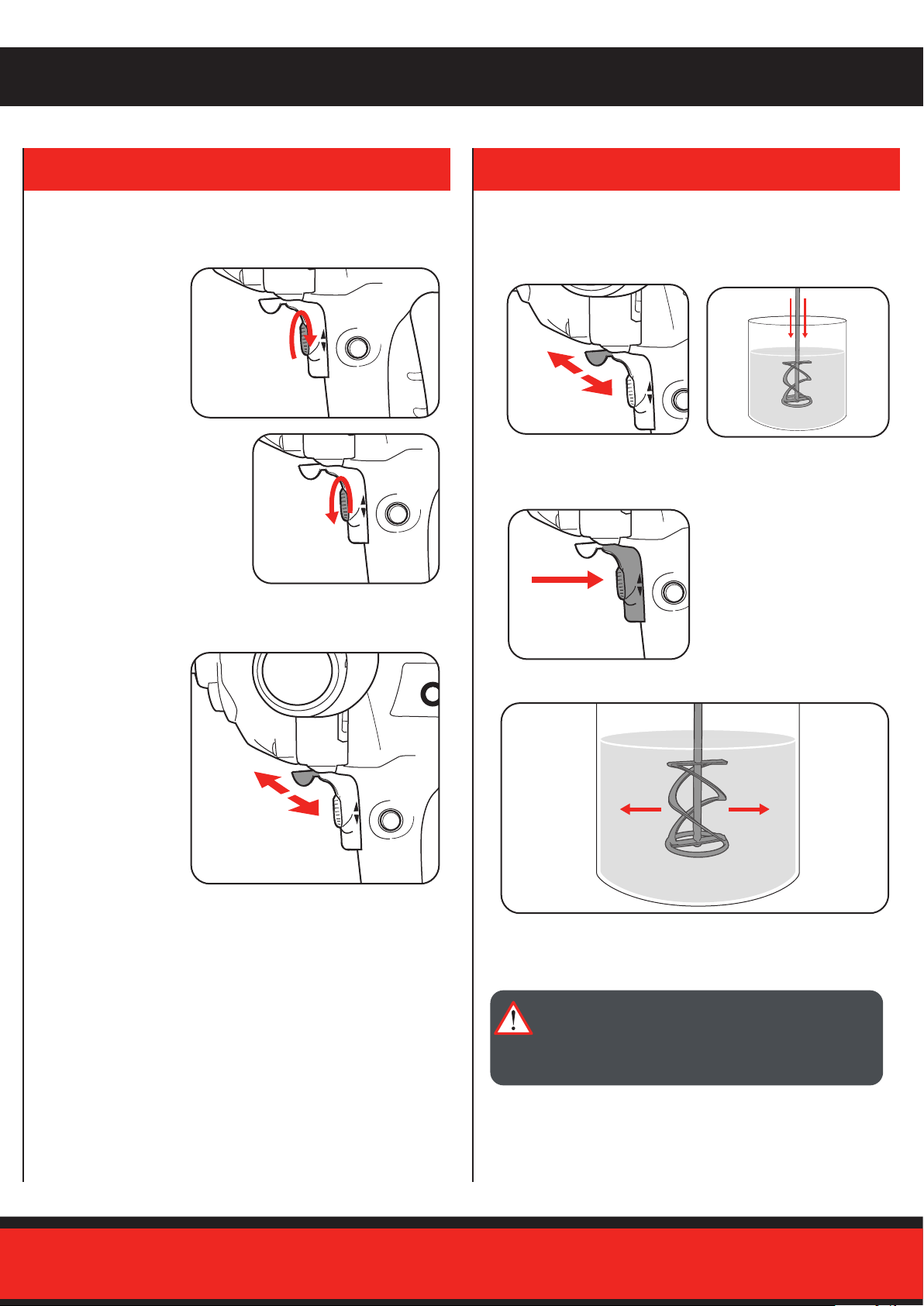
• Always reduce the speed when submerging the mixer in the material or lifting
it out. Once the mixer is fully submerged, increase the speed again to ensure
that the motor is adequately cooled.
WARNING! Some dust created by power sanding, sawing, grinding, drilling
and other construction activities contain chemicals known to cause cancer,
birth defects or other reproductive harm.
Some examples of these chemicals are:
• Lead from lead-based paints;
• Crystalline silica from bricks, cement and other masonry products, and;
• Arsenic and chromium from chemically-treated timber.
The risk from such exposures vary depending on how often you do this type of work.
To reduce your exposure to these chemicals; work in a well ventilated area, and
workwithapprovedsafetyequipment,suchasthosedustmasksthatarespecically
designedtolteroutmicroscopicparticles.
MULTI-PURPOSE MIXER SAFETY WARNINGS
WARNING! When using mains-powered tools, basic safety precautions, including the
following, should always be followed to reduce risk of re, electric shock, personal injury and
material damage.
Readthewholemanualcarefullyandmakesureyouknowhowtoswitchthetooloinanemergency,before
operating the tool.
Save these instructions and other documents supplied with this tool for future reference.
The electric motor has been designed for 230V and 240V only. Always check that the power supply corresponds
to the voltage on the rating plate.
Note: The supply of 230V and 240V on Ozito tools are interchangeable for Australia and New Zealand.
This tool is double insulated therefore no earth wire is required.
Note: Double insulation does not take the place of normal safety precautions when operating this tool. The
insulation system is for added protection against injury resulting from a possible electrical insulation failure within
the tool.
This tool is recommended for the use with a residual current device with a rated residual current of 30mA or less.
Ifthesupplycordisdamaged,itmustbereplacedbythemanufacturer,itsserviceagentorsimilarlyqualied
persons in order to avoid a hazard.
Using an Extension Lead
Always use an approved extension lead suitable for the power input of this tool. Before use, inspect the
extension lead for signs of damage, w ear and ageing. Replace the extension lead if damaged or defective.
When using an extension lead on a reel, always unwind the lead completely. Use of an extension lead not
suitableforthepowerinputofthetoolorwhichisdamagedordefectivemayresultinariskofreandelectric
shock.
GENERAL POWER TOOL SAFETY WARNINGS
ELECTRICAL SAFETY
WARNING! Read all safety warnings and all instructions. Failure to follow the warnings and
instructionsmayresultinelectricshock,reand/orseriousinjury.
Save all warnings and instructions for future reference. The term “power tool” in the
warnings refers to your mains-operated (corded) power tool or battery-operated (cordless) power
tool.
1. Work area safety
a. Keep work area clean and well lit. Cluttered or dark areas invite accidents.
b. Do not operate power tools in explosive atmospheres, such as in the presence of ammable
liquids, gases or dust. Power tools create sparks which may ignite the dust or fumes.
c. Keep children and bystanders away while operating a power tool. Distractions can cause you to
lose control.
2. Electrical safety
a. Power tool plugs must match the outlet. Never modify the plug in any way. Do not use any
adapter plugs with earthed (grounded) power tools.Unmodiedplugsandmatchingoutletswill
reduce risk of electric shock.
b. Avoid body contact with earthed or grounded surfaces, such as pipes, radiators, ranges and
refrigerators. There is an increased risk of electric shock if your body is earthed or grounded.
c. Do not expose power tools to rain or wet conditions. Water entering a power tool will increase the
risk of electric shock.
d. Do not abuse the cord. Never use the cord for carrying, pulling or unplugging the power tool.
Keep cord away from heat, oil, sharp edges or moving parts. Damaged or entangled cords increase
the risk of electric shock.
e. When operating a power tool outdoors, use an extension cord suitable for outdoor use. Use of a
cord suitable for outdoor use reduces the risk of electric shock.
f. If operating a power tool in a damp location is unavoidable, use a residual current device (RCD)
protected supply. Use of an RCD reduces the risk of electric shock.
3. Personal safety
a. Stay alert, watch what you are doing and use common sense when operating a power tool. Do
not use a power tool while you are tired or under the inuence of drugs, alcohol or medication. A
moment of inattention while operating power tools may result in serious personal injury.
b. Use personal protective equipment. Always wear eye protection. Protective equipment such as dust
mask, non-skid safety shoes, hard hat, or hearing protection used for appropriate conditions will reduce
personal injuries.
c. Prevent unintentional starting. Ensure the switch is in the o-position before connecting to
power source and/or battery pack, picking up or carrying the tool. Carrying power tools with your
ngerontheswitchorenergisingpowertoolsthathavetheswitchoninvitesaccidents.
d. Remove any adjusting key or wrench before turning the power tool on. A wrench or a key left
attached to a rotating part of the power tool may result in personal injury.
e. Do not overreach. Keep proper footing and balance at all times. This enables better control of the
power tool in unexpected situations.
f. Dress properly. Do not wear loose clothing or jewellery. Keep your hair, clothing and gloves away
from moving parts. Loose clothes, jewellery or long hair can be caught in moving parts.
g. If devices are provided for the connection of dust extraction and collection facilities, ensure
these are connected and properly used. Use of dust collection can reduce dust-related hazards.
4. Power tool use and care
a. Do not force the power tool. Use the correct power tool for your application. The correct power tool
will do the job better and safer at the rate for which it was designed.
b. Do not use the power tool if the switch does not turn it on and o. Any power tool that cannot be
controlled with the switch is dangerous and must be repaired.
c. Disconnect the plug from the power source and/or the battery pack from the power tool before
making any adjustments, changing accessories, or storing power tools. Such preventive safety
measures reduce the risk of starting the power tool accidentally.
d. Store idle power tools out of the reach of children and do not allow persons unfamiliar with the
power tool or these instructions to operate the power tool. Power tools are dangerous in the hands
of untrained users.
e. Maintain power tools. Check for misalignment or binding of moving parts, breakage of parts and
any other condition that may aect the power tool’s operation. If damaged, have the power tool
repaired before use. Many accidents are caused by poorly maintained power tools.
f. Keep cutting tools sharp and clean. Properly maintained cutting tools with sharp cutting edges are
less likely to bind and are easier to control.
g. Use the power tool, accessories and tool bits etc. in accordance with these instructions, taking
into account the working conditions and the work to be performed. Use of the power tool for
operationsdierentfromthoseintendedcouldresultinahazardoussituation.
5. Service
a. Have your power tool serviced by a qualied repair person using only identical replacement
parts. This will ensure that the safety of the power tool is maintained.