manuals.online logo
Brands
  1. Home
  2. •
  3. Brands
  4. •
  5. Panasonic
  6. •
  7. Speakers System
  8. •
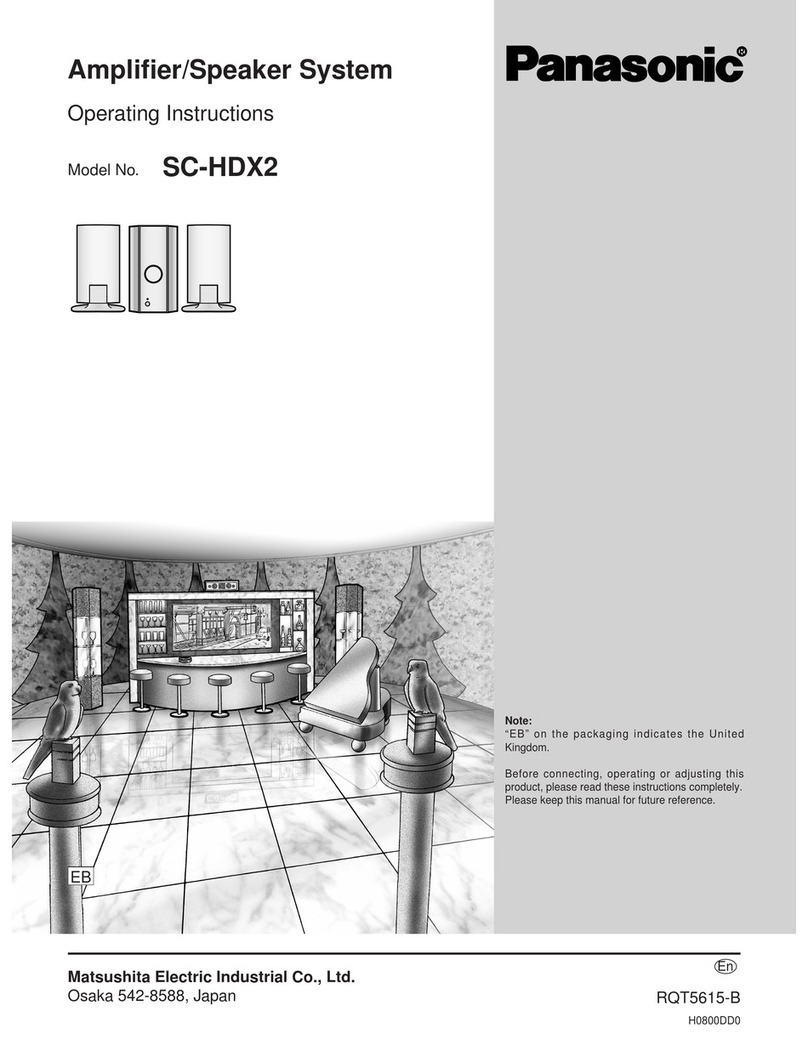
  9. Panasonic SA-HT535EE User manual

Panasonic SA-HT535EE User manual

Other Panasonic Speakers System manuals
Panasonic SB-HS750P User manual

Panasonic

Panasonic SB-HS750P User manual

Panasonic SC-NE1 User manual

Panasonic

Panasonic SC-NE1 User manual

Panasonic RXDT770 - RADIO CASSETTE W/CD User manual

Panasonic

Panasonic RXDT770 - RADIO CASSETTE W/CD User manual

Panasonic SC-TMAX10PU User manual

Panasonic

Panasonic SC-TMAX10PU User manual

Panasonic SC-BTT885 User manual

Panasonic

Panasonic SC-BTT885 User manual
Panasonic SCHT720 - RECEIVER W/5-DISK DV User manual
Panasonic

Panasonic SCHT720 - RECEIVER W/5-DISK DV User manual

Panasonic SB-T300 User manual

Panasonic

Panasonic SB-T300 User manual

Panasonic SBTP1000 - SYSTEM -MULTI LANG User manual

Panasonic

Panasonic SBTP1000 - SYSTEM -MULTI LANG User manual

Panasonic SB-HT250 User manual

Panasonic

Panasonic SB-HT250 User manual

Panasonic SC-NE5DB User manual

Panasonic

Panasonic SC-NE5DB User manual

Panasonic SBHS100A - SPEAKER SYSTEM - MULTI LANGUAGE User manual

Panasonic

Panasonic SBHS100A - SPEAKER SYSTEM - MULTI LANGUAGE User manual

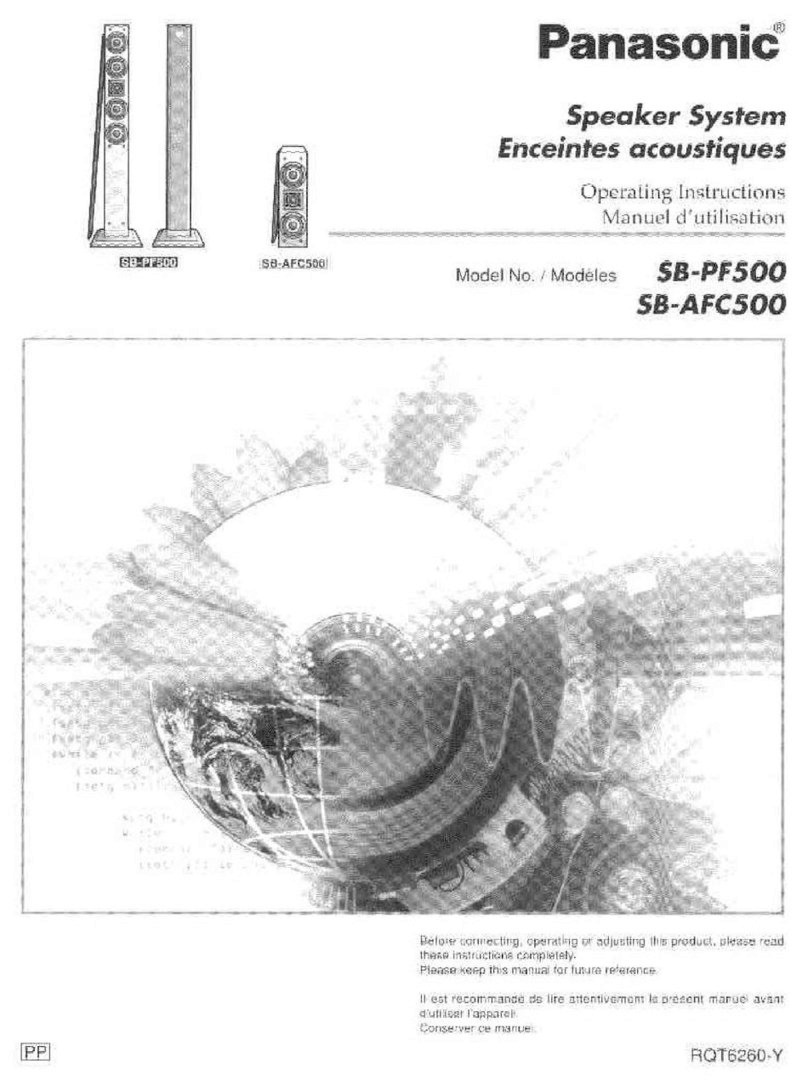
Panasonic SB-PF500 User manual

Panasonic

Panasonic SB-PF500 User manual

Panasonic SB-PC40P User manual

Panasonic

Panasonic SB-PC40P User manual

Panasonic RP-SP1000 User manual

Panasonic

Panasonic RP-SP1000 User manual

Panasonic SOUNDSLAYER SC-HTB01 Technical specifications

Panasonic

Panasonic SOUNDSLAYER SC-HTB01 Technical specifications

Panasonic SA-HT670PC User manual

Panasonic

Panasonic SA-HT670PC User manual

Panasonic SB-MAX4000E User manual

Panasonic

Panasonic SB-MAX4000E User manual

Panasonic SB-LV305 User manual

Panasonic

Panasonic SB-LV305 User manual

Panasonic SA-PT464P User manual

Panasonic

Panasonic SA-PT464P User manual

Panasonic SB-HSX70 User manual

Panasonic

Panasonic SB-HSX70 User manual

Panasonic SC-HDA710 User manual

Panasonic

Panasonic SC-HDA710 User manual

Panasonic WS-TN13E User manual

Panasonic

Panasonic WS-TN13E User manual

Panasonic SB-HS950P User manual

Panasonic

Panasonic SB-HS950P User manual

Panasonic SC-UA7 User manual

Panasonic

Panasonic SC-UA7 User manual
Popular Speakers System manuals by other brands

Monster MT-SB21 user manual

Monster

Monster MT-SB21 user manual

Monacor ESP-76AB/ WS manual

Monacor

Monacor ESP-76AB/ WS manual

Samsung HW-J430 user manual

Samsung

Samsung HW-J430 user manual

WILSON AUDIO WATT owner's manual

WILSON AUDIO

WILSON AUDIO WATT owner's manual

Hisense AX3125H user manual

Hisense

Hisense AX3125H user manual

EisSound KBSound iSelect user manual

EisSound

EisSound KBSound iSelect user manual

Boston Acoustics VRi793 manual

Boston Acoustics

Boston Acoustics VRi793 manual

Sven SPS-707bL Operation manual

Sven

Sven SPS-707bL Operation manual

Monacor DSM-26LAN instruction manual

Monacor

Monacor DSM-26LAN instruction manual

JVC CS-SR100 instructions

JVC

JVC CS-SR100 instructions

Samsung HW-C450 user manual

Samsung

Samsung HW-C450 user manual

TaoTronics evatronic ET-SK011 user guide

TaoTronics

TaoTronics evatronic ET-SK011 user guide

JVC HX-D7C instructions

JVC

JVC HX-D7C instructions

Pyle PBMSPG190 user manual

Pyle

Pyle PBMSPG190 user manual

Sven SPS-607 Operation manual

Sven

Sven SPS-607 Operation manual

iSP Technologies LT2 series owner's manual

iSP Technologies

iSP Technologies LT2 series owner's manual

Samsung Crystal Surround Air Track HW-F550 user manual

Samsung

Samsung Crystal Surround Air Track HW-F550 user manual

Bose Acoustimass 6 Series II owner's guide

Bose

Bose Acoustimass 6 Series II owner's guide

manuals.online logo
manuals.online logoBrands
  • About & Mission
  • Contact us
  • Privacy Policy
  • Terms and Conditions

Copyright 2025 Manuals.Online. All Rights Reserved.

ORDERNO. MD0508309C3
DVDHome Theater Sound System
SA-HT535EE
Colour
(S)...Silver Type
SPECIFICATIONS
Specification
1
PDFcreated withpdfFactoryProtrialversion www.pdffactory.com
Amplifier Section
RMS Output Power: DolbyDigital Mode
Front Ch
55 Wper channel (6), 1kHz, 10%THD
Surround Ch
55 Wper channel (6), 1kHz, 10%THD
Center Ch
160 Wper channel (6), 1kHz, 10%THD
Subwoofer Ch
220 Wper channel (4), 100 Hz, 10%THD
Total RMS DolbyDigital Mode
Power
600 W
DIN Output Power: DolbyDigital Mode
Front Ch
40 Wper channel (6), 1kHz, 1%THD
Surround Ch
40 Wper channel (6), 1kHz, 1%THD
Center Ch
120 Wper channel (6), 1kHz, 1%THD
Subwoofer Ch
150 Wper channel (4), 100 Hz, 1%THD
Total DIN DolbyDigital Mode
Power
430 W
FM/AM Tuner, Terminals
Section
Preset station FM 15 stations
AM/MW15 stations
FrequencyModulation (FM)
FrequencyRange
87.50-108.00 MHz (50-kHz step)
Sensitivity 1.5V (IHF)
S/N 26 dB 1.2V
Antennaterminals 75 (unbalanced)
AmplitudeModulation (AM/MW)
FrequencyRange 522-1629 kHz (9-kHz step)
AM SensitivityS/N 20 dB at 999
kHz
560 V/m
PhoneJack
Terminal Stereo, 3.5mm jack
MicJack
Sensitivity 0.7mV, 1.2k
Terminal Mono, 6.3mm jack (2
systems)
Disc Section
Disc played[8cm or12 cm]
1. DVD (DVD-Video, DVD-Audio, DivX*1, 2)
2. DVD-RAM (DVD-VR, JPEG*2, 3, MPEG4*2, 4, DivX*1, 2)
3. DVD-R (DVD-Video, DivX*1, 2)
4. DVD-RW(DVD-Video, DVD-VR, DivX*1, 2)
5. +R/+RW(Video)
2
PDFcreated withpdfFactoryProtrialversion www.pdffactory.com
6. CD, CD-R/RW[CD-DA, Video-CD, SVCD*5, MP3*2, 6, WMA*2, 7,
JPEG*2, 3, MPEG*2, 4, DivX*1, 2, HIGHMATLevel 2(Audioand
Image)]
*1 DivX 3.11, 4.x, 5.x
GMC (Global Motion Compensation) isnot supported.
*2 Thetotal combinedmaximumnumber of recognizableaudio,
picture and videocontentsand groups: 4000 audio, picture and
videocontentsand 400 groups.
*3 Exif Ver 2.1JPEG Baselinefiles
Picture resolution: between160 X 120 and 6144 X 4096 pixels
(Sub sampling is4:2:2or4:2:0)
*4 MPEG4datarecordedwithPanasonicSD multi-cameras or
DVD videorecorders
Conforming toSD VIDEO specifications(ASFstandard)/MPEG4
(SimpleProfile) videosystem/G.726 audiosystem
*5 Conforming toIEC62107.
*6 MPEG-1Layer 3, MPEG-2Layer 3.
*7 WindowsMediaAudioVer.9.0L3.
Not compatiblewithMultipleBit Rate(MBR)
Pick up
Wavelength CD 785 nm
DVD 662 nm
Laser power CLASS 2/CLASS 3A
Audiooutput (Disc)
Number of channels 5.1ch(FL, FR, C, SL, SR, SW)
VideoSection
VideoSystem
Signal system PAL625/50, PAL525/60, NTSC
Compositevideooutput
Output level 1 Vp-p(75 )
Terminal Pinjack (1system)
Scart jack (1system)
S-videooutput
Y output level 1 Vp-p(75 )
C output level PAL; 0.3Vp-p(75 )
NTSC; 0.286 Vp-p(75 )
Terminal S terminal (1system)
Scart jack (1system)
Component VideoOutput
[NTSC: 525 (480) p/525 (480) i, PAL: 625 (576) p/625 (576)i]
Y output level 1 Vp-p(75 )
PBoutput level 0.7Vp-p(75 )
PRoutput level 0.7Vp-p(75 )
Terminal
Pinjack (Y: green, PB: blue, PR: red) (1system)
RGB videooutput
R output level 0.7Vp-p(75 )
G output level 0.7Vp-p(75 )
B output level 0.7Vp-p(75 )
Terminal Scart jack (1system)
General
3
PDFcreated withpdfFactoryProtrialversion www.pdffactory.com
Power Supply AC 230 V, 50 Hz
Power consumption 25 W(SA-HT535), / 250 W(SB
-WA535)
Dimensions(WxH xD) 430 x60 x348.3mm
Mass 2.7kg(SA-HT535)
Operating temperature range +5°C to+35 °C
Operating humidityrange
5%to90 %RH (no condensation)
Power consumption instandbymode: approx. 0.7W
*8Rating withlowcut filter equippedamplifier
System
System: SC-HT535 (EE)
Mainunit: SA-HT535 (EE-S)
Satellitespeaker: SB-HT535 (EG-S)
Activesubwoofer: SB-WA535 (EE-S)
Speakers: SB-HT535 (EG)
Front speakers: SB-FS535 (EG-S)
Surround speakers: SB-FS536 (EG-S)
Center speaker: SB-PC535 (EG-S)
Note:
1. Specificationsaresubject to changewithoutnotice. Mass and
dimensionsareapproximate.
2. Total harmonicdistortion ismeasured bythedigital spectrum analyzer.
2005 Matsushita ElectricIndustrial Co. Ltd.. All rights reserved.
Unauthorized copying and distribution isaviolation of law.
1. Use of Active Subwoofer
1.1. Checking MainUnitwhen Active Subwoofer isUsed
4
PDFcreated withpdfFactoryProtrialversion www.pdffactory.com
1.2. Checking MainUnitUsing Power Jig
If the active subwooferis not available during time of repairtothe unit, the following equipment
couldbe used.
Jigproduct number
RFKZ0182 (110V , 127V, 220V, 230V - 240V forwithvoltage selectoroverseas domestic use).
2. Before Repair and Adjustment (Using Active
5
PDFcreated withpdfFactoryProtrialversion www.pdffactory.com
Subwoofer Unit)
Disconnect AC power, discharge PowerSupplyCapacitors C2080 through a 10 , 10 W resistor
toground.
DO NOTSHORT-CIRCUITDIRECTLY (witha screwdriverblade, forinstance), as this may
destroysolidstate devices.
Afterrepairs are completed, restore powergraduallyusing a variac, toavoidovercurrent.
Current consumption at AC 230V, 50Hz inNO SIGNALmode shouldbe ~850 mA (Active
Subwoofer).
3. SAFETY PRECAUTIONS
3.1. GENERALGUIDELINES
1. When servicing, observe the original lead dress. Ifashort circuit
isfound, replace all parts which have been overheated or
damaged bythe short circuit.
2. After servicing, ensure that all the protective devices such as
insulation barriers, insulation papers shields are properly
installed.
3. After servicing, make the following leakage current checks to
prevent the customer from being exposed to shock hazards.
3.1.1. LEAKAGE CURRENTCOLD CHECK (FOR ACTIVE SUBWOOFER)
1. Unplug the AC cord and connect ajumper between the two
prongs on the plug.
2. Measure the resistance value, with an ohmmeter, between the
jumpered AC plug and each exposed metalliccabinet part on the
equipment such as screwheads, connectors, control shafts, etc.
When the exposed metallicpart has areturn path to the chassis,
the reading shouldbe between 1M and 5.2 . / When the
exposed metal does not have areturn path to the chassis, the
reading must be .
Fig. 1
3.1.2. LEAKAGE CURRENTHOTCHECK (See Figure1.)
6
PDFcreated withpdfFactoryProtrialversion www.pdffactory.com
1. Plug the AC cord directlyinto the AC outlet. Donot use an
isolation transformer for thischeck.
2. Connect a1.5k , 10 watts resistor, inparallel with a0.15 F
capacitor, between each exposed metallicpart on the set and a
good earth ground such as awater pipe, as showninFigure 1.
3. Use an AC voltmeter, with 1000 ohms/voltor more sensitivity, to
measure the potential across the resistor.
4. Check each exposed metallicpart, and measure the voltage at
each point.
5. Reverse the AC plug inthe AC outlet and repeat each of the above
measurements.
6. The potential at anypoint shouldnot exceed 0.75 volts RMS. A
leakage current tester (Simpson Model 229 or equivalent) maybe
used to make the hot checks, leakage current must not exceed 1/2
milliamp. Incase ameasurement isoutside of the limits specified,
there isapossibilityof ashock hazard, and the equipment should
be repaired and rechecked before itisreturned to the customer.
4. Handling the Lead Solder
4.1. About lead free solder (PbF)
Distinction of PbF P.C.B. :
P.C.B.s (manufactured) using leadfree solderwill have a PbF stampon the P.C.B.
Caution:
-Pb free solder has ahigher melting point that standard solder;
Typicallythe melting point is50 -70°F (30 -40°C)higher. / Please
use ahigh temperature soldering iron. Incase of the soldering
iron with temperature control, please set itto 700 ± 20°F (370 ±
10°C).
-Pb free solder will tend to splash when heated too high (about
1100°F/600°C).
-When soldering or unsoldering, please completelyremove all of
the solder on the pins or solder area, and be sure to heat the
soldering points with the Pb free solder until itmelts enough.
5. Protection Circuitry
The protection circuitrymayhave operatedif eitherof the following conditions are noticed:
7
PDFcreated withpdfFactoryProtrialversion www.pdffactory.com
-Nosound isheard when the power isturned on.
-Sound stops during aperformance.
The function of this circuitryis toprevent circuitrydamage if, forexample, the positive and
negative speakerconnection wires are
“shorted”, orif speakersystems withanimpedance less thanthe indicatedratedimpedance of
the amplifierare used.
If this occurs, followthe procedure outlines below:
1. Turn off the power.
2. Determine the cause of the problem and correct it.
3. Turn on the power once againafter one minute.
Note :
Whenthe protection circuitryfunctions, the unit will not operate unless the poweris first turned
off and thenon again.
6. Prevention of Electro Static Discharge (ESD) to
Electrostatically Sensitive (ES) Devices
Some semiconductor(solidstate) devices canbe damagedeasilybyelectricity. Such
components commonlyare calledElectrostaticallySensitive (ES) Devices. Examples of typical
ES devices are integratedcircuits and some field-effect transistors and semiconductor“chip”
components. The following techniques shouldbe usedtohelpreduce the incidence of
component damage causedbyelectrostatic discharge (ESD).
1. Immediatelybefore handling anysemiconductor component or
semiconductor-equiped assembly, drainoff anyESDon your
bodybytouching aknownearth ground. Alternatively, obtainand
wear acommerciallyavailabledischarging ESDwrist strap, which
shouldbe removed for potential shock reasons prior to applying
power to the unitunder test.
2. After removing an electrical assemblyequiped with ES devices,
place the assemblyon aconductive surface such as aluminium
foil, to prevent electrostaticcharge buildup or exposure of the
assembly.
3. Use onlyagrounded-tipsoldering iron to solder or unsolder ES
devices.
4. Use onlyan anti-staticsolder remover device. Some solder
removal devices not classified as “anti-static(ESDprotected)”
can generate electrical charge to damage ES devices.
5. Donot use freon-propelled chemicals. These can generate
electrical charges sufficient to damage ES devices.
8
PDFcreated withpdfFactoryProtrialversion www.pdffactory.com
6. Donot remove areplacement ES device from its protective
package until immediatelybefore you are readyto install it. (Most
replacement ES devices are packaged with leads electrically
shorted together byconductive foam, aluminium foil or
comparableconductive material).
7. Immediatelybefore removing the protective material from the
leads of areplacement ES device, touch the protective material to
the chassisor circuitassemblyinto which the device will be
installed.
Caution
Besure no power isapplied to the chassisor circuit, and observe
all other safetyprecautions.
8. Minimize bodilymotions when handling unpackaged replacement
ES devices. (Otherwise harmless motion such as the brushing
together of your clothes fabricor the lifting of your foot from a
carpeted floor can generate staticelectricity(ESD)sufficient to
damage an ES device).
7. Cautions to Be Taken When Handling Optical
Pickup
-The laser diode used inside the optical pickup couldbe destroyed
due to staticelectricity(potential difference iscaused by
electrostaticload discharged from clothes and human body).
Handlethe parts carefullyto avoidelectrostaticdestruction during
repair&during replacement.
7.1. Handling Optical Pickup
1. Donot cause anystrong impact on optical pickup as the unit
structurallyuses an extremelyprecise technology.
2. Short-circuitthe flexiblecableof optical pickup removed from the
circuitboard using ashort-circuitpinor clipinorder to prevent
laser diode from electrostaticdestruction. (Refer to Fig. 7-1 and
9
PDFcreated withpdfFactoryProtrialversion www.pdffactory.com
Fig. 7-2.)
3. Donot handleflexiblecables forciblyas thismaycause snapping.
Handlethe parts carefully. (Refer to Fig. 7-1)
4. Anew optical pickup isequipped with an anti-staticflexiblecable.
After replacing and connecting to the flexibleboard, cut the anti-
staticflexiblecable. (Refer to Fig. 7-1)
Fig. 7-1
Fig. 7-2
7.2. Cautions to BeTaken During Replacement of Optical Pickup
Suppliedoptical pickup is equippedwitha short clipfound at the end of flexible cable inorder
toprevent electrostatic destruction of laserdiode. Before connection, remove the short clip, and
check that the short land is opened(remove solderif the part is short-circuited). Alsoensure
humanbodyis properlyground (ReferSection 7.3)
7.3. Grounding for Preventing ElectrostaticDestruction
10
PDFcreated withpdfFactoryProtrialversion www.pdffactory.com