- 7 -
IM-ENG-114/GB
4.4 CONFIGURATION OF INPUT LINES
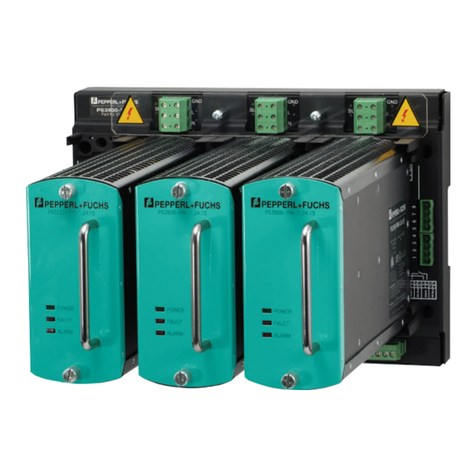
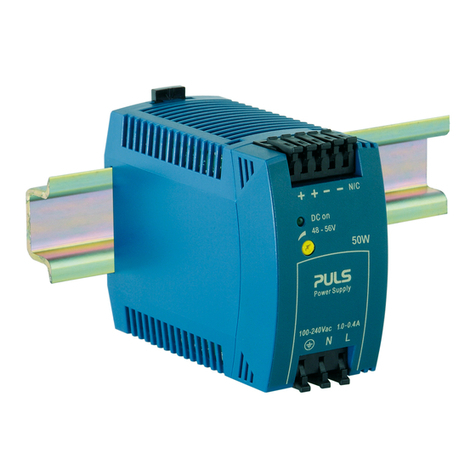
The PS1550 system equipped with two Line Modules can be powered by two separate voltages (Line1 and Line 2)
and its particular type of redundancy permits dealing with the loss of one of the lines without affecting output..
The possibility of having an alternating or continuous current , makes the system highly flexible leaving the user the
possibility of selecting the best strategy to employ.
Various cases are possible:
A) ONE ALTERNATING CURRENT INPUT
In order to have a reliable system the power line must be furnished with a UPS unit to guarantee redundancy of
line Modules, Line1 and Line 2 must be connected in parallel to mains.
B) TWO STANDARD ALTERNATING CURRENT INPUTS
This is a low cost solution and is very easy to carry out: it simply requires connecting two power lines; so that if
one line fails, the second automatically fulfills all power requirements.
The two power lines must originate from two separate power sources so that if one fails it does not provoke the
additional consequent loss of the other.
If the probability and duration of one line loss is low for both inputs, it is easy to assume that the contempora-
neous loss of both inputs would be an improbable event and therefore system reliability is at any rate guaran-
teed.
C) STANDARD ALTERNATING CURRENT AND EMERGENCY ALTERNATING CURRENT
(OR UPS) INPUT
This solution utilizes standard alternating current as well as an emergency power source (it must be activated
within 10ms from the loss of the power line or must be an uninterruptible type –UPS-). In order to avoid having
the UPS line under permanent charge, its voltage output must always remain slightly below (a few volts) that of
the main line so that it does not supply current under normal conditions.
This set up is more costly than A) due to the fact that it has a truly independent source, but is certainly more
practical and safe.
If the line is not a UPS type, make sure that maximum intervention time does not exceed 10 ms in order to avoid
‘glitches’ or transitory output losses.
D) STANDARD ALTERNATING CURRENT (115 Vac) AND DIRECT CURRENT BUFFER
(BATTERY at 110 Vdc)
This solution utilizes standard alternating current at 115 Vac which normally powers the system, and an emer-
gency direct current system (system with buffer battery at 110 Vdc) which intervenes in case of loss of main li-
ne.
This set up is cheaper than B) and offers equal or even more reliability.
The battery system must be such as to permit 24 V output for at least 20 minutes for maximum power (20 minu-
tes is generally an acceptable time to carry out emergency procedures).
In all cases analyzed the loss of one line is signaled via alarm relay mounted on respective line Module.