manuals.online logo
Brands
  1. Home
  2. •
  3. Brands
  4. •
  5. RITE-HITE
  6. •
  7. Lock
  8. •
  9. RITE-HITE DOK-LOK VBR-300M User manual

RITE-HITE DOK-LOK VBR-300M User manual

Other RITE-HITE Lock manuals

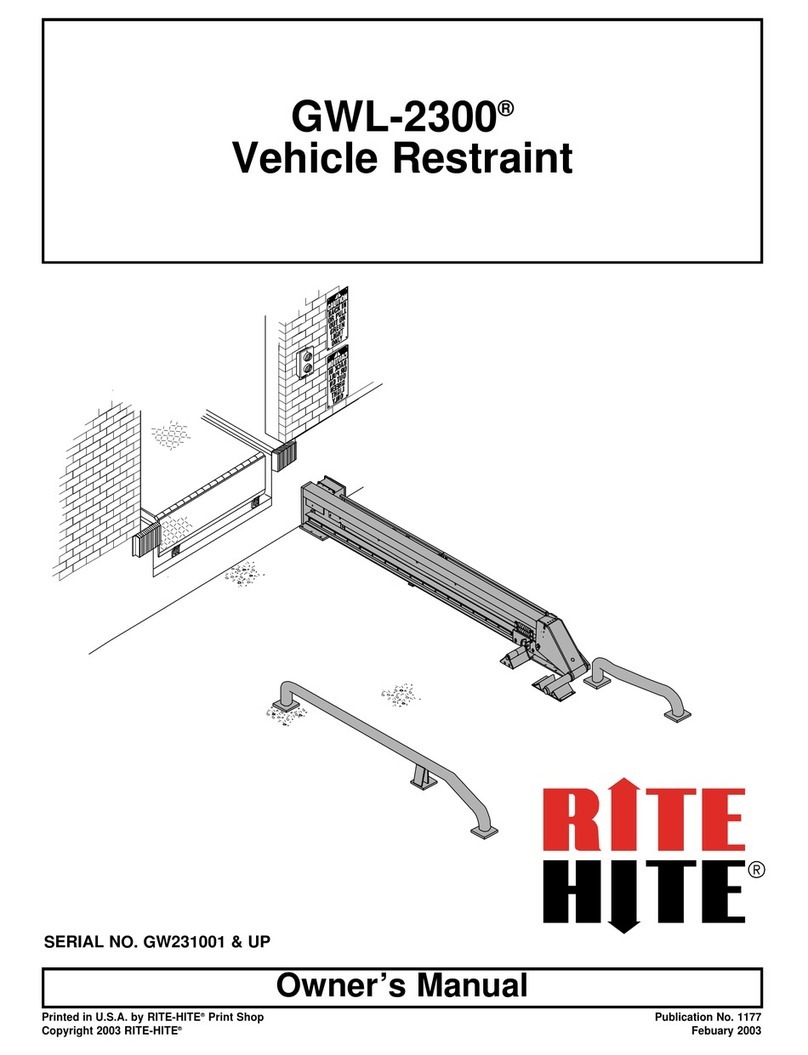
RITE-HITE Wheel-Lok GWL-2300 User manual

RITE-HITE

RITE-HITE Wheel-Lok GWL-2300 User manual

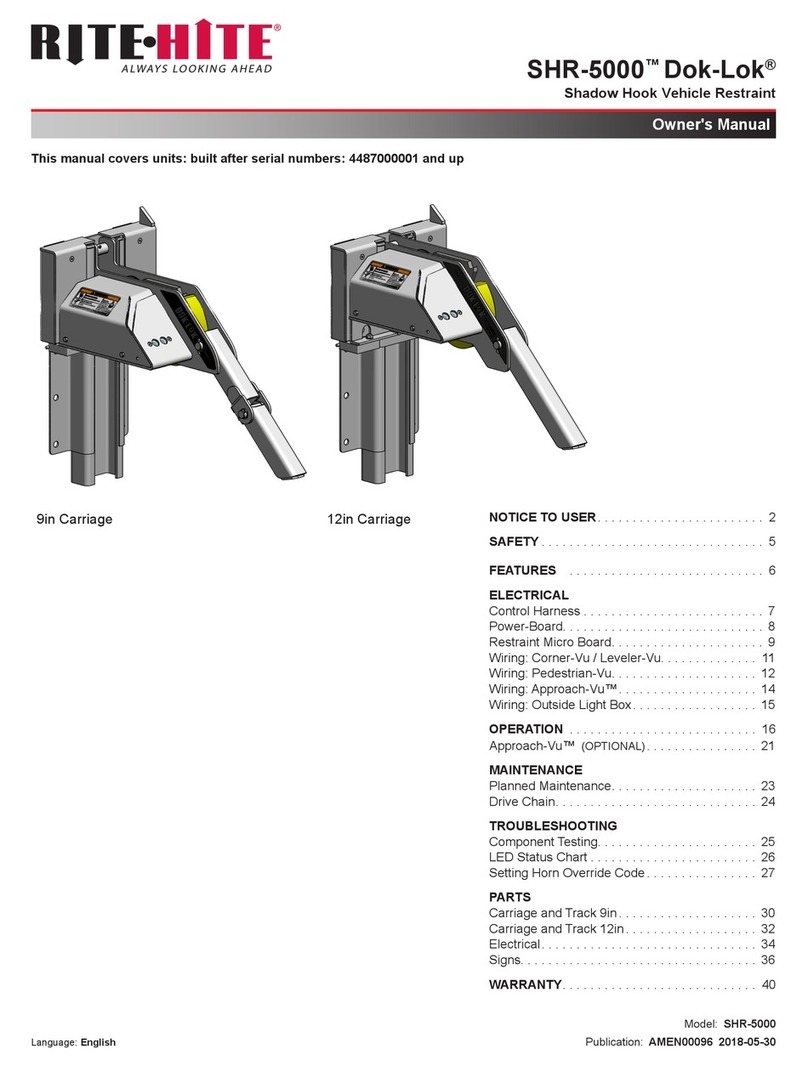
RITE-HITE Dok-Lok SHR-5000 User manual

RITE-HITE

RITE-HITE Dok-Lok SHR-5000 User manual

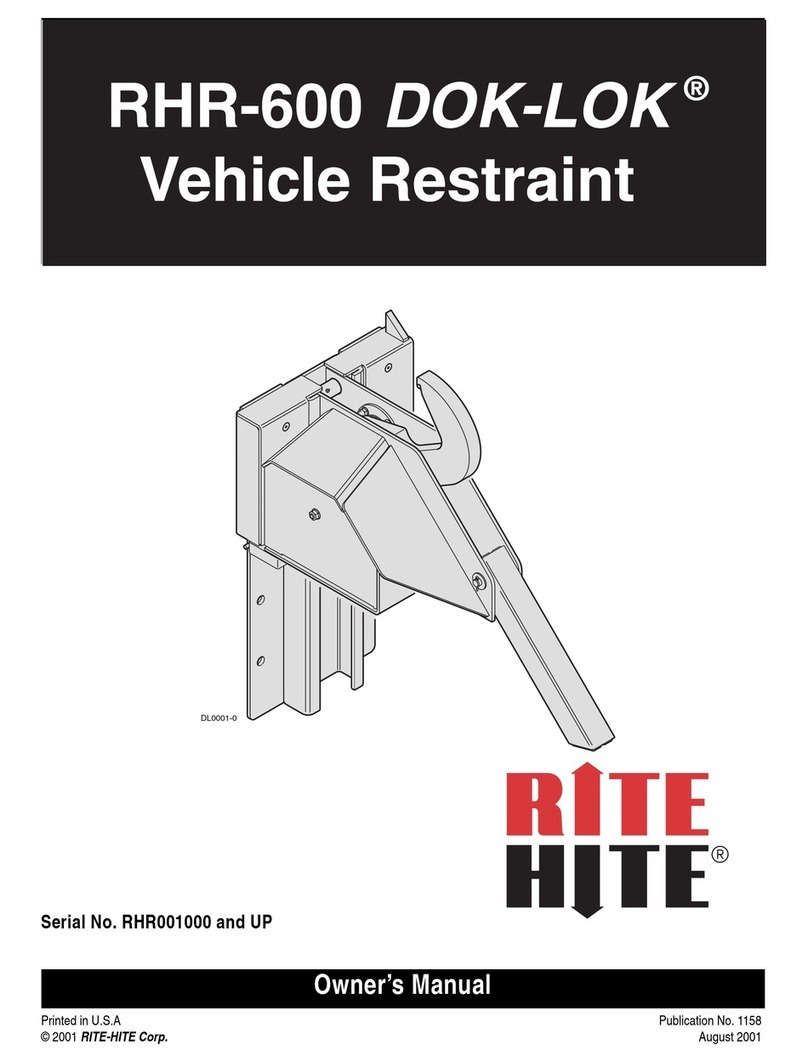
RITE-HITE DOK-LOK RHR-600 User manual

RITE-HITE

RITE-HITE DOK-LOK RHR-600 User manual

Popular Lock manuals by other brands

Magic 105 manual

Magic

Magic 105 manual

Gantner GAT NET.Lock 7020 System Installation, configuration & operation

Gantner

Gantner GAT NET.Lock 7020 System Installation, configuration & operation

Dorma Studio Classic Installation instruction

Dorma

Dorma Studio Classic Installation instruction

Securam ECSL-601 quick start guide

Securam

Securam ECSL-601 quick start guide

Sudhaus 3003 operating manual

Sudhaus

Sudhaus 3003 operating manual

Safety 1st 48517 user guide

Safety 1st

Safety 1st 48517 user guide

Pado FDS-10 user manual

Pado

Pado FDS-10 user manual

Esco systeQ Series installation instructions

Esco

Esco systeQ Series installation instructions

COMPX National D8951 instruction sheet

COMPX

COMPX National D8951 instruction sheet

secureo Key Box instruction manual

secureo

secureo Key Box instruction manual

Stock Loks C8713 instruction sheet

Stock Loks

Stock Loks C8713 instruction sheet

COMPX 1T-058 Information

COMPX

COMPX 1T-058 Information

Auslock T11 user manual

Auslock

Auslock T11 user manual

Stealth SAFES ShadowVault Instructions & Troubleshooting

Stealth SAFES

Stealth SAFES ShadowVault Instructions & Troubleshooting

Knox KeySecure 5 Admin & user guide

Knox

Knox KeySecure 5 Admin & user guide

Kwikset 48334/01 Quick installation guide

Kwikset

Kwikset 48334/01 Quick installation guide

Metra Electronics Door Access Terminal Combo Technical manual

Metra Electronics

Metra Electronics Door Access Terminal Combo Technical manual

Kilitronik miniK10m operating manual

Kilitronik

Kilitronik miniK10m operating manual

manuals.online logo
manuals.online logoBrands
  • About & Mission
  • Contact us
  • Privacy Policy
  • Terms and Conditions

Copyright 2025 Manuals.Online. All Rights Reserved.

Vehicle Restraint
Owner’s Manual
This Manual Covers Restraints Built After Serial Numbers:
VB3001000 and up
PRINTED IN U.S.A.
RITE-HITE PRINT SHOP
PUBLICATION NO. 1168
AUGUST 2016
VBR-300M Dok-Lok®
MADE IN U.S.A.
RITE-HITE®VBR-300MNL DOK-LOK®Owner’s Manual
2 Pub. No. 1168 - August 2016
RITE-HITE®VBR-300MNL DOK-LOK®Owner’s Manual
Pub. No. 1168 - August 2016 3
Table Of Contents
Safety Warnings . . . . . . . . . . . . . . . . . . . . . . . . . . . . . . .4
FCC Compliance . . . . . . . . . . . . . . . . . . . . . . . . . . . . . . .5
Owner Responsibility . . . . . . . . . . . . . . . . . . . . . . . . . . . . .6
Denition and Function . . . . . . . . . . . . . . . . . . . . . . . . . . . .7
Features . . . . . . . . . . . . . . . . . . . . . . . . . . . . . . . . . . 7
Operating Procedures . . . . . . . . . . . . . . . . . . . . . . . . . . . . .9
Maintenance . . . . . . . . . . . . . . . . . . . . . . . . . . . . . . . 13
Electrical Schematic. . . . . . . . . . . . . . . . . . . . . . . . . . . . . 20
Replacement Parts . . . . . . . . . . . . . . . . . . . . . . . . . . . . . 22
INTRODUCTION
The VBR-300MNL DOK-LOK vehicle restraint by Rite-Hite®is intended to provide a safer workplace for workers in
shipping and receiving dock areas. The VBR-300MNL DOK-LOK vehicle restraint is a manually activated restraint device
that, when properly installed and operated, retains a secure connection between the truck and dock. Signal lights, warning
horn and signs provide instructions to the truck driver and DOK-LOK vehicle restraint operator that a safe condition exists.
The DOK-LOK vehicle restraint is operated by lifting or lowering the barrier with an operating bar.
PRODUCT SPECIFIC WARRANTY
RITE-HITE Company, LLC and its a󰀩liates (collectively “RITE-HITE”) warrants to the owner (“Owner”) that the
VBR-300MNL Dok-Lok®Vehicle Restraints by Rite-Hite®sold to the Owner will be free of defects in design, materials and
workmanship (ordinary wear and tear excepted) for a period of 1 year parts and labor.
IMPORTANT
Read and understand contents of this manual prior to installation or operation of this equipment.
For best results, have this product serviced by your authorized Rite-Hite®representative.
NOTICE TO USER
Your local Rite-Hite® representative provides a Planned Maintenance Program (P.M.P.) which can be tted to your specic
operation. Call your local representative or Rite-Hite®at 414-355-2600.
The Rite-Hite products in this manual are covered by one or more of the following U.S. patents: 5882167, 6065172,
6070283, 6085375, 6092970, 6106212, 6116839, 6190109, 6276016, 6311352, 6318947, 6322310, 6360394, 6368043,
6431819, 6488464, 6524053, 6726432, 6773221, 6832403, 6880301, 7032267, 7062814, 7213285, 7216391, 7363670,
7380305, 7503089, 7533431, 7546655, 7584517, 7681271, 7823239, 7841823, 7877831, 7914042, 8006811, 8065770,
8141189, 8191194, 8286757, 8287223, 8303235, 8307956, 8443474, 8464384, 8464846, 8465245, 8497761, 8499897,
8544130, 8547234, 8590087, 8590673, 8616826, 8657551, 8662535, 8678736, 8690087, 8905198, 9010501, 9096170,
9096397, 9126775, 9139384, 9145273, 9150367, 9174811, 9227799, 9230419 and pending U.S and foreign patent
applications. RITE-HITE®, THINMANTM, SAFE-T-LIP®, HYDRACHEK®, WHEEL-LOKTM, DOK-LOK®, DUAL-DOK®,
SAFE-T-STRUTTM, DOK-COMMANDER®, JUMBOTM, HYDRA-RITETM, SAFE-T-GATE®, RITE-VUTM LIGHT
COMMUNICATION SYSTEM and SMOOTH TRANSITION DOK SYSTEMTM, are trademarks of Rite-Hite®.
RITE-HITE®VBR-300MNL DOK-LOK®Owner’s Manual
4 Pub. No. 1168 - August 2016
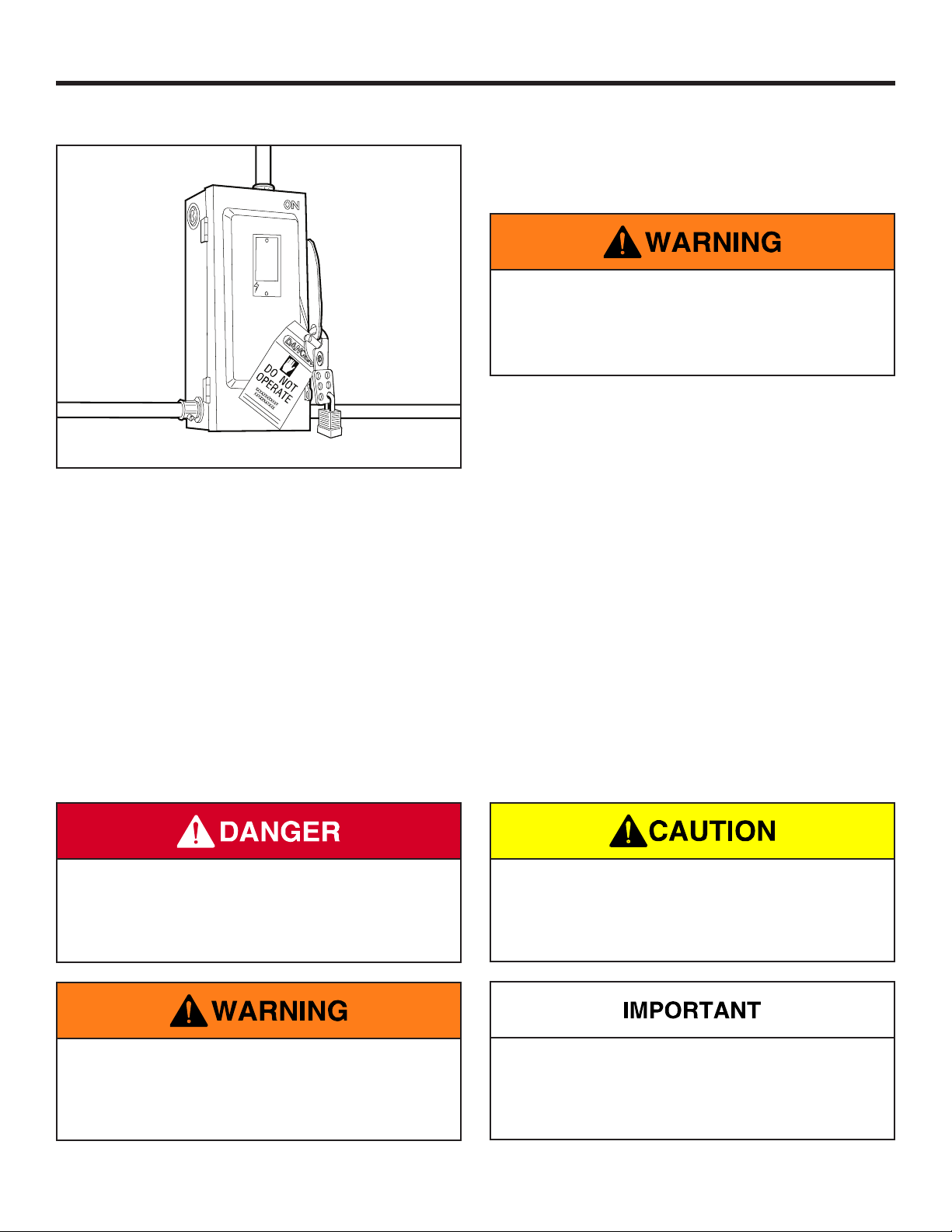
FIGURE 1 - LOCKOUT/TAGOUT
LOCKOUT/TAGOUT PROCEDURES
The Occupational Safety and Health Administration requires that, in addition to posting safety warnings and barricading
the work area, the power supply has been locked in the OFF position or disconnected. It is mandatory that an approved
lockout device is utilized. An example of a lockout device is illustrated. The proper lockout procedure requires that the
person responsible for the repairs is the only person who has the ability to remove the lockout device.
In addition to the lockout device, it is also a requirement to tag the power control in a manner that will clearly note that
repairs are under way and state who is responsible for the lockout condition. Tagout devices have to be constructed and
printed so that exposure to weather conditions or wet and damp locations will not cause the tag to deteriorate or become
unreadable.
RITE-HITE®Corporation does not recommend any particular lockout device, but recommends the utilization of an
OSHA approved device (refer to OSHA regulation 1910.147). RITE-HITE®Corporation also recommends the review
and implementation of an entire safety program for the Control of Hazardous Energy (Lockout/Tagout). These
regulations are available through OSHA publication 3120.
This is the highest level statement. Failure to
follow the listed instructions will most likely result
in severe injury or death.
The statements used with this level of
warning deal with a safe operating
procedure. If the procedure is ignored, the
possibility of personal injury may exist.
IMPORTANT is used to draw attention
to a procedure that needs to be followed to prevent
machine or property damage.
When working with electrical or electronic controls,
make sure that the power source has been locked
out and tagged according to OSHA regulations and
approved local electrical codes.
SAFETY WARNINGS
This is a statement of serious hazard. Failure
to follow the listed instructions could place the
individual at risk of serious injury or death.
RITE-HITE®VBR-300MNL DOK-LOK®Owner’s Manual
Pub. No. 1168 - August 2016 5
FCC COMPLIANCE
FCC COMPLIANCE
NOTE: This equipment has been tested and found to
comply with the limits for a Class A digital device,
pursuant to Part 15 of the FCC Rules. These limits
are designed to provide reasonable protection
against harmful interference when the equipment
is operated in a commercial environment. This
equipment generates, uses, and can radiate
radio frequency energy and, if not installed
and used in accordance with the instruction
manual, may cause harmful interference to radio
communications. Operation of this equipment
in a residential area is likely to cause harmful
interference in which case the user will be required
to correct the interference at his or her own
expense.
NOTE: Changes or modications not expressly approved
by the party responsible for compliance could void
the user’s authority to operate the equipment.
This device complies with Part 15 of the FCC Rules.
Operation is subject to the following to conditions: (1) This
device may not cause harmful interference, and (2) this
device must accept any interference received, including
interference that may cause undesirable operation.
RITE-HITE®VBR-300MNL DOK-LOK®Owner’s Manual
6 Pub. No. 1168 - August 2016
OWNER RESPONSIBILITY
1. The owner should recognize the inherent danger of
the interface between dock and transport vehicle. The
owner should, therefore, train and instruct operators
in the safe use of dock equipment in accordance with
the information provided below. The manufacturer shall
publish, provide to the initial purchaser, and make the
following information readily available to owners:
• Installation instructions
• Recommended initial and periodic inspections
procedures
• Maintenance procedures
• Operating instructions
• Descriptions or specications for replaceable or
repairable parts
• Tables identifying the grade (slope) for all variations
of length or conguration of the dock equipment,
and
• Information identifying the maximum uncontrolled
drop encountered upon sudden removal of support
while within the working range of the equipment.
It shall be the responsibility of the owner to verify that
the material listed in this section has been received
and that it is made available for the instruction
and training of presonnel entrusted with the use or
maintenance of the dock equipment.
2. When a transport vehicle is parked at a loading dock, it
is important that the vehicle is relatively perpendicular
to the dock face and in close contact with at least one
of the dock bumpers.
3. Nameplates, cautions, instructions, and posted
warnings shall not be obscured from the view of
operating or maintenance personnel for whom such
warnings are intended.
4. Manufacturer’s recommended periodic maintenance
and inspection procedures in e󰀨ect at date of
shipment shall be followed, and written records of the
performance of these procedures should be kept.
5. As with any piece of machinery, dock equipment
requires routine maintenance, lubrication, and
adjustments. Your local Rite-Hite representative o󰀨ers
owners the option of a Planned Maintenance Program
(P.M.P.). As part of this service, your local Rite-
Hite representative will do all routine maintenance,
lubrication, and adjustments.
6. Dock equipment that is structurally damaged shall be
removed from service, inspected by a manufacturer’s
authorized representative, and repaired as needed
before being placed back in service.
7. The manufacturer shall make available replacement
nameplates, caution/instruction labels, and operating/
maintenance manuals upon request of the owner. The
owner shall see that all nameplates, caution/instruction
markings or labels are in place and legible, and that
the appropriate operating/maintenance manuals are
provided to users.
8. Modications or alterations of dock equipment shall
be made only with written permission of the original
manufacturer. These changes shall also satisfy all
safety recommendations of the original equipment
manufacturer for the particular application of the dock
equipment.
9. In order to be entitled to the benets of the standard
product warranty, the dock equipment must have been
properly installed, maintained and operated within its
rated capacities and/or specic design parameters,
and not otherwise abused.
10. It is recommended that trailers equipped with air
ride suspensions should remove the air from the
suspension to minimize trailer bed drop, prior to
loading or unloading.
11. When industrial trucks are driven on and o󰀨 transport
vehicles during the loading and unloading operation,
the brakes on the transport vehicle shall be applied
and wheel chocks or a positive restraining device shall
be engaged.
12. It is recommended that an adequate stabilizing device
or devices be employed at the front of the trailer in all
cases where a trailer is being loaded or unloaded with
the trailer resting on its support legs (landing gear)
rather than a tractor fth wheel or a converter dolly.
13. In selecting dock equipment, it is important to consider
not only present requirements but also future plans or
adverse environments.

RITE-HITE®VBR-300MNL DOK-LOK®Owner’s Manual
Pub. No. 1168 - August 2016 7
DEFINITION AND FUNCTION FEATURES
The VBR-300ALP DOK-LOK vehicle restraint is a manually
activated, ground stored restraint device used to secure trucks
and semi-trailers with an intact Rear Impact Guard (R.I.G.) to the
face of a loading dock. This is achieved by securing the R.I.G.
with a steel barrier positioned by a gas spring. This prevents
forward movement of the truck/trailer that may create an unsafe
void between the face of the dock and the rear end of the truck/
trailer as a forklift travels from the loading dock onto the trailer; or
to create an obstruction noticeable to the truck driver, should the
driver accidentally try to pull the truck/trailer away while it is being
serviced.
The proper or improper activation of the barrier is monitored by:
• VISUAL CONTROL
— One set of ashing green or red lights located at the
inside of the building for the forklift operator, and one
set located outside of the building for the truck driver. In
addition to the lights, there are three instruction signs.
• AUDIO CONTROL
— A horn will sound at the inside of the building, warning
the forklift operator if there is no R.I.G. present, or if the
engagement is improper. In this case, the trailer must
be secured by other means (wheel chocks, etc.) prior to
servicing trailer.
Prerequisite for proper barrier engagement is that the trailer is
parked rmly against a 4” (trade standard) thick dock bumper.
The activation/deactivation is solely controlled from the inside of
the building by momentarily depressing either the Lock (raise)
button or the Unlock (lower) button.
The normal mode of the barrier is in the lower STORED
position, showing a ashing red light (trailer not secured) at the
inside of the building and a ashing green light (trailer free to
move to or away from the loading dock) at the outside of the
building.
Once the trailer is parked, the dock attendant will lift the barrier
with the operating bar. This will raise the barrier to engage the
R.I.G. As soon as the R.I.G. is properly locked, there will be
simultaneous light change — the inside will change from red to
green ashing (trailer secured) and the outside will change from
green to red ashing (do not move trailer). After the service is
completed, the dock attendant will have to lower the barrier with
the operating bar to its stored position and press the UNLOCK
button to change the lights. A proper barrier engagement is
achieved when the barrier raises unobstructed to secure the
horizontal cross member of the R.I.G. Assembly. An improper
barrier engagement is if the horizontal cross member of the
R.I.G. is missing, obstructed or it is bent or located so far toward
the rear axle of the trailer that it will prevent the free passage of
the barrier. In either case, the lights will stay in a non-serviceable
mode and a horn will sound. At this point, the trailer must be
secured by other means (example: wheel chocks) in order to
become serviceable.
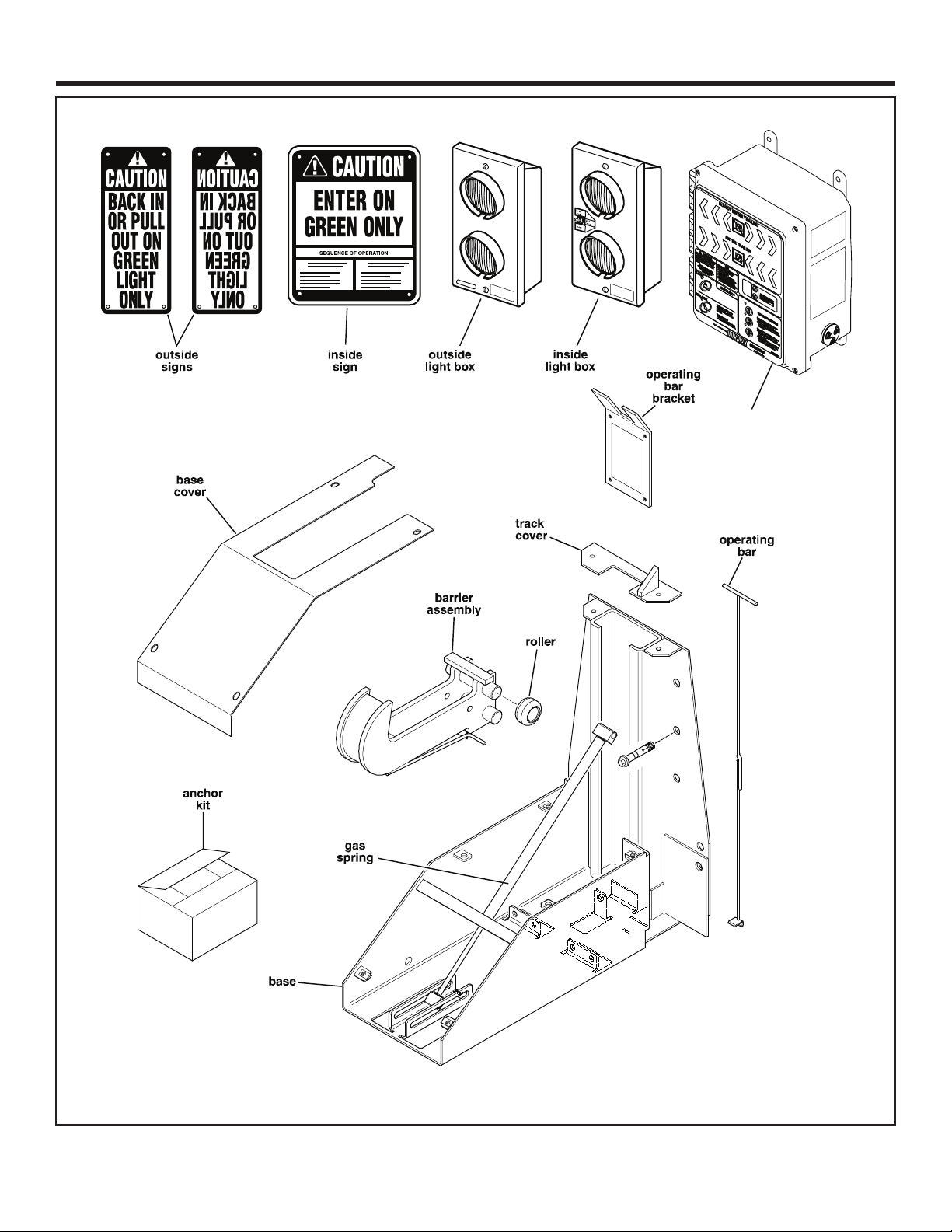
Refer to Figure 2, page 8 for locations of these features:
R.I.G.
Acronym used for the Federally mandated rear impact guard
located on the rear of over the road trailers to prevent accidental
underride by automobiles.
ROLLER TRACK ASSEMBLY
Mounted to the loading dock wall to guide the barrier assembly
in a vertical plane and transmit the creep or pull out force from a
trailer to the loading dock wall.
BARRIER ROLLER ASSEMBLY
Comprised of a steel roller housing, a pre-lubricated needle
bearing to allow easy movement of the barrier assembly.
GAS SPRING
Keeps barrier assembly in constant contact with the R.I.G.
R.I.G. SENSOR
Detects when the barrier is secured to the R.I.G.
BARRIER ASSEMBLY
Secures R.I.G. to prevent trailer from rolling/creeping away from
the dock.
BASE COVER
Protects the barrier assembly, oat mechanism, hydraulic hoses
and lift cylinder from debris.
TRACK COVER WITH INTEGRAL LIP GUIDE
Keeps debris out of the roller track. Integral lip guide is used to
guide the lip past the roller track assembly in a below dock end
load condition.
CONTROL BOX, OUTSIDE LIGHT BOX AND SIGNAGE
Combination of these components is used to provide audio/visual
communications to the dock attendant and trailer driver.
OPERATING BAR AND BRACKET
Used to position the barrier assembly from inside of building.
Bracket provides storage for Operating Bar while not in use.
RITE-HITE®VBR-300MNL DOK-LOK®Owner’s Manual
8 Pub. No. 1168 - August 2016
VBR-300ALP
control
box
FIGURE 2 - VBR-300MNL DOK-LOK VEHICLE RESTRAINT FEATURES
RITE-HITE®VBR-300MNL DOK-LOK®Owner’s Manual
Pub. No. 1168 - August 2016 9
• Before loading or unloading a vehicle at your
loading dock while using a DOK-LOK vehicle
restraint, always visually inspect to be sure
that the barrier blocks the R.I.G. assembly. If
a condition occurs that cannot be remedied
by backing the trailer rmly against the dock
bumpers, secure the trailer by other means.
• Be sure that the area around the R.I.G. assembly
is free of plates or other obstructions.
• Always operate the DOK-LOK vehicle restraint
from the top of the dock.
• Inspect all restraint lights daily to make certain
they work properly.
• Perform maintenance on restraints in
accordance with Maintenance section in this
manual.
• DOK-LOK vehicle restraints should be operated
only by authorized personnel who have read
and understand the Owner’s Manual.
• Call your local representative or Rite-Hite at
(800) 456-0600 with any questions.
FAILURE TO FOLLOW THESE PROCEDURES COULD
ALLOW UNEXPECTED TRAILER / LOADING DOCK
SEPERATION RESULTING IN DEATH OR SERIOUS
INJURY!
Stored Position / Restraint UNLOCKED
Barrier is in the STORED position. Inside light is ashing
red alerting forklift operator unsafe condition exists.
Outside light is ashing green alerting truck driver it is safe
to back in.
OPERATING PROCEDURES
Outside Lights
OUTSIDE LIGHT
STATUS
Inside Lights
CONTROL BOX
STATUS
RESTRAINT POSITION
RED
GREEN
OUTSIDE LIGHTS
Checkoutside lights when
bothLEDs are o.
UNLOCK
LOCK
HORN OVERRIDE
DOK-LOK®
DO NOT ENTER TRAILER
ENTER TRAILER
Visually inspect before loading/
unloading vehicle. DOK-LOK
hook must secure rear impact
guard. See warnings on side
panel.
Additional warning labels,
manuals and other information
are available by calling:
1-800-456-0600
If red light is on and/or horn
sounds, DOK-LOK is not
properly engaged.
Check operation of DOK-LOK.
Vehiclemay not be against dock.
R.I.G. may not be compatible.
Hook travel may be obstructed.
Before using "HORN OVERRIDE,"
secure vehicle by other means.
FIGURE 3 - STORED POSITION
RITE-HITE®VBR-300MNL DOK-LOK®Owner’s Manual
10 Pub. No. 1168 - August 2016
Restraint Locking, LOCK Button Pressed
Trailer has backed into loading dock and is parked rmly
against dock bumpers. Operator lifts barrier by hooking
beneath the barrier pull out bar with the operating bar.
Inside light is ashing red and horn is pulsing, alerting the
operator that an unsafe condition exists and barrier is in
transit. Outside light is ashing red alerting truck driver not
to move. If R.I.G. cannot be captured, go to Hook Fault
State.
Restraint LOCKED
Once the R.I.G. is obstructed by the barrier, a LOCKED
condition exists. Inside light is ashing green alerting the
forklift operator a safe condition exists. Outside light is
ashing red alerting truck driver not to move.
If during loading/unloading the inside light turns red and
the horn sounds, go to Hook Fault State.
Operating Bar
OUTSIDE LIGHT
STATUS
CONTROL BOX
STATUS
RESTRAINT POSITION
Outside Lights
Inside Lights
RED
GREEN
OUTSIDE LIGHTS
Checkoutside lights when
bothLEDs are o.
UNLOCK
LOCK
HORN OVERRIDE
DOK-LOK
®
DO NOT ENTER TRAILER
ENTER TRAILER
Visually inspect before loading/
unloading vehicle. DOK-LOK
hook must secure rear impact
guard. See warnings on side
panel.
Additional warning labels,
manuals and other information
are available by calling:
1-800-456-0600
If red light is on and/or horn
sounds, DOK-LOK is not
properly engaged.
Check operation of DOK-LOK.
Vehiclemay not be against dock.
R.I.G. may not be compatible.
Hook travel may be obstructed.
Before using "HORN OVERRIDE,"
secure vehicle by other means.
FIGURE 4 - RESTRAINT LOCKING
Visually inspect to ensure that the DOK-LOK barrier
obstructs the R.I.G. of the trailer being serviced
before operating the dock leveler.
OUTSIDE LIGHT
STATUS
CONTROL BOX
STATUS
RESTRAINT POSITION
Outside Lights
Inside Lights
RED
GREEN
OUTSIDE LIGHTS
Checkoutside lights when
bothLEDs are o.
UNLOCK
LOCK
HORN OVERRIDE
DOK-LOK®
DO NOT ENTER TRAILER
ENTER TRAILER
Visually inspect before loading/
unloading vehicle. DOK-LOK
hook must secure rear impact
guard. See warnings on side
panel.
Additional warning labels,
manuals and other information
are available by calling:
1-800-456-0600
If red light is on and/or horn
sounds, DOK-LOK is not
properly engaged.
Check operation of DOK-LOK.
Vehiclemay not be against dock.
R.I.G. may not be compatible.
Hook travel may be obstructed.
Before using "HORN OVERRIDE,"
secure vehicle by other means.
FIGURE 5 - RESTRAINT LOCKED