manuals.online logo
Brands
  1. Home
  2. •
  3. Brands
  4. •
  5. Sharp
  6. •
  7. Portable Stereo System
  8. •
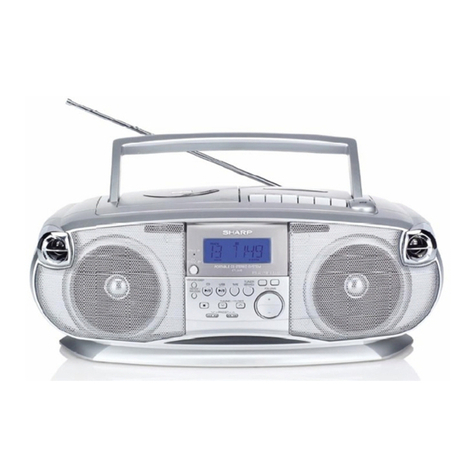
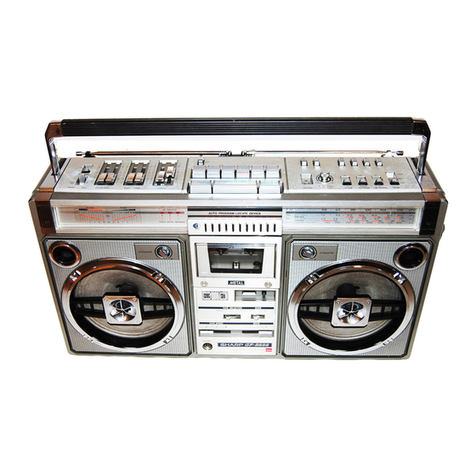
  9. Sharp GF-9000H User manual

Sharp GF-9000H User manual

This manual suits for next models

1

Other Sharp Portable Stereo System manuals

Sharp WF-2100W User manual

Sharp

Sharp WF-2100W User manual

Sharp ZC-D830H User manual

Sharp

Sharp ZC-D830H User manual

Sharp GF-780H User manual

Sharp

Sharp GF-780H User manual

Sharp GF-9696 User manual

Sharp

Sharp GF-9696 User manual

Sharp QT-UH4H User manual

Sharp

Sharp QT-UH4H User manual

Sharp GF-320A User manual

Sharp

Sharp GF-320A User manual

Sharp GF-777 Installation instructions

Sharp

Sharp GF-777 Installation instructions

Sharp GF-800HS User manual

Sharp

Sharp GF-800HS User manual

Sharp WF-5000W User manual

Sharp

Sharp WF-5000W User manual

Sharp WQ-740W User manual

Sharp

Sharp WQ-740W User manual

Sharp GX-BT9H User manual

Sharp

Sharp GX-BT9H User manual

Sharp GF-4646 User manual

Sharp

Sharp GF-4646 User manual

Sharp GX-M10 (OR) User manual

Sharp

Sharp GX-M10 (OR) User manual

Sharp GF-320A User manual

Sharp

Sharp GF-320A User manual

Sharp GX-BT9 User manual

Sharp

Sharp GX-BT9 User manual

Sharp WQ-740W User manual

Sharp

Sharp WQ-740W User manual

Sharp GX-M10H(OR) User manual

Sharp

Sharp GX-M10H(OR) User manual

Sharp QT-CD70H System manual

Sharp

Sharp QT-CD70H System manual

Sharp Auvi SD-FX10 User manual

Sharp

Sharp Auvi SD-FX10 User manual

Sharp GF-800Z User manual

Sharp

Sharp GF-800Z User manual

Sharp QT-UH5H User manual

Sharp

Sharp QT-UH5H User manual

Sharp WF-940H User manual

Sharp

Sharp WF-940H User manual

Sharp WF-T380H User manual

Sharp

Sharp WF-T380H User manual

Sharp WF-A500H User manual

Sharp

Sharp WF-A500H User manual

Popular Portable Stereo System manuals by other brands

KEF KEF picoforte Stereo System I instructions

KEF

KEF KEF picoforte Stereo System I instructions

Blaupunkt BB31LED owner's manual

Blaupunkt

Blaupunkt BB31LED owner's manual

Memorex MP3441 instruction manual

Memorex

Memorex MP3441 instruction manual

auna 10032045 manual

auna

auna 10032045 manual

Panasonic RXDS520 - RADIO CASSETTE W/CD operating instructions

Panasonic

Panasonic RXDS520 - RADIO CASSETTE W/CD operating instructions

Philips AZ305 user manual

Philips

Philips AZ305 user manual

Manta BBX002 user manual

Manta

Manta BBX002 user manual

Sony ZS-BTG900 operating instructions

Sony

Sony ZS-BTG900 operating instructions

Memcorp Disney DB3000-P user guide

Memcorp

Memcorp Disney DB3000-P user guide

Philips AZ 2760 user manual

Philips

Philips AZ 2760 user manual

Philips AZ202C null

Philips

Philips AZ202C null

Hyundai H-1443 instruction manual

Hyundai

Hyundai H-1443 instruction manual

Sony ZS-S10CP instruction & operation manual

Sony

Sony ZS-S10CP instruction & operation manual

LG SB159ST owner's manual

LG

LG SB159ST owner's manual

Sony HCD-E301 Service manual

Sony

Sony HCD-E301 Service manual

Panasonic SCSP100 - COMPACT STEREO SYSTEM operating instructions

Panasonic

Panasonic SCSP100 - COMPACT STEREO SYSTEM operating instructions

RCA RP-7987 user guide

RCA

RCA RP-7987 user guide

AudioSonic 42373117 user manual

AudioSonic

AudioSonic 42373117 user manual

manuals.online logo
manuals.online logoBrands
  • About & Mission
  • Contact us
  • Privacy Policy
  • Terms and Conditions

Copyright 2025 Manuals.Online. All Rights Reserved.

HARP
SERVICE
MANUAL
/SERVICE-ANLEITUNG/
MANUEL
DE
SERVICE
—
DC
ocevsvsrem]
©
*
Noise
reduction
system
manufactured
under
license
from
Dolby
Laboratories
Licensing
Corporation.
“Dolby’'
and
the
double-O
symbol
are
trademarks
of
Dolby
Laboratories
Licensing
Corporation.
»
Gerauschunterdriickungssystem
unter
Lizenz
von
Dolby
Labor-
atories
Licensing
Corporation
hergestellt.
Das
Wort
“Dolby’’
und
das
Symboi
des
doppelten
D
sind
die
Markenzeichen
von
Dolby
Laboratories
Licensing
Corporation.
*
Circuit
de
réduction
des
bruits
fabriqué
sous
licence
des
Dolby
Laboratories
Licensing
Corporation.
Le
mot
“Dolby”
et
le
symbole
Double
D
sont
les
marques
de
fabrique
des
Dolby
Laboratories
Licensing
Corporation.
Caution!
leadless
parts.
Consult
pages
18
and
23
without
fail
before
replacing
them.
Vorsicht!
Durch
Anwendugn
der
neuesten
Technologien
werden
ftir
dieses
Geradt
leitungslose
Teile
verwendet.
Unbedingt
auf
die
Seite
18
und
23
Bezug
nehmen,
bevor
diese
ausgewechselt
werden.
Attention!
Utilisant
la
technologie
ia
plus
avancée,
cet
appareil
utilise
des
piéces
sans
plomb.
Consulter
sans
faute
les
pages
18,
23,
|
avant
les
remplacer.
Under
the
employment
of
latest
technologies
this
set
uses
|
ATSM282032RCS
GF-9000H
GF-9000E
+
In
the
interests
of
user-safety
the
set
should
be
restored
to
is
|
Original
condition
and
only
parts
identical
to
those
specified
be
used,
7
«Im
Interesse
der
Benutzer-Sicherheit
solite
dieses
Geradt
wieder
auf
seinen
urspriinglichen
Zustand
eingestellt
und
nur
die
vorgeschriebenen
Teile
verwendet
werden.
*
Dans
l‘intérét
de
la
sécurité
de
l'utilisateur,
l'apparei)
devra
étre
reconstitué
dans
sa
condition
premiére
et
seules
des
piéces
identiques
a
celles
spécifiées,
doivent
étre
utilisées.
Note
for
users
in
UK:
Recording
and
playback
of
any
material
may
require
consent
which
SHARP
are
unable
to
give.
Please
refer
particularly
to
the
provisions
of
Copyright
Act
1956,
the
Dramatic
and
Musical
Performers
Protection
Act
1958,
the
Performers
Protection
Acts
1963
and
1972
and
to
any
subsequent
statutory
enactments
and
orders.
*
For
the
adjustment
of
the
radio
(high
frequency)
circuit,
refer
to
“GENERAL
ALIGNMENT
INSTRUCTION”
in
the
GF-777H
Service
Manual.
*
Einzelheiten
Uber
die
Ejinstellung
der
Radio
(Hochfrequenz)-
Schaltung
sind
im
Abschnitt
“ALLGEMEINE
ABGLEICHAN-
LEITUNG”
der
Service-Anleitung
fir
GF-777H
angegeben.
*
Pour
le
réglage
du
circuit
radio
(haute
fréquence),
voir
les
‘‘Instruc-
tions
générales
pour
I’alignement’’
dans
le
“Manuel
de
service’
du
GF-777H.
SHARP
CORPORATION
OSAKA,
JAPAN
GF-9000H
GF-S000E
GB
FOR
A
COMPLETE
DESCRIPTION
OF
THE
OPERATION
OF
THIS
UNIT,
PLEASE
REFER
TO
THE
OPERATION
MANUAL.
INDEX
TO
CONTENTS
SPECIFICATIONS
.............00000
eee
eeee
2,3
INFORMATION
OF
LEADLESS
TYPE
RESISTORS,
NAMES
OF
PARTS
..............00000e0
ee
4,5
CAPACITORS
&
JUMPERS
.............
18
~
23
SUPPLY
VOLTAGE
.................0..0005
4,5
NOTES
ON
SCHEMATIC
DIAGRAM
........
24~
26
DIAL
CORD
STRINGING
.....................
6
SCHEMATIC
DIAGRAM
...............
27,
28,
33
AC
POWER
SUPPLY
CORD
.................-.
6
WIRING
SIDE
OF
PRINTED
WIRING
DISASSEMBLY
seg
and
36
atl
siete
eset
ed
ova
eh
ane
7~
10
BOARD
.............-0--
cece
eee
29
~
32
34
BLOCK
DIAGRAM
................000005
11,
12
CABINET
EXPLODED
VIEW........
Slay
a
shet’s
35
~
38
MECHANICAL ADJUSTMENT
..............
12,
13
MECHANISM
EXPLODED
VIEW
...............
39
ELECTRICAL
ADJUSTMENT..............
Aa
TT
PACKING
DIAGRAM
............000.00000ee
40
REPLACEMENT
PARTS
LIST
.............
41
~
48
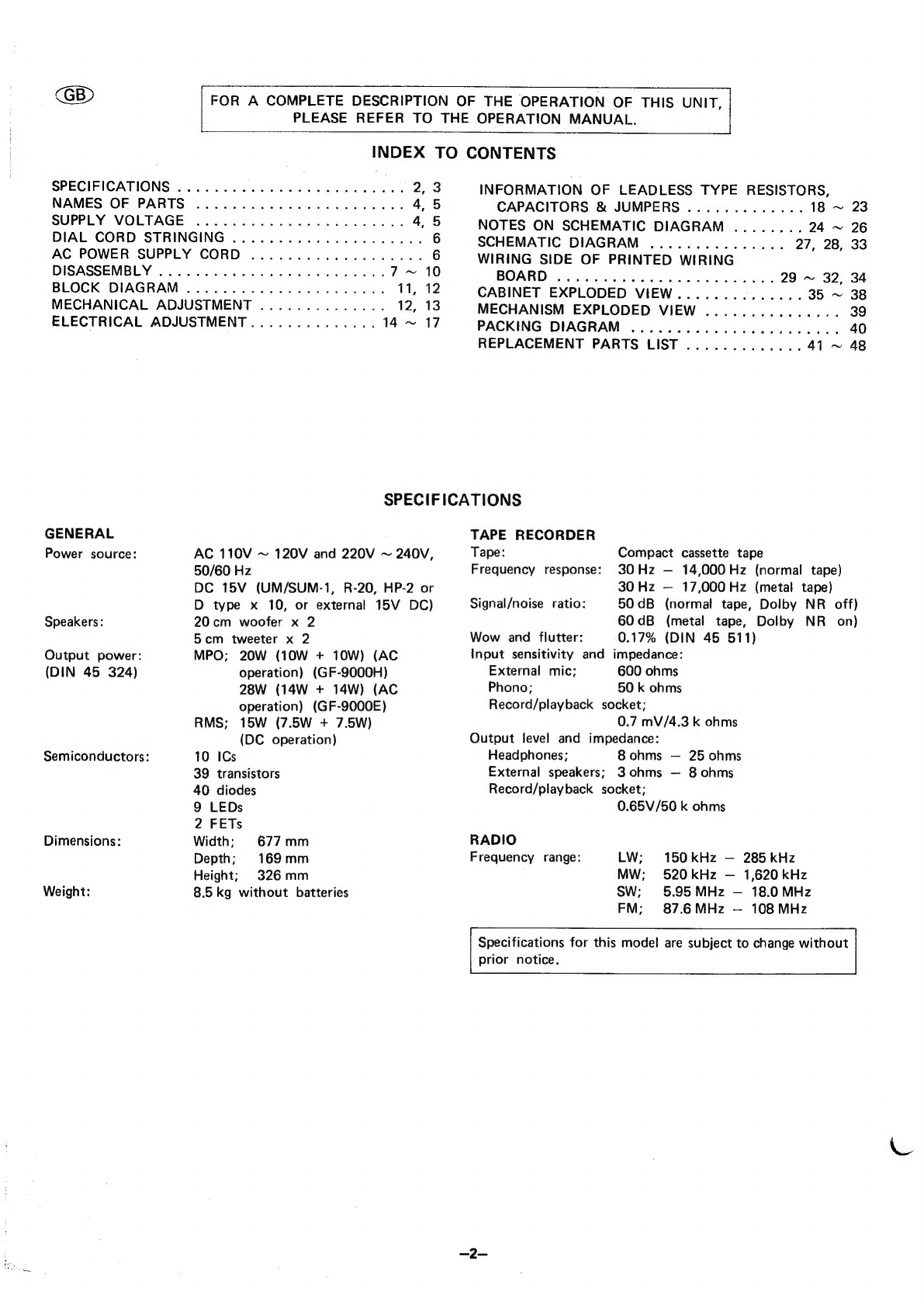
SPECIFICATIONS
GENERAL
Power
source:
Speakers:
Output
power:
(DIN
45
324)
Semiconductors:
Dimensions:
Weight:
AC
110V
~
120V
and
220V
~
240V,
50/60
Hz
DC
15V
(UM/SUM-1,
R-20,
HP-2
or
D
type
x
10,
or
external
15V
DC)
20cm
woofer
x
2
5cm
tweeter
x
2
MPO;
20W
(10W
+
10W)
(AC
operation)
(GF-9000H)
28W
(14W
+
14W)
(AC
operation)
(GF-9000E)
RMS;
15W
(7.5W
+
7.5W)
(DC
operation)
10
ICs
39
transistors
40
diodes
9
LEDs
2
FETs
Width;
677mm
Depth;
169mm
Height;
326mm
8.5
kg
without
batteries
TAPE
RECORDER
Tape:
Compact
cassette
tape
Frequency
response:
30Hz
—
14,000
Hz
(normal
tape)
30
Hz
—
17,000
Hz
(metal
tape)
50
dB
(normal
tape,
Dolby
NR
off)
60dB
(metal
tape,
Dolby
NR_
on)
Wow
and
flutter:
0.17%
(DIN
45
511)
Input
sensitivity
and
impedance:
External
mic;
600
ohms
Phono;
50
k
ohms
Record/playback
socket;
0.7
mV/4.3
k
ohms
Output
level
and
impedance:
Headphones;
8
ohms
—
25
ohms
External
speakers;
3
ohms
—
8
ohms
Record/playback
socket;
0.65V/50
k
ohms
Signal/noise
ratio:
RADIO
Frequency
range:
LW;
150kHz
—
285
kHz
MW;
520kHz
—
1,620
kHz
SW;
5.95MHz
—
18.0
MHz
FM;
87.6MHz
--
108
MHz
Specifications
for
this
model
are
subject
to
change
without
prior
notice.
ae,
fas
FUR
EINE
VOLLSTANDIGE
BESCHREIBUNG
DER
BEDIE-
NUNG
DIESES
GERATES
SOLLTE
DIE
BEDIENUNGSAN-
LEITUNG
KONSULTIERT
WERDEN.
INHALTZVERZEICHNIS
TECHNISCHE
DATEN...
2.6...
eee
ee
ee
2:8
BEZEICHNUNG
DER
TEILE.............000000--
4,5
NETZSPANNUNG
..
0.0.0.0
e
eet
4,5
SPANNEN
DER
SKALENSCHNUR
.........-.-..00--
6
NETZZULEITUNGSKABLE
....
2.0...
.0.0
00-00
eeu aee
6
ZERLEGEN!
6S
ecny
hove
Ree
ees
aa
Rlgw
he
ate
S
7~10
BLOCKSCHALTBILD
. 5
oo
ck
ae
Viewers
wees
a
gees
11,12
MECHANISCHE
EINSTELLUNGEN...............
12,
13
ELEKTRISCHE
EINSTELLUNGEN
..............
4~17
INFORMATION
UBER
STIFTLOSE
WIDERSTANDE,
KONDEN-
SATOREN
UND
UBERBRUCKUNGSDRAHTE
.....
18
~
23
ANMERKUNGEN
UBER
DEN
SCHEMATISCHEN
SCHALTPLAN
........
0.00002
eee
eee
eee
24
~
26
SCHEMATISCHER
SCHALTPLAN..............
27,
28,
33
VERDRAHTUNGSSEITE
DER
LEITERPLATTE
....
29~
32,
34
EXPLOSIONSDARSTELLUNG
DES
GEHAUSES......
35
~
38
EXPLOSIONSDARSTELLUNG
DES
LAUFWERKS
........
39
ERSATZTEILLISTE
2... ....
ee
ee
ee
ee
ee
41~48
TECHNISCHE
DATEN
ALLGEMEINE
Stromversorgung:
Wechselstrom
110V
—
120V
und
220V
—
240V,
50/60
Hz
Gleichstrom
15V
(10
Batt.
Typ
UM/SUM-1,
R-20,
HP-2
oder
D,
bzw.
ext.
Gleichstrom-
versorgung
15V)
Lautsprecher:
2
x
20
cm-Tiefténer
2
x
5
cm-Hochténer
20W
Musikausgangsleistung
(10W
pro
Kanal)
(Netzstrombetrieb)
(GF-9000H)
28W
Musikausgangsleistung
(14W
pro
Kanal)
(Netzstrombetrieb)
(GF-9000E)
15W
Sinusleistung
(7,5W
pro
Kanal)
(Gleichstrombetrieb)
10
ICs
39
Transistoren
40
Dioden
9
LEDs
2
FETs
Breite;
Ausgangsleistung:
(DIN
45
324)
Halbleiter:
677
mm
Tiefe;
169
mm
Hohe;
326
mm
8,5
kg
ohne
Batterien
Abmessungen:
Gewicht:
CASSETTENRECORDER-TEIL
Band:
Kompaktcassette
Frequenzgang:
30
Hz
—
14
kHz
(Normatband)
30
Hz
—
17
kHz
(Reineisenband)
50
dB
(Normalband,
Dolby
NR
Aus)
60
dB
(Reineisenband,
Dolby
NR
Ein)
Gleichlaufschwankungen:
0,17%
(DIN
45
511)
Eingangsempfindlichkeit
und
Impedanz:
Ext.
Mikrofon;
600
Ohm
Phono;
50
kOhm
Aufnahme/Wiedergabe-Buchse;
0,7
mV/4,3
kOhm
Ausgangsspannung
und
Impedanz:
KopfhGrer;
8
bis
25
Ohm
AuBentautsprecher;
3
bis
8
Ohm
Aufnahme/Wiedergabe-Buchse;
0,65V
/50
kOhm
Signal
/Rauschabstand:
RADIO-TEIL
Frequenzbereiche:
LW;
150
kHz
—
285
kHz
MW;
520
kHz
—
1
620
kHz
KW;
5,95
MHz
—
18,0
MHz
87,6
MHz
—
108
MHz
Die
technischen
Daten
fiir
dieses
Modeli
kénnen
ohne
vorherige
Ankiindigung
Anderungen
unterworfen
sein.
POUR
LA
DESCRIPTION
COMPLETE
DU
FONCTIONNEMENT
DE
CET
APPAREIL,
SE
REPORTER
AU
MODE
D’‘EMPLOI.
TABLES
DES
MATIERES
CARACTERISTIQUES
..
0...
2...
eee
ee
ees
2,3
NOMENCLATURE
..
1...
2.
2
ce
es
4,5
ALIMENTATION
2.0...
0.
ce
ee
ees
4,5
MONTAGE
DU
FiL
DE
CADRAN
................4..
6
CORDON
D‘ALIMENTATION
SECTEUR
..............
6
DEMONTAGE
...
1...
2.
ee
ee
7~10
DIAGRAMME
SYNOPTIQUE............0.2002-
11,12
REGLAGE
MECANIQUE
.........
0.0.5.2
eee
12,13
REGLAGE
ELECTRIQUE.............0-
0405.
14~17
tNFORMATIONS
SUR
LES
RESISTANCES
SANS
PIEDS
CONDENSATEURS
ET
FILS
VOLTANTS
.......
18
~
23
REMARQUES
CONCERNANT
LE
DIAGRAMME
SCHEMATIQUE
...
2.2...
0.
ce
ee
24
~
26
DIAGRAMME
SCHEMATIQUE................
27,
28,
33
COTE
CABLAGE
DE
LA
PLAQUETTE
DE
MONTAGE
IMPRIME:
6.2
csi
ics
Sen
fa
se
Ew
29
~
32,
34
VUE
SEPAREE
DU
COFFRET
..............-.
35
~
38
VUE
SEPAREE
DES
ELEMENTS
DU
MECANISME
.......
39
LISTE
DES
PIECES
DE
RECHANGE
............
41~
48
CARACTERISTIQUES
GENERALE
Source
d’alimentation:
110V
4
120V
et
220V
4
240V
CA,
50/60
Hz
15V
CC
(10
piles
UM/SUM-1,
R-20,
HP-2
ou
type
D,
ou
15V
CC
externe)
Woofer
de
20
cm
x
2
Tweeter
de
5
cm
x
2
Musicale;
20W
(10W
+
10W)
(opération
CA)
Haut-parleurs:
Puissance
de
sortie:
(DIN
45
324)
(GF-9000H)
28W
(14W
+
14W)
(opération
CA)
(GF-9000E)
Efficace;
15W
(7,5W
+
7,5W)
(opération
CC)
Semi-conducteurs:
10Cl
39
transistors
40
diodes
9
LED
2
FET
Dimensions:
Largeur;
677
mm
Profondeur;
169mm
Hauteur;
326
mm
Poids:
8,5
kg
sans
piles
MAGNETOPHONE
Bande:
Bande
cassette
compacte
Réponse
de
fréquence:
30
Hz
4
14.000
Hz
(bande
normale)
30
Hz
a
17.000
Hz
(bande
métallique)
50
dB
(bande
normale,
Dolby
NR
coupé)
60
dB
(bande
métallique,
Dolby
NR
allumé)
Pleurage
et
scintillement:
0,17%
(DIN
45
511)!
Sensibilité
et
impédance
d’‘entrée:
Micro
externe;
600
ohms
Phono;
50
kohms
Douille
d’enregistrement/lecture;
0,7
mV/4,3
kohms
Niveau
et
impédance
de
sortie:
Casques;
8
&
25
ohms
Enceintes
externes;
348
ohms
Douille
d’enregistrement/lecture;
0,65V
/50
kohms
Rapport
signal/bruit:
RADIO
Gamme
de
fréquences:
GO;
150
kHz
—
285
kHz
PO;
520kHz
—
1.620
kHz
Oc;
5,95
MHz
—
18,0
MHz
FM;
87,6
MHz
—
108
MHz
Les
caractéristiques
de
ce
modele
sont
sujette
4
modification
sans
Préavis.
NAMES
OF
PARTS
.
Tweeter
(Left
Channel)
.
Built-in
Microphone
(Left
Channel)
Power
Switch
Power
Indicator
FM
Stereo
Indicator
.
Record
Indicator
.
APLD
Programme
Number
Indicators
.
Digital
Tape
Counter
.
Tape
Counter
Reset
Button
.
Dolby
NR
_
Indicator
.
Band
Selector
Switch
.
Built-in
Microphone
(Right
Channel)
.
Tweeter
(Right
Channel)
.
Tuning
Control
.
Fine
Tuning
Control
.
Woofer
(Left
Channel)
.
Cassette
Compartment
.
Woofer
(Right
Channel)
.
Record
Muting
Button
.
Dolby
NR
Switch
.
Record
Mode
Selector
Switch
.
Tape
Selector
Switch
.
Mode
Selector
Switches
.
FM
Mode
Selector
Switch
.
APLD
Programme
Set
Button
.
Record
Level
Controls
.
VU
Meter
(Left
Channel)/Battery
Meter
.
VU
Meter
(Right
Channel)/Tuning
Meter
.
Output
Volume
Controls
.
Eject
Button
.
Record
Button
.
Playback
Button
.
Stop
Button
.
Rewind/Reverse
APLD
Button
.
Fast
Forward/Forward
APLD
Button
.
Pause
Button
.
Speaker
Selector
Switch
.
Headphones
Jack
.
Bass
Control
.
Treble
Control
-
AC
Power
Supply
Socket
.
External
DC
Power
Supply
Socket
.
FM/SW
Telescopic
Rod
Aerial
.
External
Microphone
Jacks
.
Earth
Terminal
.
Phono
Input
Jacks
.
Record/Playback
Jack
.
Beat
Cancel
Switch
.
Remote
Control
Jack
.
External
Speaker
Jacks
.
Battery
Compartment
OONAMNARWNH=
19
20
21
22
SUPPLY
VOLTAGE
-
The
unit
operates
on
AC
110V
~
120V
or
220V
~
240V,
50
Hz
or
60
Hz.
The
unit
may
also
be
operated
on
an
internal
(batteries)
or
external
DC
supply
of
15V.
-
Be
sure
to
check
the
voltage
setting
of
the
voltage
selector
before
connecting
AC
power
supply
cord
plug
to
the
AC
outlet.
If
necessary,
adjust
the
setting
as
follows:
1)
Loosen
the
securing
screw
of
the
AC
power
supply
voltage
selector.
2)
Slide
the
panel
right
or
left,
until
the
correct
voltage
reading
is
seen
on
either
side.
3)
Secure
the
screw.
4
23
Figure
4—2
13
14 15
17
Figure
4—1
41
42
Figure
4—3
43
49
50
51
Figure
4—4
110
~
120V
220
~
240V
Figure
4—5
Figure
4—6
CD>
BEZEICHNUNG
DER
TEILE
.
HochtGner
(linker
Kanal)
.
Eingebautes
Mikrofon
(linker
Kanal)
.
Ein-Aus-Schalter
.
Einschaltanzeige
UKW-Stereoanzeige
.
Aufnahmeanzeige
.
APLD-Programmnummernanzeige
.
Digitales
Bandzahiwerk
.
Bandzahlwerk-Riickstellknopf
10.
Dolby-Rauschunterdriickungsanzeige
11.
WellenbereichswahIschalter
12.
Eingebautes
Mikrofon
(rechter
Kanal)
13.
Hocht6ner
(rechter
Kanal)
14.
Abstimmknopf
15.
Feinabstimmknopf
16.
Tiefténer
(linker
Kanal)
17.
Cassettenfach
18.
Tiefténer
(rechter
Kanal)
19.
Aufnahme-Tondampfungstaste
20.
Dolby-Rauschunterdriickungsschalter
21.
Aufnahme-BetriebsartenwahlIschalter
22.
Bandwahischalter
23.
Betriebsartenwahlschalter
24.
UKW-Betriebsartenwahlischalter
25.
APLD-Programmeinstelltaste
26.
Aussteuerungsregler
27.
Aussteuerungsanzeige
(linker
Kanal)/Batterieanzeige
28.
Aussteuerungsanzeige
(rechter
Kanal)/Abstimmanzeige
29.
Ausgangslautstarkeregler
30.
Auswurftaste
31.
Aufnahmetaste
32.
Wiedergabetaste
33.
Stopptaste
34.
Riickspul-/APLD-Riicklauftaste
35.
Schnellvorlauf-/APLD-Vorlauftaste
36.
Pausentaste
37.
Lautsprecherwahlschalter
38.
Kopfh6érerbuchse
39.
BaRregler
40.
Hdhenregler
41.
Netzanschlu&
42.
FremdgleichstromanschluB&
43.
UKW/KW-Teleskopantenne
44.
AuBenmikrofonbuchsen
45.
Erdklemme
46.
Plattenspieler-Eingangsbuchsen
47.
Aufnahme-/Wiedergabebuchse
48.
Schalter
zum
Unterdriicken
von
Interferenzpfeifen
49.
Fernbedienungsbuchse
50.
Au&enlautsprecherbuchsen
51.
Batteriefach
OMDNOMNARWN—
NETZSPANNUNG
+
Dieses
Gerat
kann
iber
110
~
120V
oder
220
~
240V
Netzstrom,
50
oder
60Hz,
betrieben
werden.
Das
Gerat
kann
auBerdem
tiber
eine
interne
(Batterien)
oder
externe
Gleichstromversorgung
von
15V
betrieben
werden.
+
Unbedingt
die
Spannungseinstellung
des
Spannungswahlers
iiberpriifen,
bevor
der
Netzkabelstecker
in
eine
Netzsteckdose
gesteck
wird.
Die
Einstellung
erforderlichenfalls
wie
folgt
andern:
1)
Die
Sicherungsschraube
des
Netzspannungswahlers
ldsen.
2)
Das
Plattchen
nach
rechts
oder
links
schieben,
bis
die
der
richtigen
Spannung
entsprechende
Zahl
sichtbar
ist.
3)
Die
Schraube
wieder
anziehen.
5
CFD
NOMENCLATURE
.
Haut-parleur
pour
fréquences
élevées
(canal
gauche)
.
Microphone
incorporé
(canal
gauche)
Commutateur
d’alimentation
Témoin
d’alimentation
Témoin
de
stéréo
FM
Témoin
d’enregistrement
.
Témoins
de
numéro
de
programme
APLD
.
Compteur
numérique
de
la
bande
.
Bouton
de
remise
a
zéro
du
compteur
de
la
bande
CONAAARWN>
10.
Témoin
de
RB
Dolby
11.
Commutateur
du
sélecteur
de
gamme
d’ondes
12.
Microphone
incorporé
(canal droit)
13.
Haut-parleur
pour
fréquences
élevées
(canal
droit)
14.
Commande
d’accord
15.
Commande
d’accord
fin
16.
Haut-parleur
pour
fréquences
basses
(canal
gauche)
17.
Compartiment
de
la
cassette
18.
Haut-parleur
pour
fréquences
basses
(canal
droit)
19.
Bouton
de
réglage
silencieux
de
l!’enregistrement
20.
Commutateur
de
RB
Dolby
21.
Commutateur
de
sélection
de
mode
d’enregistrement
22.
Commutateur
de
sélection
de
la
bande
23.
Commutateurs
de
sélection
de
mode
24.
Commutateur
de
sélection
du
mode
FM
25.
Bouton
de
réglage
du
programme
APLD
26.
Commandes
de
niveau
d’enregistrement
27.
Décibelmétre
(canal
gauche)/compteur
de
niveau
28.
Décibelmétre
(canal
droit)/compteur
de
niveau
29.
Commandes
du
volume
de
sortie
30.
Bouton
d’éjection
31.
Bouton
d’enregistrement
32.
Bouton
de
lecture
33.
Bouton
d’arrét
34.
Bouton
de
retour/retour
APLD
35.
Bouton
d’avance
rapide/avande
APLD
36.
Bouton
de
pause
37.
Commutateur
de
sélection
du
haut-parleur
38.
Prise
femelle
du
casque
39.
Commande
des
graves
40.
Commande
des
aigués
41.
Douille
d’alimentation
secteur
42.
Douille
d’alimentation
CC
extérieure
43.
Antenne
a
barre
télescopique
FM/OC
44.
Prises
femelles
de
microphone
extérieur
45.
Borne
de
mise
a
la
terre
46.
Prises
femelles
d’entrée
de
phono
47.
Prise
femelle
d’enregistrement/lecture
48.
Commutateur
de
suppression
de
battement
49.
Douille
de
commande
a
distance
50.
Douilles
de
haut-parleur
extérieur
51.
Compartiment
pour
piles
ALIMENTATION
+
L’appareil
fonctionne
sur
CA
110V
~
120V
ou
220
~
240V,
50
Hz
ou
60
Hz.
II
peut
aussi
fonctionner
sur
alimentation
CC
interne
(piles)
ou
externe
de
15V.
-S’assurer
que
le
réglage
de
tension
du
sélecteur
de
tension
est
correct
avant
de
connecter
la
fiche
du
cordon
d’alimen-
tation
secteur
a
une
prise
murale.
Si
nécessaire,
régler
la
tension
de
la
maniére
suivante:
1)
Desserrer
la
vis
de
fixation
du
sélecteur
de
tension
d’alimentation.
2)
Faire
glisser
le
panneau
a
droit
ou
gauche,
jusqu’a
ce
que
|’indication
correcte
soit
visible
sur
|’un
des
deux
cétés.
3)
Resserrer
la
vis.
DIAL
CORD
STRINGING
1)
Turn
the
drum
fully
counterclockwise
and
stretch
its
cord
over
the
parts
in
the
numerical
order
—
as
shown
in
Fig.
6-1.
2)
Turn
the
tuning
control
shaft
fully
counterclockwise,
and
fix
it
with
the
pointer
aligned
with
the
zero
(0)
point
on
the
dial
scale.
See
Fig.
6—2.
Notice
that
the
notch
position
of
the
pulley
before
the
stringing
is
different
from
that
after
the
stringing.
CD>
SPANNEN
DER
SKALENSCHNUR
1)
Die
Trommel
bis
zum
Anschlag
entgegen
dem
Uhrzeigersinn
drehen
und
die
Schnur
in
der
in
Abb.
6—1
gezeigten
numerischen
Reihenfolge
iiber
die
einzelnen
Teile
spannen.
2)
Die
Abstimmknopfachse
bis
zum
Anschlag
entgegen
dem
Uhrzeigersinn
drehen
und
so
befestigen,
da&
der
Zeiger
auf
den
Nullpunkt
(0)
der
Skala
ausgerichtet
ist.
Siehe
Abb.
6—2.
Bitte
beachten,
da&
sich
die
Kerbe
der
Schnurscheibe
vor
dem
Spannen
in
einer
anderen
Lage
als
nach
dem
Spannen
befindet.
CFD
MONTAGE
DU
FIL
DE
CADRAN
1)
Faire
tourner
complétement
le
tambour
dans
le
sens
inverse
des
aiguilles
d’‘une
montre,
et
tendre
le
fil
sur
les
diverses
parties
dans
l’‘ordre
numérique
—
comme
indiqué
dans
la
Fig.
6—1.
2)
Faire
tourner
complétement,
dans
le
sens
inverse
des
aiguilles
d’une
montre,
la
tige
de
commande
d’accord,
et
la
fixer
avec
l’aiguille
alignée
sur
le
point
zéro
(0)
du
cadran
gradué.
Voir
la
Fig.
6—2.
Noter
que
la
position
de
cran
de
la
poulie
avant
le
montage
du
fil
est
différente
de
la
position
aprés
le
montage.
AC
POWER
SUPPLY
CORD
NETZZULEITUNGSKABEL
CORDON
D’ALIMENTATION
SECTEUR
“f=
+
3-1/2
turns
and
move
for
the
upper
half
©
\-5
wins
for
the
lower
half
&
as
After
the
stringing,
the
pulley’s
notch
should
face
as
shown
in
the
above
figure.
Hook
the
spring
into
the
middle
hole.
®
ae
Notch
After
the
stringing,
the
\
ah
©
+
4.3/4
turns
for
the
pulley’s
notch
should
Ht
eS
upper
half
face
os
shown
in
the
+
3.1/2
turns
and
right
figure.
more
for
the
lower
Figure
6—1
—
chennet
|
876
—
108
MHz
|
$95
~
180
MHz
540
600
700
8
150
170
190
‘
me
Zero
(0)
point
Figure
6—2

CGB)
DISASSEMBLY
Caution:
Prior
to
the
disassembly,
be
sure
to
draw
the
AC
power
supply
cord
plug
from
the
AC
power
supply
socket
of
the
unit
and
to
unload
the
cassette
compartment
with
a
cassette
tape.
1.
REMOVAL
OF
FRONT
CABINET
1)
Pull
out
ten
knobs
shown
in
Fig.
7—1.
2)
Push
the
cassette
ejection
key
to
open
the
cassette
com-
partment.
See
Fig.
7—1.
3)
Remove
ten
screws
from
the
rear
cabinet.
See
Fig.
7—2.
4)
Pull
out
the
socket
A
connected
to
the
meter
inside
the
front
cabinet
and
the
socket
(B)
connected
to
the
power
amplifier
P.W.B.
See
Fig.
7—3.
Figure
7—2
2.
REMOVAL
OF
OUTPUT
VOLUME/RECORD
LEVEL
CONTROL
P.W.B.
1)
Separate
the
front
cabinet
from
the
rear
cabinet.
Refer
to
“REMOVAL
OF
FRONT
CABINET”.
2)
Remove
the
screws
(1),
@)and@)
from
the
output
volume/
record
level
control
P.W.B.,
and
take
the
P.W.B.
off.
See
Fig.
7—4.
3.
REMOVAL
OF
DIAL
CORD
STRINGING
FRAME
1)
Separate
the
front
cabinet
from
the
rear
cabinet.
Refer
to
“REMOVAL
OF
FRONT
CABINET”.
2)
Detach
the
built-in
microphones
(C)
and
(0)
from
the
frame..
See
Fig.
7—4.
3)
Pull
out_the
socket
©
connected
to
the
radio
P.W.B.,
the
tip
connected
to
the
telescopic
rod
aerial
and
the
socket
connected
to
the
power
amplifier
P.W.B.
See
Fig.
7—5
and
9-2.
4)
Remove
the
screws
@)
to
®
from
the
frame,
and
take
it
off.
See
Fig.
7—4.
*Also
remove
LED
P.W.B.
if
necessary.
To
remove
it,
detach
the
pointer
from
the
pointer
holder
and
the
dial
plate
from
the
frame
beforehand.
4.
REMOVAL
OF
MAIN
FRAME
1)
Separate
the
front
cabinet
from
the
rear
cabinet.
Refer
to
“REMOVAL
OF
FRONT
CABINET”.
2)
Pull
out
the
built-in
microphones
©
and
©
,
the
socket
connected
to
the
radio
P.W.B.
and
the
sockets
and
)
connected
to
the
power
amplifier
P.W.B.
See
Figs.
7—4,
7-5
and
9-2.
3)
Remove
the
screws
(8)
to
(2

from
the
frame,
and
take
it
off.
*Also
remove
LED
P.W.B.
if
necessary.
To
remove
it,
detach
the
pointer
from
the
pointer
holder
and
the
dial
plate
from
the
frame
beforehand.
Figure
7—1
Figure
7—3
Figure
7—5
D>
ZERLEGEN
Vorsicht:
Vor
dem
Zerlegen
unbedingt
den
Netzkabelstecker
aus
dem
NetzanschluR
des
Gerates
ziehen
und
die
Bandcassette
aus
dem
Cassettenfach
entfernen.
1.
ENTFERNEN
DER
VORDEREN
GEHAUSEHALFTE
1)
Zehn
Knépfe
gemaR
Abb.
7—1
herausziehen.
2)
Die
Cassettenauswurftaste
driicken,
um
das
Cassettenfach
zu
Offnen.
Siehe
Abb. 7—1.
3)
Zehn
Schrauben
von
der
hinteren
Gehdusehalfte
entfernen.
Siehe
Abb.
7—2.
4)
Den
an
das
Anzeigeinstrument
in
der
vorderen
Gehause-
half
angeschlossenen
Anschlu&
(A)
und
den
an
die
Endver-
starker-Leiterplatte
angeschlossenen
Anschlu&
heraus-
ziehen.
Siehe
Abb.
7—3.
2.
ENTFERNEN
DER
AUSGANGSLAUTSTARKE-/
AUSSTEUERUNGSREGLER-LEITERPLATTE
1)
Die
vordere
Gehdusehdlfte
von
der
hinteren
Gehause-
halfte
trennen.
Siehe
Abschnitt
“ENTFERNEN
DER
VORDEREN
GEHAUSEHALFTE”.
2)
Die
Schrauben
a2)
und
3)
von
der
Ausgangslautstarke-/
Aussteuerungsregler-Leiterplatte
abschrauben
und
die
Leiterplatte
entfernen.
Siehe
Abb.
7—4.
3.
ENTFERNEN
DES
SKALENSCHNURSPANNRAHMENS
1)
Die
vordere
Gehadusehalfte
von
der
hinteren
Gehguse-
halfte
trennen.
Siehe
Abschnitt
“ENTFERNEN
DER
VORDEREN
GEHAUSEHALFTE”.
2)
Die
eingebauten
Mikrofone
©
und
(©)
vom
Rahmen
entfernen.
Siehe
Abb.
7—4,
3)
Den
an
die
Radio-Leiterplatte
angeschlossenen
Anschiu&
,
die
an
die
Teleskopantenne
angeschlossene
Spitze
und
den
an
die
_Endverstarker-Leiterplatte
ange-
schlossenen
Anschlu&
)
herausziehen.
Siehe
Abb.
7—5.
und
9—2.
4)
Die
Schrauben
4)
bis
‘@)
vom
Rahmen
abschrauben
und
den
Rahmen
entfernen.
Siehe
Abb.
7—4.
*Falls
erforderlich,
auRerdem
die
Leuchtdioden-Leiterplatte
entfernen.
Vor
dem
Entfernen
der
Leiterplatte
den
Zeiger
vom
Zeiger-
halter
und
die
Skalenplatte
vom
Rahmen
abnehmen.
4.
ENTFERNEN
DES
HAUPTRAHMENS
1)
Die
vordere
Gehausehdlfte
von
der
hinteren
Gehduse-
halfte
trennen.
Siehe
Abschnitt
“ENTFERNEN
DER
VORDEREN
GEHAUSEHALFTE”.
2)
Die
eingebauten
Mikrofone
©
und
©)
,
den
an
die
Radio-
Leiterplatte
angeschlossenen
Anschlu&
€)
und
die
an
die
Endverstarker-Leiterplatte
angeschlossenen
Anschliisse
und
(H)
herausziehen.
Siehe
Abb.
7—4,
7—5
und
9-2.
3)
Die
Schrauben
bis
(2
vom
Rahmen
abschrauben
und
den
Rahmen
entfernen.
*Falls
erforderlich,
auRerdem
die
Leuchtdioden-Leiterplatte
entfernen.
Vor
dem
Entfernen
der
Leiterplatte
den
Zeiger
vom
Zeiger-
halter
und
die
Skalenplatte
vom
Rahmen
entfernen.
CE
DEMONTAGE
Attention:
Avant
le
démontage,
vérifier
que
I’on
a
bien
débranché
la
fiche
d’alimentation
secteur
de
la
prise
murale,
et
que
l’on
a
enlevé
la
cassette
du
compartiment
pour
cassette.
1.
ENLEVEMENT
DU
COFFRET
AVANT
1)
Retirer
les
dix
boutons
indiqués
dans
la
Fig.
7-1.
2)
Abaisser
la
touche
d’éjection
de
la
cassette
pour
ouvrir
le
compartiment
de
la
cassette.
Voir
Fig.
7—1.
3)
Enlever
les
dix
vis
du
coffret
arriére.
Voir
Fig.
7—2.
4)
Retirer
la
douille
@)
connectée
au
compteur
4
|’intérieur
du
coffret
avant,
et
la
douille
connectée
4a
la
plaquette
de
cablage
imprimé
de
|‘amplificateur
d’‘alimentation.
Voir
Fig.
7—3.
2.
ENLEVEMENT
DE
LA
PLAQUETTE
DE
MONTAGE
IMPRIME
DE
COMMANDE
DU
NIVEAU
D’ENREGISTREMENT/VOLUME
DE
SORTIE
1)
Séparer
le
coffret
avant
du
coffret
arriére.
Se
reporter
a
“ENLEVEMENT
DU
COFFRET
AVANT”.
2)
Enlever
les
vis
@),
(2)
et
3)
de
la
plaquette
de
montage
imprimé
de
commande
du
niveau
d’enregistrement/volume
de
sortie,
et
retirer
la
plaquette
de
montage
imprimé.
Voir
la
Fig.
7—4.
3.
ENLEVEMENT
DU
BATI
DE
MONTAGE
DU
FIL
DE
CADRAN
1)
Séparer
le
coffret
avant
du
coffret
arriére.
Se
reporter
a
“ENLEVEMENT
DU
COFFRET
AVANT”.
2)
Détacher
les
microphones
incorporés
©
et
©)
du
_
bati.
Voir
la
Fig.
7—4.,
3)
Retirer
la
douille
©
connectée
a
la
plaquette
de
montage
imprimé
de
radio,
l’extrémité
(F
connectée
4a
|’antenne
a
barre,
et
la
douille
()
connectée
a
la
plaquette
de
montage
imprimé
de
|’amplificateur
d’alimentation.
Voir
les
Figures
7-5
et
9—2.,
4)
Enlever
les
vis
(4)
a
®
du
bati,
et
retirer
celui-ci.
Voir
la
Fig.
7—4.
*Enlever
également
la
plaquette
de
montage
imprimé
de
LED
lorsque
c’est
nécessaire.
Pour
I’enlever,
détacher
|’aiguille
de
son
support,
et
la
plaque
graduée
du
bati
au
préalable.
4.
ENLEVEMENT
DU
BATI
PRINCIPAL
1)
Séparer
le
coffret
avant
du
coffret
arriére.
Se
reporter
a
“ENLEVEMENT
DU
COFFRET
AVANT”.
2)
Retirer
les
microphones
incorporés
©)
et
0),
la
douille
connectée
a
la
plaquette
de
montage
imprimé
de
radio,
et
les
douilles
©
et
®)
connectées
a4
la
plaquette
de
montage
imprimé
de
|l’amplificateur
d’alimentation.
Voir
les
Figures
7-4,
7-5
et
9-2.
3)
Enlever
les
vis
a
a2
du
bati,
et
retirer
celui-ci.
*Enlever
aussi
la
plaquette
de
montage
imprimé
de
LED
si
nécessaire.
Pour
I’enlever,
détacher
I’aiguille
de
son
support,
et
la
plaque
graduée
au
préalable.
5.
REMOVAL
OF
MECHANISM
BLOCK
1)
Detach
the
main
frame
from
the
rear
cabinet.
Refer
to
“REMOVAL
OF
MAIN
FRAME”.
2)
Pull
out
the
socket
(1)connected
to
the
mechanism
P.W.B.,
and
the
socket
(Q)
and
®)
connected
to
the
record/
playback
amplifier
P.W.B.
See
Figs.
9-1
and
9—3.
3)
Take
the
tape
counter
drive
belt
GQ)
off.
See
Fig.
9—1.
4)
Remove
the
screws
(3
to
)
from
the
mechanism
block,
and
take
it
off.
See
Fig.
9—1.
6.
REMOVAL
OF
POWER
AMP.
P.W.B.
1)
Detach
the
main
frame
from
the
rear
cabinet.
Refer
to
“REMOVAL
OF
MAIN
FRAME”.
2)
Pull
out
the
sockets
(kK)
to
@)
connected
to
the
power
amplifier
P.W.B.
See
Fig.
9—2.
3)
Remove
the
screws
to
@2
from
the
P.W.B.,
and
take
it
off.
See
Fig.
9—2.
7.
REMOVAL
OF
JACKS
P.W.B.
AND
RECORD/
PLAYBACK
AMP.
P.W.B.
1)
Detach
the
main
frame
from
the
rear
cabinet.
Refer
to
“REMOVAL
OF
MAIN
FRAME”.
2)
Pull
out
the
socket
(1)
connected
to
the
mechanism
P.W.B.,
the
socket
©
connected
to
the
power
amplifier
P.W.B.
and
the
sockets
@)
and
(R)
connected
to
the
record/
playback
amplifier
P.W.B.
See
Figs.
9-1,
9—2
and
9-3.
Remove
the
screws
@)
to
@9
holding
the
jacks
P.W.B.
and
the
screws
@3
to
6
holding
the
record/playback
amplifier
P.W.B.
Then
both
P.W.B.
can
be
removed.
See
Fig.
9-3.
3
—
REMOVAL
OF
SWITCHES
P.W.B.
Detach
the
main
frame
from
the
rear
cabinet.
Refer
to
“REMOVAL
OF
MAIN
FRAME”.
Pull
out
the
sockets
«)
and
(P)
connected
to
the
POWER
P.W.B.
and
the
socket
©
connected
to
the
OUTPUT
VOLUME/RECORD
LEVEL
CONTROL
P.W.B.
See
Figs.
9—1
and
9-2.
3)
Remove
the
screws
60
to
65)
from
the
P.W.B.,
and
take
it
off.
See
Fig.
9—4.
SF
2
~—
Note:
To
remove
the
buttons
mentioned
below,
place
them
to
their
Original
positions.
*
Recording
muting
button
*
Dolby
NR
button
*
Recording
mode
selector
button
*
Tape
selector
button
*
Mode
selector
button
*FM
mode
selector
button
—9-
~
Figure
9—2
g
aN
.
{=e
fe
Figure
9—4
CD>
5.
ENTFERNEN
DES
MECHANISMUSBLOCKES
1)
Den
Hauptrahmen
von
der
hinteren
Gehdusehdlfte
ent-
fernen.
Siehe
Abschnitt
“ENTFERNEN
DES
HAUPT-
RAHMENS”.
2)
Den
an
die
Mechanismus-Leiterplatte
angeschlossenen
Anschlu&
a)
und
die
an
die
Aufnahme-/Wiedergabever-
starker-Leiterplatte
angeschlossenen
Anschliisse
@)
und
herausziehen.
Siehe
Abb.
9—1
und
9-3.
3)
Den
Bandzahlwerk-Antriebsriemen
g)
abnehmen.
Siehe
Abb.
9—1.
4)
Die
Schrauben
(3)
bis
vom
Mechanismusblock
abschrauben
und
den
Mechanismusblock
entfernen.
Siehe
Abb.
9—1.
6.
ENTFERNEN
DER
ENDVERSTARKER-LEITERPLATTE
1)
Den
Hauptrahmen
von
der
hinteren
Gehdusehdlfte
ent-
fernen.
Siehe
Abschnitt
“ENTFERNEN
DES
HAUPT-
RAHMENS”.
2)
Die
an
die
Endverstarker-Leiterplatte
angeschlossenen
Anschliisse
(K)
bis
(P)
herausziehen.
Siehe
Abb. 9—2.
3)
Die
Schrauben
bis
@
von
der
Leiterplatte
ab-
schrauben
und
die
Leiterplatte
entfernen.
Siehe
Abb. 9—2.
7.
ENTFERNEN
DER
BUCHSEN-LEITERPLATTE
UND
DER
AUFNAHME-/WIEDERGABEVERSTARKER-
LEITERPLATTE
Den
Hauptrahmen
von
der
hinteren
Gehdusehalfte
ent-
fernen.
Siehe
Abschnitt
“ENTFERNEN
DES
HAUPT-
RAHMENS”,.
2)
Den
an
die
Mechanismus-Leiterplatte
angeschlossenen
Anschlu&
@),
den
an
die
Endverstarker-Leiterplatte
ange-
schlossenen
Anschlu&
©
und
die
an
die
Aufnahme-/
Wiedergabeverstarker-Leiterplatte
|
angeschlossenen
An-
schlusse
@)
und
®)
herausziehen.
Siehe
Abb.
9—1,
9—2
und
9-3.
Die
Schrauben
QD
bis
@9
,
mit
denen
die
Buchsen-
Leiterplatte
befestigt
ist,
und
die
Schrauben
@3
bis
@
i
mit
denen
die
Aufnahme-/Wiedergabeverstarker-Leiter-
platte
befestigt
ist,
entfernen.
Danach
k6nnen
beide
Leiter-
platten
entfernt
werden.
Siehe
Abb.
9—3.
1
~—
3
—
8.
ENTFERNEN
DER
SCHALTER-LEITERPLATTE
Den
Hauptrahmen
von
der
hinteren
Gehausehdalfte
ent-
fernen.
Siehe
Abschnitt
“ENTFERNEN
DES
HAUPT-
RAHMENS”.
2)
Die
an
die
Stromversorgungs-Leiterplatte
angeschlossenen
Anschliisse
()
und
(P)
und
den
an
die
Ausgangslautstarke-
/Aussteuerungsregler-Leiterplatte
angeschlossenen
Anschiu&
@herausziehen.
Siehe
Abb.
9—1
und
9-2.
3)
Die
Schrauben
60
bis
65
von
der
Leiterplatte
ab-
schrauben
und
die
Leiterplatte
entfernen.
Siehe
Abb.
9—4.
=
~~
Anmerkung:
Um
die
untenerwahnten
Knopfe
zu
entfernen,
diese
auf
die
urspriingliche
Position
stellen.
+
Aufnahme-Tondampfungsknopf
+
Dolby-NR-Knopf
-
Aufnahme-Betriebsartenwahlknopf
+
Bandwahlknopf
-
Betriebsartenwahlknopf
-
UKW-Betriebsartenwahiknopf
CFD
5.
ENLEVEMENT
DU
BLOC
DU
MECANISME
1)
Détacher
le
bati
principal
du
coffret
arriére.
Se
reporter
a
“ENLEVEMENT
DU
BATI
PRINCIPAL”.
2)
Retirer
la
douille
qa)
connectée
a
la
plaquette
de
montage
imprimé
du
mécanisme,
et
les
douilles
Q)
et
(R)
connectées
a
la
plaquette
de
montage
imprimé
de
|’amplificateur
d’enregistrement/lecture.
Voir
les
Figures
9—1
et
9-3.
3)
Retirer
la
courroie
d’entrainement
GQ)
du
compteur
de
bande.
Voir
la
Fig.
9—1.
4)
Enlever
les
vis
a3)
a
du
bloc
du
mécanisme,
et
retirer
celui-ci.
Voir
la
Fig.
9—1.
6.
ENLEVEMENT
DE
LA
PLAQUETTE
DE
MONTAGE
IMPRIME
DE
L’AMPLIFICATEUR
D’ALIMENTATION
1)
Détacher
le
bati
principal
du
coffret
arriére.
Se
reporter
a
“ENLEVEMENT
DU
BATI
PRINCIPAL”.
2)
Retirer
les
douilles
«)
a
(P)
connectées
a
la
plaquette
de
montage
imprimé
d’alimentation.
Voir
la
Fig.
9—2.
3)
Enlever
les
vis
a
@2
de
la
plaquette
de
montage
imprimé,
et
retirer
celle-ci.
Voir
la
Fig.
9—2.
7.
ENLEVEMENT
DE
LA
PLAQUETTE
DE
MONTAGE
IMPRIME
DE
PRISES
FEMELLES
ET
DE
LA
PLAQUETTE
DE
MONTAGE
IMPRIME
DE
L’AMPLIFICATEUR
D’ENREGISTREMENT/LECTURE
1)
Détacher
le
bati
principal
du
coffret
arriére.
Se
reporter
a
“ENLEVEMENT
DU
BATI
PRINCIPAL”.
2)
Retirer
la
douille
C1)
connectée
a
la
plaquette
de
montage
imprimé
du
mécanisme,
la
douille
©
connectée
4a
la
pla-
quette
de
montage
imprimé
de
l’amplificateur
d’alimen-
tation,
et
les
douilles
(Q)
et
(R)
connectées
a
la
plaquette
de
montage
imprimé
de
|’amplificateur
d’enregistrement/
lecture.
Voir
les
Figures
9-1,
9-2
et
9-3.
3)
Enlever
les
vis
QD
a
@9
qui
maintiennent
la
plaquette
de
montage
imprimé
des
prises
femelles,
et
les
vis
a
@6)
qui
maintiennent
la
plaquette
de
montage
imprimé
de
l’amplificateur
d’enregistrement/lecture.
Voir
la
Fig.
9-3.
8.
ENLEVEMENT
DE LA
PLAQUETTE
DE
MONTAGE
IMPRIME
DES
COMMUTATEURS
1)
Détacher
le
bati
principal
du
coffret
arriére.
Se
reporter
a
“ENLEVEMENT
DU
BATI
PRINCIPAL”.
2)
Retirer
les
douilles
«)
et
()
connectées
a
la
plaquette
de
montage
imprimé
de
I’alimentation
et
la
douille
connectée
a
la
plaquette
de
montage
imprimé
de
la
commande
de
volume
de
sortie/niveau
d’enregistrement.
Voir
les
Figures
9—1
et
9—2.
3)
Enlever
les
vis
80
a
65
de
la
plaquette
de
montage
imprimé,
et
retirer
celle-ci.
Voir
la
Fig.
9—4,
Note:
Pour
enlever
les
boutons
mentionnés
ci-dessous,
les
placer
sur
leurs
positions
d’origine.
-
Bouton
d’assourdissement
d’enregistrement
-
Bouton
Dolby
NR
-
Bouton
sélecteur
de
mode
d’enregistrement
-
Bouton
sélecteur
de
bande
-
Bouton
sélecteur
de
mode
-
Bouton
sélecteur
de
mode
FM
—10—
12
346
67
@ ©
©
|CNPIO!
0365
Sw203-C
L-CH
Soe
|
Sw2ol-a
|
hears
:
a
ane
cee
erg
nae
2
Pe
T6OI
Power
Trans,
Ge
ee
met
oe
24
D601
+
~~
thy
1
-74
1
1
1
SW60!
1
0364
Dolby
#1
indicator
A
APSS
SW
SW703
Volume}
Solenoid
SOL7OI
VR40-A
VR402-A
VRSO!|
Bass
VR40I-8
VR402-B
VR502
I
Q.
OF
ae
aa
S
i
ol
74
eS
a
ee
toe
roi
os
3
-4
ES
;
%
+P
1B
6
|
BROS
a
Ba
.
ey
€
1
823
'
cir
-t----
Sy
ig
21
a
Hot
gs
ieee
‘i
aoe
:
i?
ee
5
1
8
:
F
lel
33
pene
é
1B
48t
3§
toe
SS
eS
ti
Pee
Ree
tele
th
el
ee
nS
eee
eke
hates
heel
ab
Sie
Se
a
ac
ge
ee
eS
he
APSS
+B
Record
Equalizer
2
SS
SSS
as
Stas,
Voltage
Regulator
Oscillation
Circuit
Bias
D366)
Phono
Equalizer
Amp,
©
[>
L-CH|
|
Sw206-F Sw208-D
Wa
&
&)
Sw206-D
VR204
Adjust,
PLAY
Record/Playback
Amp.
1
\
1
@203
Switching
Figure
11
BLOCK
DIAGRAM
(1/2)
-11-
3
2381
ge
com
185
(ooo,
i.
é
i
gf
Tt
al
Th
Pause
Sw
Sw704
FM
RF
AMP
Ql
Q
L
FM
IF
AMP
-)
H
TI
CFI
04
cF2
Bit
K
La
La
eed
it
|
t
—
«
(=|
ba
ie
a
os
ve
|
Ty
5
ee
swi-A
|
|
Op
1
|Pr
f
|
|
13
(or
looses
a
aS
ol
02
|
|
|
|
Adjust.
I
7
|
Ls
|
|
|
o7|
|
!
!
=
!
|
|
sw
ANT.
oe
ane
—-4+--4
aaa
~4+----—--—-~—
4——
fe
_
ff
ft
|
ts
Wh
af
.
It!
FM
0SC
re
03
05
Q9
BUFFER
AM
IF
AMP
AM
IF
AMP.
ow
‘a
7
98
swi-c
MW/LW
ANT
LZ
mw
1?
%)
SWI
(A~H)
Band
Selector
ae
|
ttt
c
[66
65005]
CNP
I
=
=
ig
l=
Ny
=
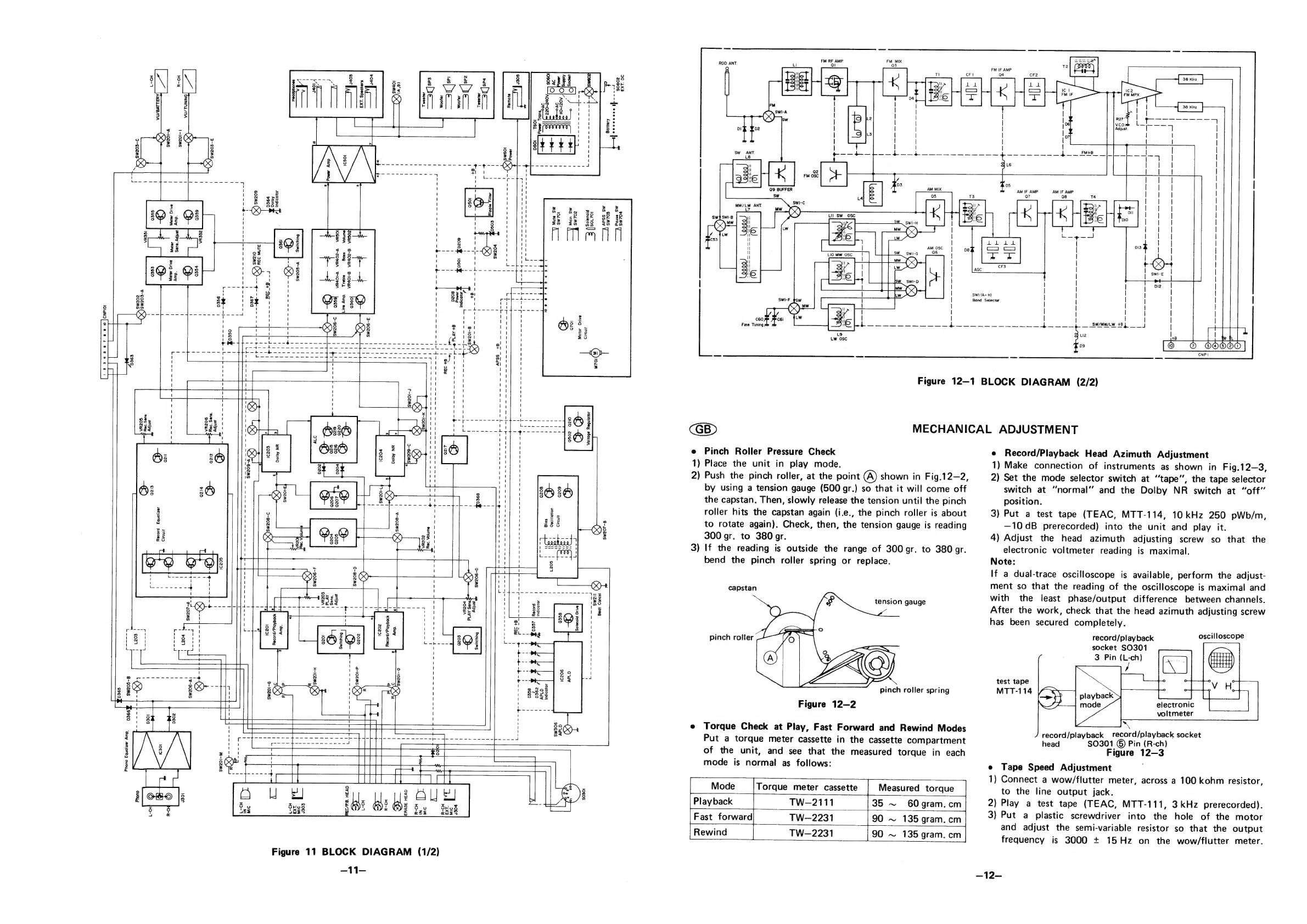
Figure
12—1
BLOCK
DIAGRAM
(2/2)
e
Pinch
Roller
Pressure
Check
1)
Place
the
unit
in
play
mode.
2)
Push
the
pinch
roller,
at
the
point
A)
shown
in
Fig.12—2,
by
using
a
tension
gauge
(500
gr.)
so
that
it
will
come
off
the
capstan.
Then,
slowly
release
the
tension
until
the
pinch
roller
hits
the
capstan
again
(i.e.,
the
pinch
roller
is
about
to
rotate
again).
Check,
then,
the
tension
gauge
is
reading
300
gr.
to
380
gr.
If
the
reading
is
outside
the
range
of
300
gr.
to
380
gr.
bend
the
pinch
roller
spring
or
replace.
3
—
capstan
tension
gauge
pinch
roller
pinch
roller
spring
Figure
12—2
e
Torque
Check
at
Play,
Fast
Forward
and
Rewind
Modes
Put
a
torque
meter
cassette
in
the
cassette
compartment
of
the
unit,
and
see
that
the
measured
torque
in
each
mode
is
normal
as
follows:
Mode
Torque
meter
cassette
Measured
torque
Playback
TW-—2111
35
~
60gram.cm
Fast
forward
TW-2231
90
~
135
gram.
cm
Rewind
TW-2231
{90
~
136
gram.
cm
MECHANICAL
ADJUSTMENT
e
Record/Playback
Head
Azimuth
Adjustment
1)
Make
connection
of
instruments
as
shown
in
Fig.12—3,
2)
Set the
mode
selector
switch
at
“tape”,
the
tape
selector
switch
at
“normal”
and
the
Dolby
NR
switch
at
“off”
position.
3)
Put
a
test
tape
(TEAC,
MTT-114,
10
kHz
250
pWb/m,
—10dB
prerecorded)
into
the
unit
and
play
it.
4)
Adjust
the
head
azimuth
adjusting
screw
so
that
the
electronic
voltmeter
reading
is
maximal.
Note:
If
a
dual-trace
oscilloscope
is
available,
perform
the
adjust-
ment
so
that
the
reading
of
the
oscilloscope
is
maximal
and
with
the
least
phase/output
difference
between
channels.
After
the
work,
check
that
the
head
azimuth
adjusting
screw
has
been
secured
completely.
record/playback
oscilloscope
socket
SO301
3
Pin
ie
test
tape
MTT-114
electronic
voltmeter
record/playback
record/playback
socket
head
$0301
©
Pin
(R-ch)
Figure
12—3
e
Tape
Speed
Adjustment
‘
1)
Connect
a
wow/flutter
meter,
across
a
100
kohm
resistor,
to
the
line
output
jack.
2)
Play
a
test
tape
(TEAC,
MTT-111,
3kHz
prerecorded).
3)
Put
a
plastic
screwdriver
into
the
hole
of
the
motor
and
adjust
the
semi-variable
resistor
so
that
the
output
frequency
is
3000
+
15Hz
on
the
wow/flutter
meter.
—12—
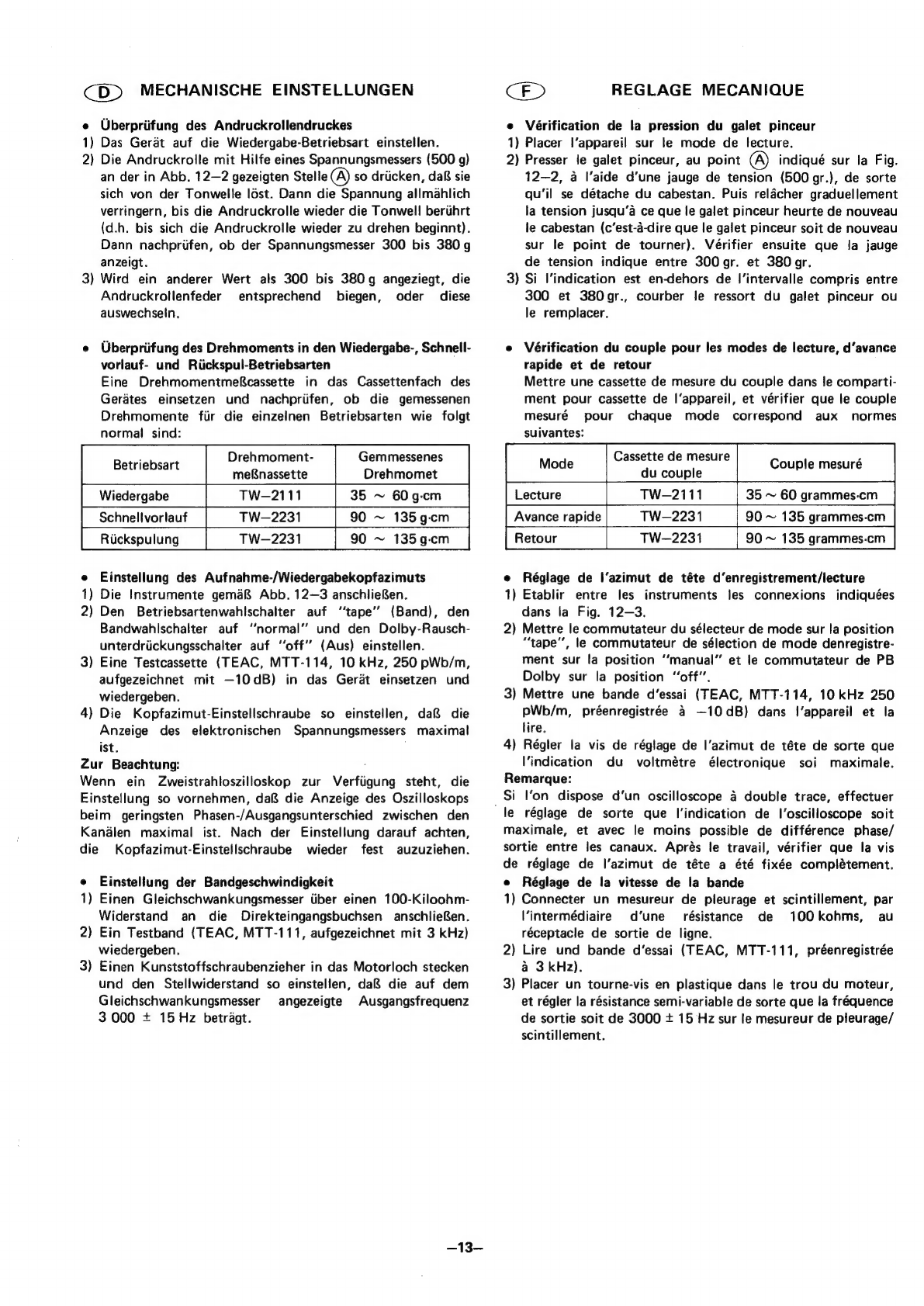
CD>
MECHANISCHE
EINSTELLUNGEN
e
Uberpriifung
des
Andruckrollendruckes
1)
Das
Gerat
auf
die
Wiedergabe-Betriebsart
einstellen.
2)
Die
Andruckrolle
mit
Hilfe
eines
Spannungsmessers
(500
g)
an
der
in
Abb.
12—2
gezeigten
Stelle
(A)
so
dricken,
daB
sie
sich
von
der
Tonwelle
lést.
Dann
die
Spannung
allmahlich
verringern,
bis
die
Andruckrolle
wieder
die
Tonwel!
beriihrt
(d.h.
bis
sich
die
Andruckrolle
wieder
zu
drehen
beginnt).
Dann
nachpriifen,
ob
der
Spannungsmesser
300
bis
380g
anzeigt.
3)
Wird
ein
anderer
Wert
als
300
bis
380g
angeziegt,
die
Andruckrollenfeder
entsprechend
biegen,
oder
diese
auswechselin,
e
Uberpriifung
des
Drehmoments
in
den
Wiedergabe-,
Schnell-
voriauf-
und
Riickspul-Betriebsarten
Eine
DrehmomentmeRcassette
in
das
Cassettenfach
des
Gerates
einsetzen
und
nachpriifen,
ob
die
gemessenen
Drehmomente
fir
die
einzelnen
Betriebsarten
wie
folgt
normal
sind:
Gemmessenes
Drehmomet
35
~
60g-cm
90
~
135
g-cm
90
~
135
g-cm
Drehmoment-
meBnassette
TW-2111
TW-2231
TW-2231
Betriebsart
Wiedergabe
Schnellvorlauf
Ruckspulung
e
Einstellung
des
Aufnahme-/Wiedergabekopfazimuts
1)
Die
Instrumente
gemaR
Abb.
12—3
anschlieRen.
2)
Den
Betriebsartenwahlschalter
auf
‘‘tape’’
(Band),
den
Bandwahlschalter
auf
“normal”
und
den
Dolby-Rausch-
unterdriickungsschalter
auf
“off”
(Aus)
einstellen.
3)
Eine
Testcassette
(TEAC,
MTT-114,
10
kHz,
250
pWb/m,
aufgezeichnet
mit
—10dB)
in
das
Gerat
einsetzen
und
wiedergeben.
4)
Die
Kopfazimut-Einstellschraube
so
einstellen,
da&
die
Anzeige
des
elektronischen
Spannungsmessers
maximal
ist.
Zur
Beachtung:
:
Wenn
ein
Zweistrahloszilloskop
zur
Verfiigung
steht,
die
Einstellung
so
vornehmen,
da&
die
Anzeige
des
Oszilloskops
beim
geringsten
Phasen-/Ausgangsunterschied
zwischen
den
Kanalen
maximal
ist.
Nach
der
Einstellung
darauf
achten,
die
Kopfazimut-Einstellschraube
wieder
fest
auzuziehen.
e
Einstellung
der
Bandgeschwindigkeit
1)
Einen
Gleichschwankungsmesser
iiber
einen
100-Kiloohm-
Widerstand
an
die
Direkteingangsbuchsen
anschlieBen.
2)
Ein
Testband
(TEAC,
MTT-111,
aufgezeichnet
mit
3
kHz)
wiedergeben.
3)
Einen
Kunststoffschraubenzieher
in
das
Motorloch
stecken
und
den
Stellwiderstand
so
einstellen,
da&
die
auf
dem
Gleichschwankungsmesser
angezeigte
Ausgangsfrequenz
3
000
+
15
Hz
betragt.
~13—
CFD
REGLAGE
MECANIQUE
e
Vérification
de
la
pression
du
galet
pinceur
1)
Placer
|’appareil
sur
le
mode
de
lecture.
2)
Presser
le
galet
pinceur,
au
point
A)
indiqué
sur
la
Fig.
12—2,
a
l’aide
d’une
jauge
de
tension
(500
gr.),
de
sorte
qu'il
se
détache
du
cabestan.
Puis
relacher
graduellement
la
tension
jusqu’a
ce
que
le
galet
pinceur
heurte
de
nouveau
le
cabestan
(c’est-a-dire
que
le
galet
pinceur
soit
de
nouveau
sur
le
point
de
tourner).
Vérifier
ensuite
que
Ja
jauge
de
tension
indique
entre
300
gr.
et
380
gr.
3)
Si
I’indication
est
en-dehors
de
|’intervalle
compris
entre
300
et
380
gr.,
courber
le
ressort
du
galet
pinceur
ou
le
remplacer.
e
Vérification
du
couple
pour
les
modes
de
lecture,
d’avance
rapide
et
de
retour
Mettre
une
cassette
de
mesure
du
couple
dans
le
comparti-
ment
pour
cassette
de
l’appareil,
et
vérifier
que
le
couple
mesuré
pour
chaque
mode
correspond
aux
normes
suivantes:
ssette
de
mesure
;
Ca
Couple
mesuré
du
couple
TW-2111
35
~
60
grammes-cm
TW-2231
90
~
135
grammes-cm
TW-—2231
90
~
135
grammes-cm
e
Réglage
de
I’azimut
de
téte
d’enregistrement/lecture
1)
Etablir
entre
les
instruments
les
connexions
indiquées
dans
la
Fig.
12-3.
2)
Mettre
le
commutateur
du
sélecteur
de
mode
sur
la
position
“tape’’,
le
commutateur
de
sélection
de
mode
denregistre-
ment
sur
la
position
‘‘manual”’
et
le
commutateur
de
PB
Dolby
sur
la
position
“off”.
3)
Mettre
une
bande
d’essai
(TEAC,
MTT-114,
10
kHz
250
pWb/m,
préenregistrée
4
—10dB)
dans
|’appareil
et
la
lire,
4)
Régler
la
vis
de
réglage
de
l’azimut
de
téte
de
sorte
que
‘indication
du
voltmétre
électronique
soi
maximale.
Remarque:
Si
l’on
dispose
d‘un
oscilloscope
4
double
trace,
effectuer
le
réglage
de
sorte
que
l’indication
de
|’oscilloscope
soit
maximale,
et
avec
le
moins
possible
de
différence
phase/
sortie
entre
les
canaux.
Aprés
le
travail,
vérifier
que
la
vis
de
réglage
de
l’azimut
de
téte
a
été
fixée
complétement.
e
Réglage
de
la
vitesse
de
la
bande
1)
Connecter
un
mesureur
de
pleurage
et
scintillement,
par
‘intermédiaire
d’une
résistance
de
100kohms,
au
réceptacle
de
sortie
de
ligne.
2)
Lire
und
bande
d’essai
(TEAC,
MTT-111,
préenregistrée
a
3
kHz).
3)
Placer
un
tourne-vis
en
plastique
dans
le
trou
du
moteur,
et
régler
la
résistance
semi-variable
de
sorte
que
la
fréquence
de
sortie
soit
de
3000
+
15
Hz
sur
le
mesureur
de
pleurage/
scintillement.
For
the
radio
Caution:
(high
frequency)
circuit,
refer
to
“GENERAL
ALIGNMENT
INSTRUCITON”
in
the
GF-777H
Service
Manual
ELECTRICAL
ADJUSTMENT
e
Record
Amplifier
Bias
Current
Adjustment
and
Bias
Oscillator
Frequency
Check
1)
Make
connection
of
instruments
as
shown
in
Fig.14—1.
2)
Set
the
mode
selector
switch
at
‘‘tape”,
the
tape
selector
switch
at
‘‘normal’,
the
beat
cancel
switch
at
“A”
and
the
record
level
control
knob
at
10
(max.)’’
position.
3)
Place
the
unit
in
record
mode.
Adjust
the
coil
(L203
or
L204)
so
that
the
electronic
voltmeter
reads
45mV:
with
the
tape
selector
switch
at
“metal”
position,
also
adjust
so
that
the
reading
is
88
+
3mvV.
4)
Check
that
the
frequency
counter
reading
available
then
is
86
+
3kHz.
If
not,
adjust
the
bias
oscillator
coil
(L205)
and
readjust
the
bias
current
in
step
3)
above.
(See
to
Table
14—1.)
e
Erase
Current
Check
1)
Make
connection
of
instruments
as
shown
in
Fig.14—2.
2)
Set
the
tape
selector
switch
at
‘‘metal”
position.
3)
Place
the
unit
in
record
mode,
and
see
that
the
electronic
voltmeter
reading
is
120
+
40
mV.
With
the
tape
selector
switch
changed
to
‘‘normal”’
position,
see
that
the
electronic
voltmeter
reading
is
60
+
20
mV.
e
VU
Meter
Sensitivity
Adjustment
1)
Make
connection
of
instruments
as
shown
in
Fig.14—3.
2)
Short
pins
and
@)
of
the
CNP202
to
cause
a
stop
of
the
oscillation.
3)
Set
the
mode
selector
switch
at
“tape’’,
the
record
mode
selector
switch
at
‘‘manual’”’
and
the
Dolby
NR
switch
at
“off”
position.
4)
From
the
audio
generator,
apply
a
signal
of
oscillation
frequency
1
kHz.
5)
Place
the
unit
in
record
mode,
and
adjust
the
record
level
control
knob
so
that
the
electronic
voltmeter
reads
580
mV.
6}
Adjust
the
semi-variable
resistor
(VR351
or
VR352)
so
that
the
VU
meter
indicates
“+3
VU”
(D0).
R207
or
R208
recctalmeveack
oscilloscope
sre
electronic
frequency
voltmeter
counter
Figure
14—1
Beat
Cancel
Switch
Oscillation
Frequency
86
+
3kHz
89
81
Table
14—1
record
mode
erase
head
oscilloscope
electronic
voltmeter
Figure
14—2
record/playback
cide
ial
eu
external
mic
Den
‘
_
jack
a
a
electronic
oscilloscope
03,48
in
(Rec
2°8
2
J303
(L-ch)
Fenatd
voltmeter
audio
generator
J304
(R-ch)
mode
attenuator
$0301
@)
Pin
(GND)
Figure
14—3
—14—