7
chiudere tutte le valvole e sostituire il tubo.
• Se la temperatura del serbatoio del refrigerante è troppo alta, o la pressione è troppo alta, lasciare
raffreddare per qualche minuto e la pressione tornerà a un livello normale.
7. Per ottimizzare la capacità di recupero, utilizzare un tubo con diametro maggiore di 4 mm e una lunghezza
minore di 1,5 m.
8. Per il recupero di grandi quantità di liquido, usare la Modalità Push/Pull (vedi Modalità Push/Pull a pagina
12)
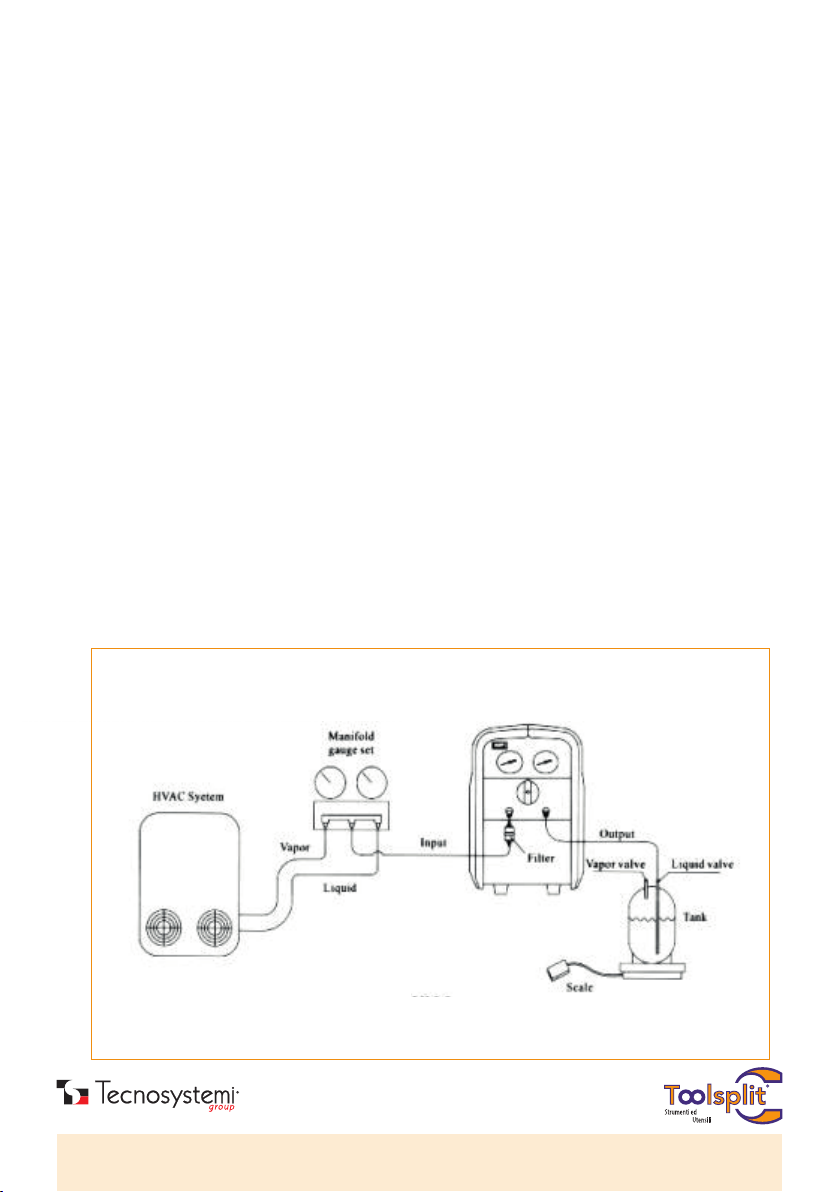
9. Dopo il recupero, assicurarsi che non sia rimasto del refrigerante nell’apparecchio. Leggere attentamente
le istruzioni per lo spurgo. Il liquido refrigerante rimasto nell’apparecchio può espandersi e distruggere i
componenti.
10.Se l’apparecchio viene messo in magazzino o non viene utilizzato per un certo periodo di tempo, si
raccomanda di svuotarlo completamente da ogni residuo di refrigerante e spurgarlo con azoto secco.
11.Si raccomanda l’uso di un tubo di collegamento con valvola di ritegno, per evitare perdite di refrigerante.
12.La valvola di aspirazione è dotata di un filtro. È necessario lavarlo spesso per tenerlo pulito.
13.L’interruttore non funziona tra le posizioni (“0”, “1”, “2”, “3”), deve puntare direttamente ai numeri.
14.Se accendere l’apparecchio risulta difficile, ruotare due volte l’interruttore per bilanciare la pressione
interna e facilitare l’accensione dell’apparecchio.
15.Il manometro di alta pressione mostra la pressione della porta di ingresso del compressore, e il manometro
di bassa pressione mostra la pressione della porta di uscita del recuperatore.
16.Dopo l’uso, portare la manopola sulla posizione “0”.
1. Do not mix different types of refrigerant in the same cylinder, as it would be impossible to separate or use them.
2. Before recovering the refrigerant, the tank must reach a vacuum level of -75 cmHg (-29.6psi), in order to remove
the non-condensable gases. At the time of production, each tank is filled with nitrogen at the factory, which
must be expelled before using the tank for the first time.
3. The switch must be in the “0 position” before switching on. When the appliance is not in use, all valves must be
closed and the inlet and outlet fittings must be covered with protective caps. In the absence of the latter, air and
humidity can negatively affect the recovery performance and reduce the life of the appliance.
4. Always use a filter dryer and replace it frequently. Each type of coolant must have its own filter. In order to
ensure good functioning of the appliance, please use the filter recommended by our company. In fact, high
quality filter dryers guarantee high quality performance.
5. Be very careful when recovering from a “burnt” system and use two filters.
6. The appliance is equipped with an internal high pressure shut-off device. If the pressure inside the device exceeds
38.5 bar, the device will switch off automatically. To restart the compressor, please reduce the internal pressure
(the internal high pressure shut-off device resets automatically), the compressor restarts automatically. When
starting the protection device, please first find the cause of the problem and solve it before turning on the power
again. Causes of a high pressure shutdown and troubleshooting:
• In case the coolant tank valve is closed, opening it may help to solve the problem.
• Check if the connection pipe between the appliance and the recovery tank is clogged. If yes, close all valves and
replace the hose.
• If the coolant tank temperature is too high, or the pressure is too high, allow it to cool for a few minutes and the
pressure will return to a normal level.
7. To optimize the recovery capacity, use a pipe with a diameter greater than 4 mm and a length less than 1.5 m.
8. For recovering large quantities of liquid, use Push/Pull Mode (see Push/Pull Mode on page 12)
9. After recovery, make sure there is no refrigerant left in the unit. Read the bleeding instructions carefully. Coolant
left in the unit can expand and destroy components.
10. If the unit is stored or not used for a certain period of time, it is recommended that it be completely emptied of
any residual refrigerant and purged with dry nitrogen.
11. It is recommended to use a connection pipe with check valve to avoid refrigerant leakage.