6
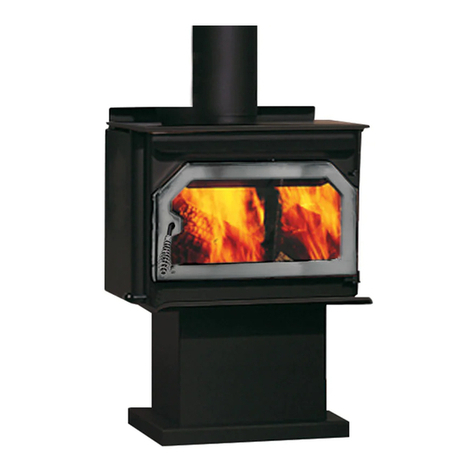
Encore®2040CE Non-Catalytic / Catalytic Wood Burning Stove
30005552
Flue Pipes with a spigot and socket joint should be fitted
with the socket facing upwards, to contain condensates
and moisture within the flue. Joints should be made gas
tight using proprietary jointing accessories, or, where ap-
propriate, by packing joint with noncombustible rope and
fire cement.
Double-wall connectors must be tested and listed for use
with solid-fuel burning appliances. Single-wall connectors
should be made of 24 gauge or heavier steel. Do not use
galvanizedconnector;itcannotwithstandthehightempera-
tures that can be reached by smoke and exhaust gases,
andmayrelease toxic fumesunderhigh heat. The connec-
tor may be 152 mm (6”) or 203 mm (8”) in diameter.
If possible, do not pass the chimney connector through
a combustible wall or ceiling. If passage through a com-
bustible wall is unavoidable, refer to the section on Wall
Pass-Throughs. Do not pass the connector through an
attic, a closet or similar concealed space. The whole con-
nector should be exposed and accessible for inspection
and cleaning.
In horizontal runs of chimney connector, maintain a dis-
tanceof 610mm (24”)from the ceiling. Keep it as short and
direct as possible, with no more than two 90° turns. Slope
horizontal runs of connector upward 6 mm per metere
(1/4” per foot) going from the stove toward the chimney.
The recommended maximum length of a horizontal run
is 914 mm (36”), and the total length should be no longer
than 2.4 m (8’). In cathedral ceiling installations, extend
the prefabricated chimney downward to within 2.4 m (8’)
of the stove.
Wear gloves and protective eyewear when drilling, cut-
ting or joining sections of chimney connector.
Double-wall Chimney Connectors
Information on assembling and installing double-wall con-
nectors is provided by the manufacturer of the double-wall
pipe. Follow the manufacturer’s instructions exactly as
you assemble the connector and attach it to the stove
and chimney. Using chimneys and connectors from the
same manufacturer makes the assembly and installation
straightforward.
NOTE: For installations using double-wall connectors,
minimumclearancesmust conformtothe listedclearances
in the clearance chart on Page 14.
If the Encore is equipped with the 203 mm (8”) flue collar,
anoval-to-round adapter will be needed. Double-wall oval-
to-roundadapters are available from somemanufacturers.
Your local dealer can help you select the right connector.
Single-wall Chimney Connectors
• Beginassembly at theflue collar ofthe stove. Insertthe
first crimped end into the stove’s flue collar, and keep
each crimped end pointing toward the stove. (Fig. 4)
Using the holes in the flue collar as guides, drill 3 mm
(1/8”) holes in the bottom of the first section of chimney
connector and secure it to the flue collar with three #10
x 1/2” sheet metal screws.
• Secure each joint between sections of chimney con-
nector,including telescoping
joints, with at least three (3)
sheet metal screws. The
pre-drilled holes in the top
of each section of chimney
connector serve as guides
when you drill 3 mm (1/8)
holes in the bottom of the
next section.
• Securethe chimney connec-
tor to the chimney. Instruc-
tions for various installations
follow.
• Be sure the installed stove
and chimney connector are
correct distances from nearby combustible materials.
NOTE: Special slip pipes and thimble sleeves that form
telescoping joints between sections of chimney connector
are available to simplify installations. They often eliminate
theneed to cut individual connector sections. Consult your
local dealer about these special pieces.
Securing the Single-wall Connector to a
Prefabricated Chimney
Followtheinstallationinstructionsofthechimneymanufac-
turer exactly as you install the chimney.The manufacturer
of the chimney will supply the accessories to support the
chimney, either from the roof of the house, at the ceiling of
the room where the stove is installed, or from an exterior
wall.
Special adapters are available from your local dealer to
make the connection between the prefabricated chimney
and the chimney connector. The top of such adapters
attaches directly to the chimney or to the chimney’s ceil-
ing support package, while the bottom of the adapter is
screwed to the chimney connector.
These adapters are designed so the top end will fit outside
the inner wall of the chimney, and the bottom end will fit
inside the first section of chimney connector. When as-
sembled in this way, any soot or creosote falling from the
inner walls of the chimney will stay inside the chimney
connector.
Fig. 4 the crimped end
of the connector points
toward stove.