manuals.online logo
Brands
  1. Home
  2. •
  3. Brands
  4. •
  5. Wadkin
  6. •
  7. Saw
  8. •
  9. Wadkin BSW 20 inch User manual

Wadkin BSW 20 inch User manual

Other Wadkin Saw manuals

Wadkin BRA 450 User manual

Wadkin

Wadkin BRA 450 User manual

Wadkin BSW User manual

Wadkin

Wadkin BSW User manual

Wadkin CK90 User manual

Wadkin

Wadkin CK90 User manual

Wadkin CK90 User manual

Wadkin

Wadkin CK90 User manual

Wadkin PBR User manual

Wadkin

Wadkin PBR User manual

Wadkin AGS400 User manual

Wadkin

Wadkin AGS400 User manual

Wadkin BSW 26 inch User manual

Wadkin

Wadkin BSW 26 inch User manual

Wadkin 24BSW User manual

Wadkin

Wadkin 24BSW User manual

Wadkin PP Series User manual

Wadkin

Wadkin PP Series User manual

Wadkin Ultracare DR User manual

Wadkin

Wadkin Ultracare DR User manual

Wadkin AGS400 User manual

Wadkin

Wadkin AGS400 User manual

Popular Saw manuals by other brands

General 90-125 M1 Setup & operation manual

General

General 90-125 M1 Setup & operation manual

Scheppach sd1600v instruction manual

Scheppach

Scheppach sd1600v instruction manual

Skil 5750 Operating/safety instructions

Skil

Skil 5750 Operating/safety instructions

Black & Decker Sawcat 3027-10 owner's manual

Black & Decker

Black & Decker Sawcat 3027-10 owner's manual

Uni-Vent PS-COS12 manual

Uni-Vent

Uni-Vent PS-COS12 manual

Bosch GKS 190 Professional Original instructions

Bosch

Bosch GKS 190 Professional Original instructions

Black & Decker KS999E user guide

Black & Decker

Black & Decker KS999E user guide

Ingco CS18528 instruction manual

Ingco

Ingco CS18528 instruction manual

IMET BS 300/60 SHI Instructions for use

IMET

IMET BS 300/60 SHI Instructions for use

Scheppach Deco-flex instruction manual

Scheppach

Scheppach Deco-flex instruction manual

CMi C-KGS-1450/210 Original instructions

CMi

CMi C-KGS-1450/210 Original instructions

Bosch GCO 14-2 operating instructions

Bosch

Bosch GCO 14-2 operating instructions

Clarke CCS185B Operation & maintenance instructions

Clarke

Clarke CCS185B Operation & maintenance instructions

Makita 2107F instruction manual

Makita

Makita 2107F instruction manual

Holzmann DKS 21PRO user manual

Holzmann

Holzmann DKS 21PRO user manual

RIDGID BS1400 owner's manual

RIDGID

RIDGID BS1400 owner's manual

Optimum OPTisaw CS 275 operating manual

Optimum

Optimum OPTisaw CS 275 operating manual

Makita BPB180 instruction manual

Makita

Makita BPB180 instruction manual

manuals.online logo
manuals.online logoBrands
  • About & Mission
  • Contact us
  • Privacy Policy
  • Terms and Conditions

Copyright 2025 Manuals.Online. All Rights Reserved.

,
20
l;
(~·S·l,v
'..
. I
www.DaltonsWadkin.com
CIRCULAR
SAWBENCH
TYP~
20'B§:tI
..
RIVING KNIFE ADJUSTABLE
TO SUIT SIZE
OF
SAW AND
RISES AND FALLS WI .SAW.
"
REMOVABLE GAP
PLATE WITHFELT
&WOOD PACKING
PIECES.
MACHINE
REFERENCE
NUMBER
PLATE~
MICRO
~DJUSTMENT
SAW RISE & FALL
, j LOCK.
I
REAR COVER GIVES
ACCESS TO BELTS.
MOTOR &PULLEYS.
www.DaltonsWadkin.com
2
SECTION A
SECTION B
Sl£CTION C
SECTION D
SECTION E
SECTION A
SECTION B
SECTION C
SECTION D
SECTIONS
SPECIFICATION
INSTALLATION
DESCRIPTION &
OP~{ATION
MAINTENANCE
SPARE PARTS
LIST
ILLUSTRATIONS·
FIG
A~
5QOmm
BSW
CIRCULAR
SAW
BENCH
FIG
B~
WIRING
DIAGRA.H
(3
PHASE)
FIG
B2
FIG
C~
FIG
C2
FIG
C3
FIG
c4
FIG
C4A
FIG
CS
FIG
c6
FIG
C7
FIG
cB-Cll
FIG
Dl
FIG
D2-D3
FIG
D4-D12
FIG
D13
FOUNDATION
PLAN
CANTING
FENCE
CONTROLS
FENCE
ALIGNMENT
POINTS
RIVING KNIFE DETAIL
R1SE
AND
FALL
CONTROLS
RIVING KNIFE DETAIL
MITRE
FENCE
MITRE FENCE STOP
ROD
POSITIONS
SAW
PACKINGS
OPERATION
OF
OPTIONAL
FEATURES
SA\{
SPINDLE ASSEHBLY
BELT
TENSIONING
SAW
MAINTENANCE
LUBRICATION
j
www.DaltonsWadkin.com
3
SECTION
A
SPECIFICATION
Maximum
diameter
of
saw-----------------------------------------
20"
500
mm
Maximum
saw
proj
ection
------------------------
7"
175
mm
Size
of
table
-------------------------------------------------
36" x 38"
915
x 965
mm
Table
height------------------------------------------------
34"
865
mm
Max.
distance
saw
to
fence
-----------------------
600
mm
Fence
dimensions-----------------------------------------------
17" x
6"
430 x
150
mm
Fence
cants
up
to----------------------------------------------
45°
Rise
and
fall
of
saw
spindle-------------------------------
100
mm
Speed
of
saw
spindle------------------------------------------
2200 rpm
Horse power
of
motor-----------------------------------------
7!
Diameter
of
saw
bore--------------------------------------
30
mm
Diame
ter
of
driving
pin
------------------------------
12
mm
Net
weight---------------------------------------------------
924
lb
420
kg
Gross
weight---------------------------------------------------
1230
lb
560
kg
Shipping
dimensions---------------------------------------------
46
cu.ft.
1.3
m3

www.DaltonsWadkin.com
4 SECTION B
•
Installation:-
Remove
protective
anti-rust
coating
£rom
bright
parts
by
applying
a
cloth
soaked
in
paraf£in
or
other
solvent.
Wiring,,:
-
The
motor
and
control
gear
have
been
wired
in
be£ore
despatch,
there£ore
all
that
is
required
to
be
done
is
to
connect
the
mains
supply
to
the
starter,
or
isolator
where
£itted.
POINTS
TO
NOTE
WHEN
CONNECTING
TO
POWER
SUPPLY.
1 -
Check
voltage,
phase
and
£requency
2 -
It
is
important
that
the
correct
cable
is
used
to
deliv~r
the
correot
voltage
to
the
starter.
RUNNING
ON
LOW
VOLTAGE
WILL
DAMAGE
MOTOR.
(SEE
LIST).
j
Check
main
line
fuses
are
of
correct
capacity.
4 -
Connect
line
leads
to
correct
terminals
(SEE
WIRING DIAGRAM).
5 -
Check
all
connections
are
sound.
6 -
Check
spindle
rotates
in
correct
direction.
If
not
reverse
any
two
o£
the
line
lead
connections.
FAILURE
TO
START:-
1
Fuses
have
blown
or
have
not
been
£itted.
2
Isolator
switch
ha~
not
been
closed.
3 -
Lock
o£f
or
stop
button
(when
fitted)
has
not
been
released.
4 -
Supply
not
available
at
machine.
STOPPAGE
DURING
OPERATION & FAILURE
TO
RESTART:-
I -
Overloads
have
tripped.
I£
hand
re-set,
set
by
pressing
button.
If
automatic
they
will
re-set
after
a
short
period.
2 -
Fuses
have
blown.
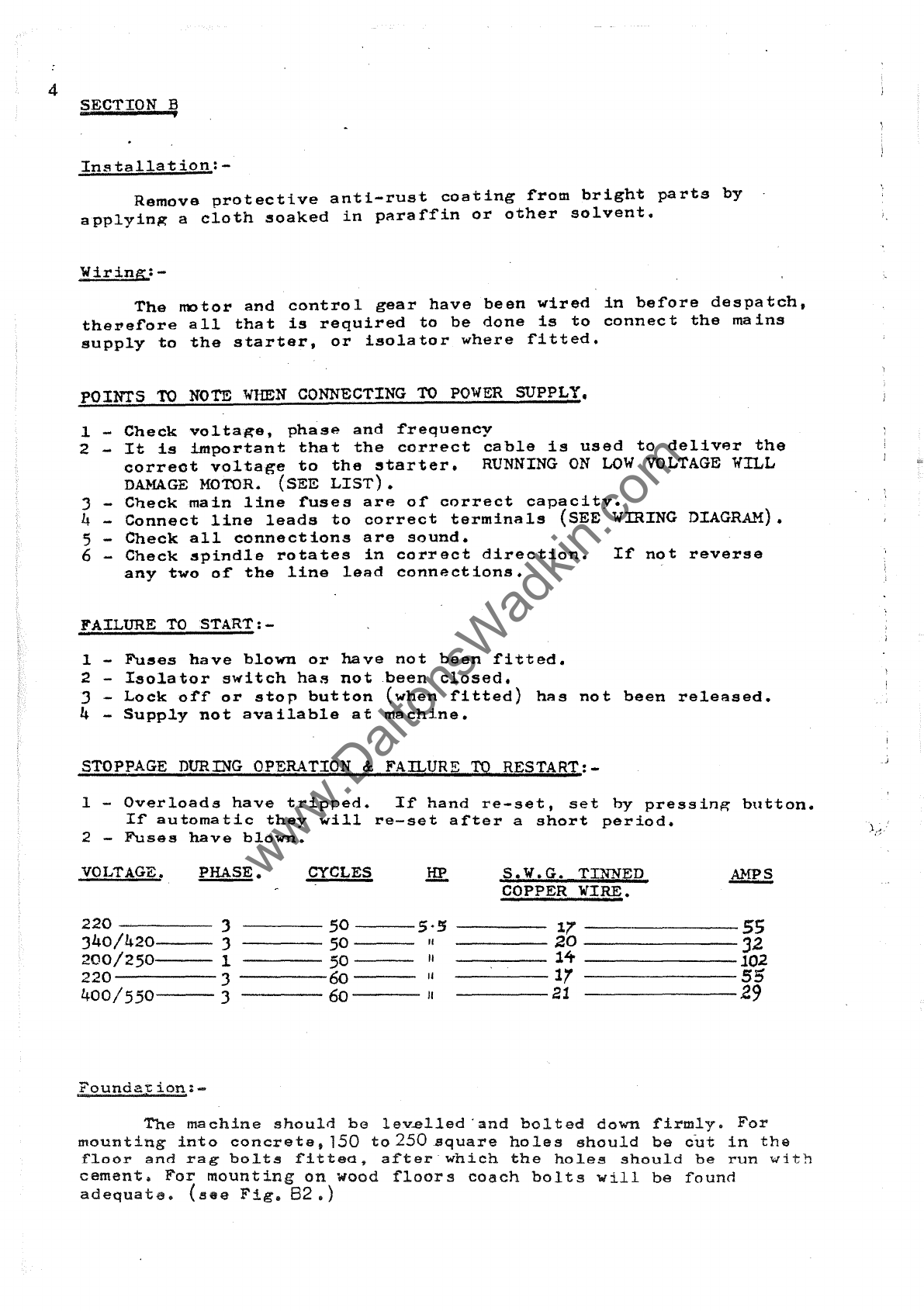
VOLTAGE.
PHASE.
CYCLES
l!!:
S.W.G.
TINNED
COPPER WIRE.
220
3
50
5-S
17'
340/420
j
50
11
.20
200/250
1
50
11
1-+
220
j
60
u
17
400/550
3
60
JI
21
,Foundat:ion:-
~
5S
32
102
55
29
The
machine
should
be
lev~lled'and
bolted
down
firmly_
For
mounting
into
concrete.
150
to250square
holes
should
be
cut
in
the
rloor
and
rag
bolts
fitted.
after
which
the
holes
should
be
run
with
cement.
For
mounting
on
wood
floors
coach
bolts
will
be
found
adequate.
(see
Fig.
82.)
www.DaltonsWadkin.com
-
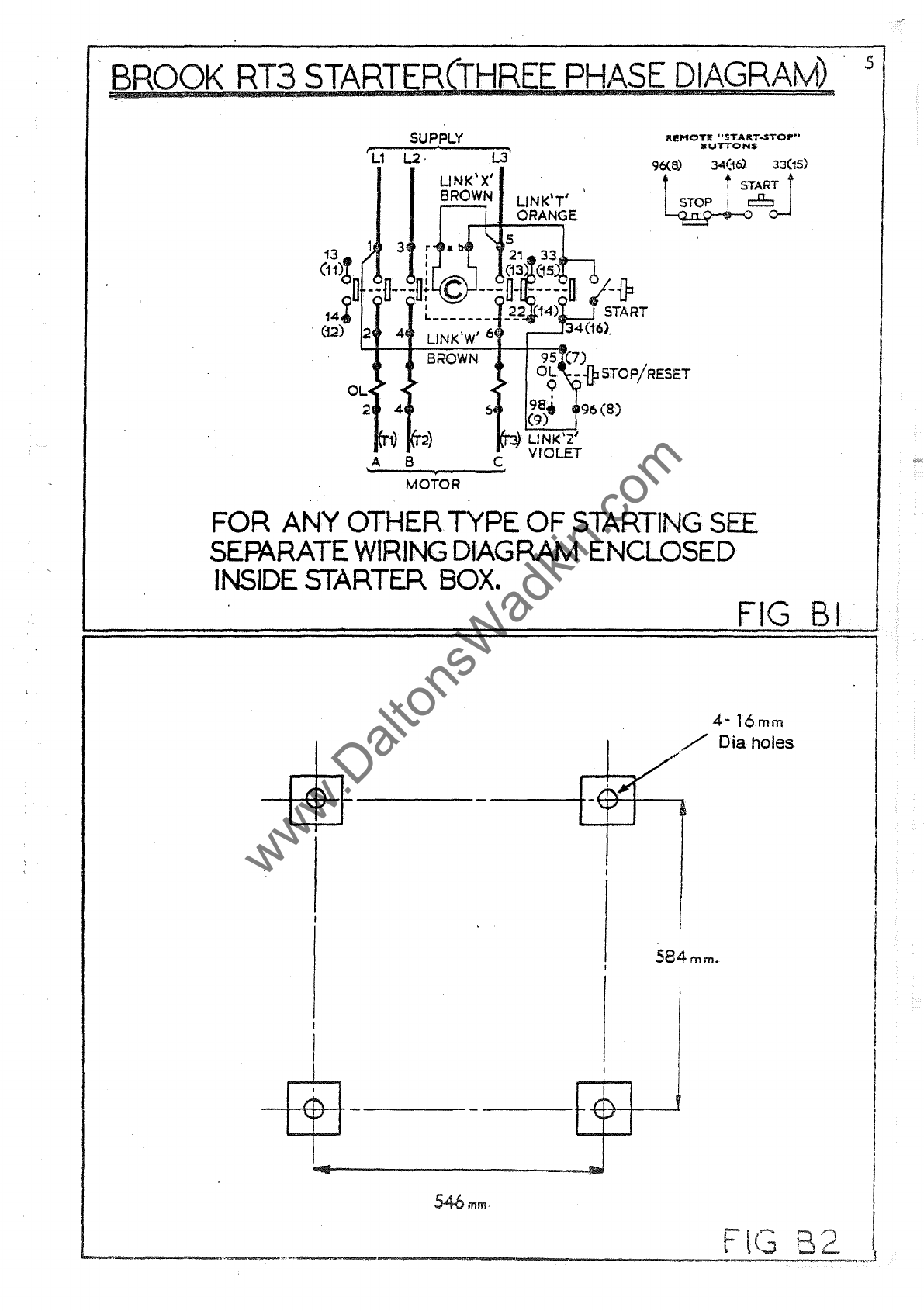
.t3BOOK
RT3
STARJER£THREE
PHhS
E
DIAGRAM).·
5
SUP,PLY
r
L1
L2
.L3'
LINK'X'
BROWN
L1NK'T' I
ORANGE
,A
B
C,
•
MOTOR
IU!,",OTI!
"STAftT·STO
..
••
IIUTTONS
FOR
ANY
OTHER
TYPE
OF
STARTING
SEE
SEPARATE
WIRING
DIAGRAM
ENCLOSED
INSIDE
STARTER
BOX.
FIG
BI
4-16mm
/Diaholes
584mm.
I I
I
!'\ --
f-
I'
~
j.I
\;
~
-
546
mm
www.DaltonsWadkin.com
6
SECTION C
CANTING &
RIP
FENCE
CONTROL~,
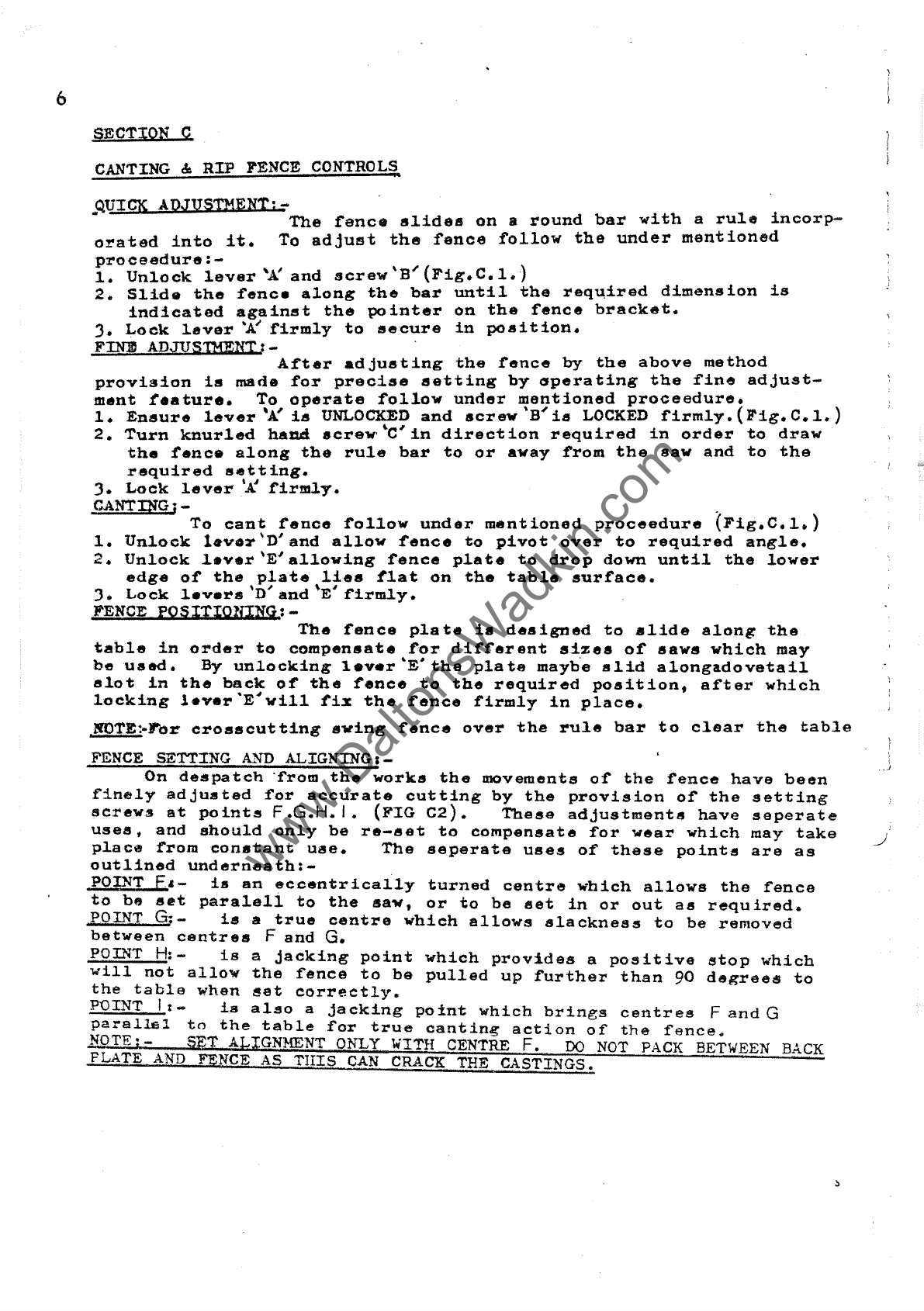
QUICK
ADJUSTMENT;-
•
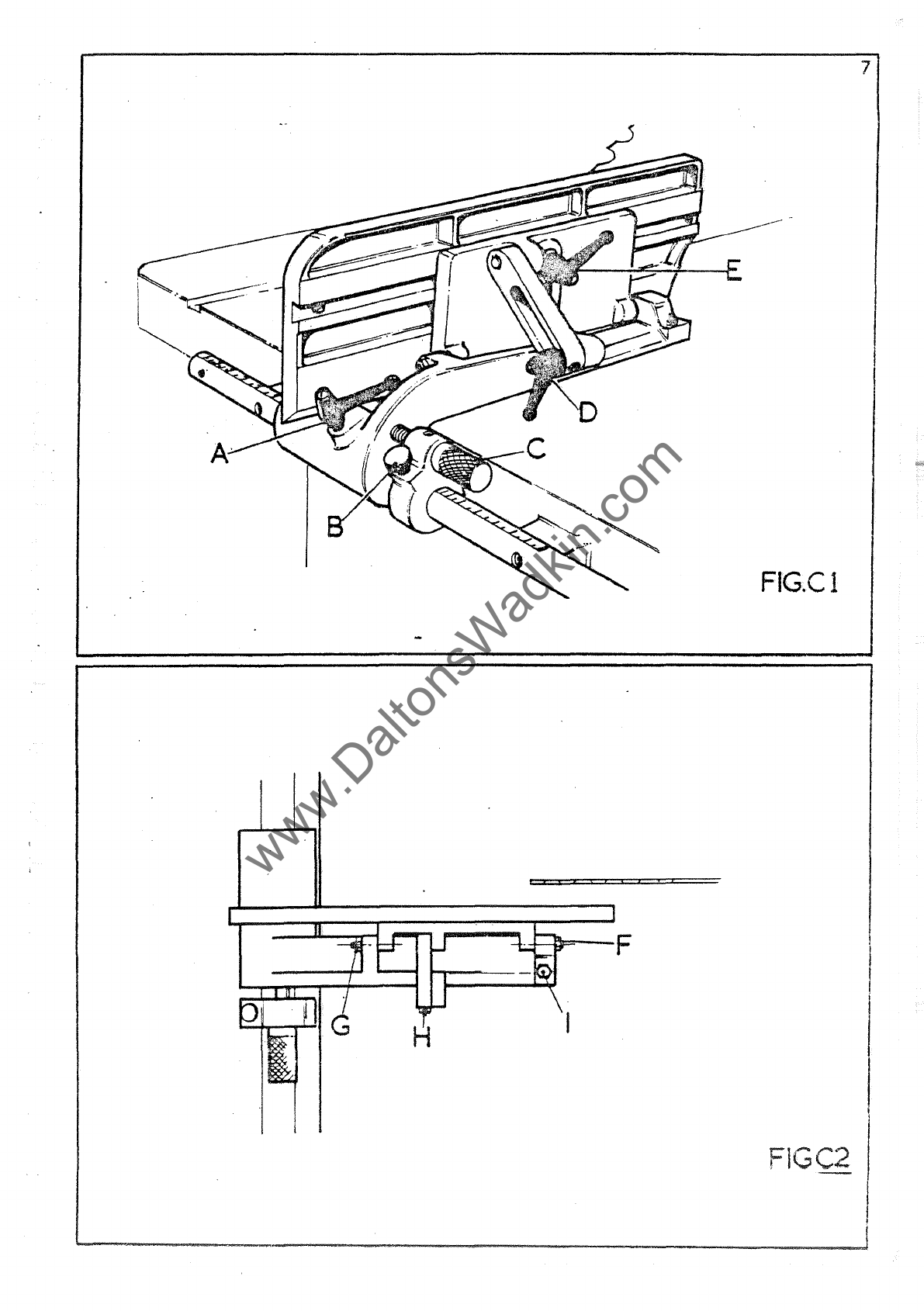
The
£ence
slides
on
a
round
bar
with
a
rule
incorp-
orated
into
it.
To
adjust
the
fenee
follow
the
under
mentioned
proceedure:-
~
L
Unlock
lever
"A:
and
screw'B
(Fig.
C.1.)
2.
Slide
the
fence
along
the
bar
until
the
req~ired
dimension
is
indicated
against
the
pointer
on
the
£ence
bracket.
3.
Lock
lever
'A"
£irm1y
to
secure
in
position.
FINlD
ADJVS1HENI:-
After
adjusting
the
fence
by
the
above
method
provision
is
made
for
precise
setting
by
Gperating
the
fine
adjust-
ment
reature.
To
operate
follow
under
mentioned
proceedure.
1.
Ensure
lever
'A'
is
UNLOCKED
and
screw'B"is
LOCKED
£irm1y.{Fig.C.1.)
2.
Turn
knurled
hand
screw'
'c'
in
direction
required
in
order
to
draw
the
fence
along
the
rule
bar
to
or
away
from
the
saw
and
to
the
required
setting.
3.
Lock
lever
'K
firmly.
CANTING;-
.
To
cant
fence
follow
under
mentioned
proceedure
(Fig.C.1.)
1.
Unlock
tevor'D'and
allow
fence
to
pivot
over
to
required
angle.
2.
Unlock
lever'E'a11owing
fence
plate
to
drop
down
until
the
lower
edge
of
the
plate
lies
flat
on
the
table
surface.
" "
3.
Lock
levers
D
and
E
firmly.
FENCE
PQSIIIQltINq:-
The
fence
plate
is
designed
to
slide
along
the
table
in
order
to
compensate
for
di£ferent
sizes
of
saws
which
may
be
used.
By
unlocking
1.v.r
'E'
the
pla
te
mayb'e
slid
alongadovetail
slot
in
the
back
of
the
fence
to
the
required
position.
after
which
locking
lever'E'Yill
fix
the
fence
firmly
in
place.
N01'E:-J'br
crosscutting
swing
fence
over
the
rule
bar
to
clear
the
table
FENCE SETTING
AND
ALIGNING:-
,.I
On
despatch
'from
the
works
the
movements
o£
the
fence
have
been
finely
adjusted
for
accurate
cutting
by
the
provision
o£
the
setting
screws
at
points
F.G.H.I.
(FIG
C2).
These
adjustments
have
seperate
uses,
and
should
only
be
re-set
to
compensate
for
wear
which
may
take
~
place
from
constant
use.
The
seperate
uses
of
these
points
are
as
outlined
underneath:-
POINT
F.,-
is
an
eccentrically
turned
centre
which
allows
the
fence
to
be
set
paraleli
to
the
say,
or
to
be
set
in
or
out
as
required.
POINT G;-
is
a
true
centre
which
allows
slackness
to
be
removed
between
centres
F
and
G.
POINT
H:-
is
a
jacking
point
which
prov1des
a
positive
stop
which
will
not
allow
the
fence
to
be
pulled
up
further
than
90
degrees
to
the
table
when
set
correctly.
POINT 1t -
is
also
a
jacking
point
which
brings
centres
F
and
G
parallel
to
the
table
for
true
canting
action
of
the
fence.
NOTFJ-
SET ALIGNMENT
ONLY
WITH
CENTRE
F.
DO
NOT
PACK
BETWEEN
BACK
PLATE
AND
FENCE
AS
THIS
CAN
CRACK
THE
CASTINGS.
www.DaltonsWadkin.com
7
FIG.Cl
IGC2
www.DaltonsWadkin.com
8
RISE
AND
FALL CONTROLS:-
By
turning
handwheel
'J'
(fig.
04
)
the
saw
may
be
raised
or
lowered
between
the
maximum
and
minimum
position
as
given
in
section
'A'
specificati~n.
Under
no
circumstances
shoulrl
this
dimension
be
varied.
It
i.
imp~~tant
after
operating
the
rise
and
fall
that
lever
handle
'K'
is
loc.ked
firmly
before
running
the
saw.
The
rise
and
fall
handwheel
is
connected
through
pivoted
yolks
at
~ints
A.
&
B.
(FIG
04.)
At
the
handwheel
end
of
the
screw
a
thrust
race
C
is
fitted
to
give
free
ro~ation
when
in
use.
It
is
therefore
important
that
th~
pivots
and
screw
are
cleaned
and
luhricated
regular-
ly
a~d
that
the
tirust
race
is
oiled
according
to
the
maintenance
schedule.
RIVING
KNIFE
PLATE:-
The
riving
knife
plate
is
situated
behind
the
saw
in
the
saw
com-
partment
ID'
(fig.
C4A}
and
allows
the
riving
knife
to
rise
and
fall
with
the
saw
at
a
set
clearance
to
the
saw
teeth.
It
is
important
that
the
area
surrounding
the
radial
slot
cut
in
the
plate
be
kept
clean
and
well
lubricated
to
give
free
movement.
RIVING
KNIFE,HOLDER DETAIL
The
riv1ng
knife
is
supplied
in
the
inverted
position.
:fit
upright
adopting
the
f'ollowing
proceedure:
-(figC3)
Remove
and
1.
~it
knife
into
groov~d
oacking
piece
'E'
and
bolt
up
to
solid
pack-
ing
piece
'P"
with
the
lOr:nm
nLJ.ts'G'
provided.
2.
With
saw
in
place
set
knife
to
clear
around
saw
teeth
approximatelv
~"
(6mm)
and
lock
firmly
in
place
with
nuts
'G'.
.
).
If
the
knife
is
not
in
line
with
the
saw,
partially
slacken
nuts
'G'
and
jeck
packing
piece
'F'
out
with
grub
screws
'H'
until
the
knif'e
has
equal
overhand
either
side
of'
the
saw
blade.
Lock
nuts
'G'
firmly.
NOTE:-
BE~ORE
RUNNING, ADJUST
SAW
GUARD
TO
GIVE
MAXIMUM
PROTECTION
AND
TO
CLEAR
SAW
BLADE.
DO
NOT
RUN
MACHINE
WIT!iOt!l'
GUARD
IN
POSITION.
IMPORTANT:-
ENSURE
THAT
RIVING
KNIFE
BLADE
IS
CORRECT
IHICKNl:tSS
FOR
SA\l USED
, H
'(:J\
® .-
~
-
(@@
:\1
E
I H
\
.Riving Knife
i
)
www.DaltonsWadkin.com
9
FIGC4 '
FIGC4A
www.DaltonsWadkin.com