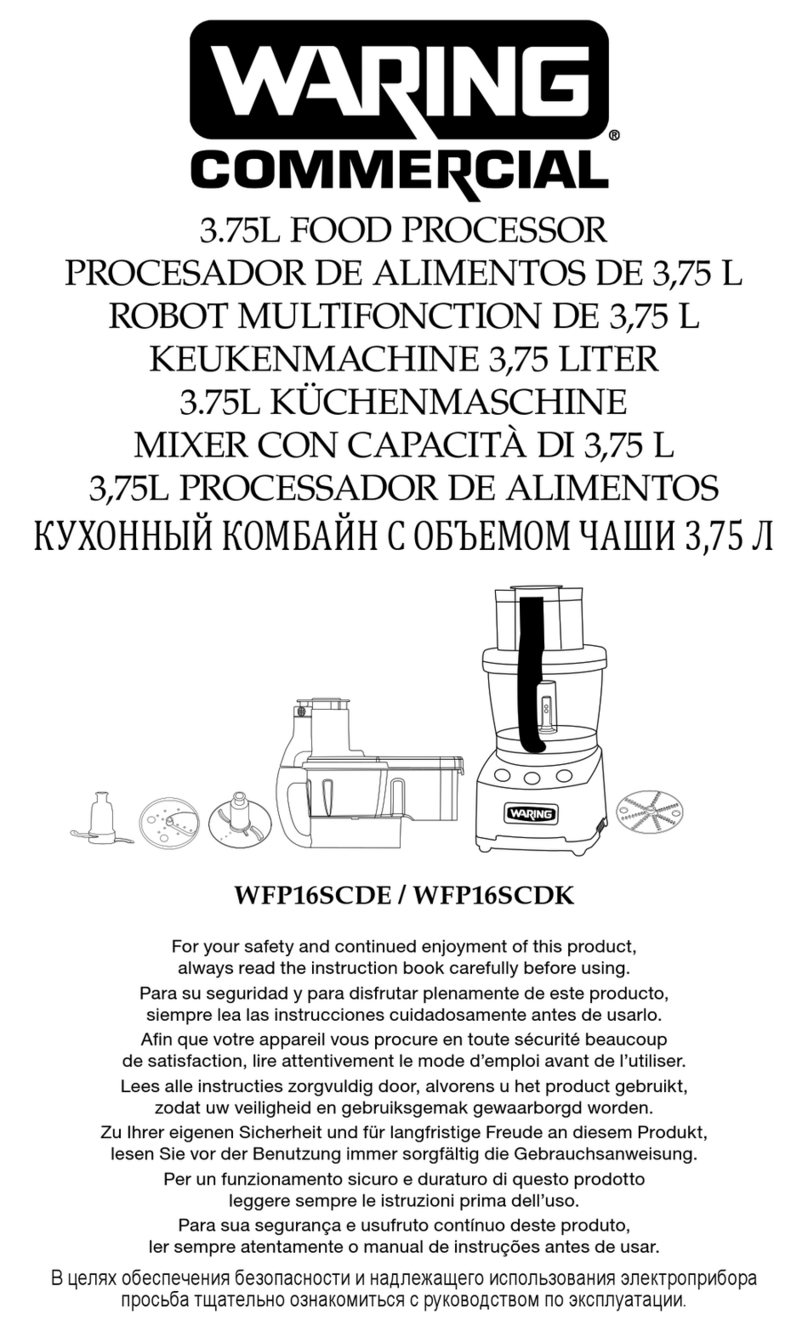
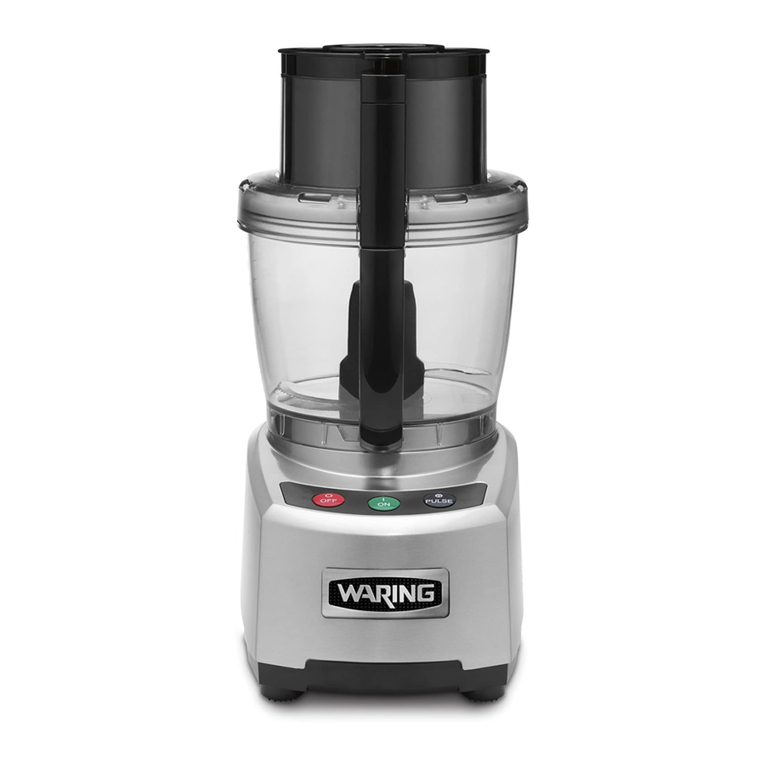
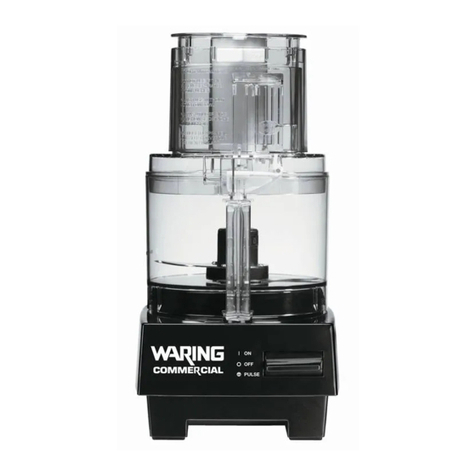
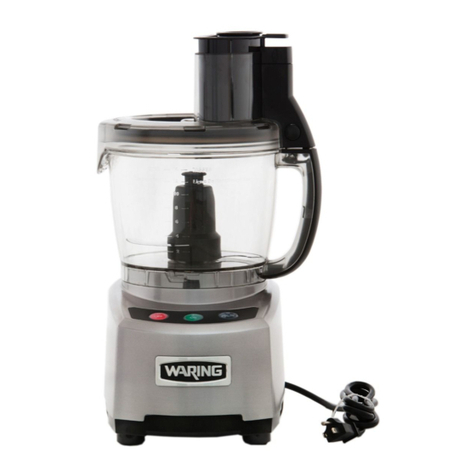
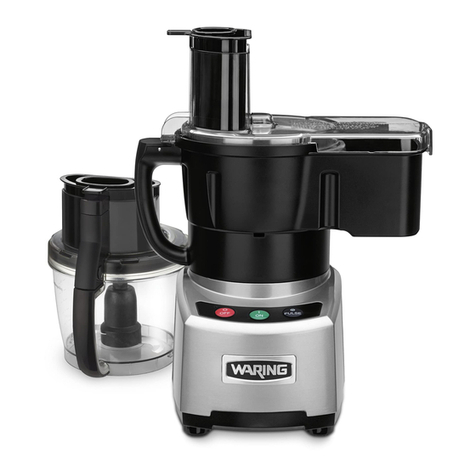
Waring WFP16SE User manual

WFP16SE/WFP16SK
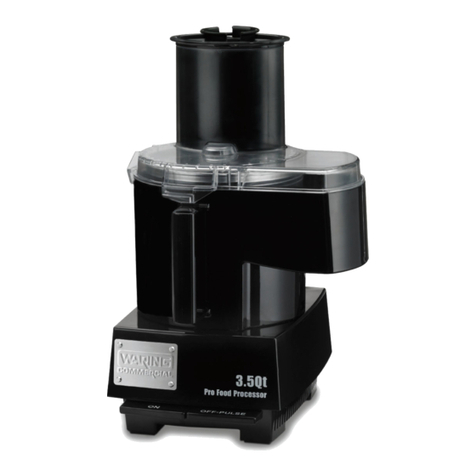
3.75L FOOD PROCESSOR
With SEAL SYSTEM
PROCESADOR DE ALIMENTOS DE 3,75 L
con SELLO HERMÉTICO
ROBOT MULTIFONCTION DE 3,75L
avec SYSTÈME D’ÉTANCHÉITÉ
KEUKENMACHINE 3,75 LITER
met AFDICHTSYSTEEM
3,75 L KÜCHENMASCHINE
Mit VERSIEGELUNGSSYSTEM
MIXER CON CAPACITÀ DI 3,75 L
Con SISTEMA DI TENUTA
3,75 L PROCESSADOR DE ALIMENTOS
Com SISTEMA DE SELAGEM
For your safety and continued enjoyment of this product,
always read the instruction book carefully before using.
Para su seguridad y para disfrutar plenamente de este producto,
siempre lea las instrucciones cuidadosamente antes de usarlo.
An que votre appareil vous procure en toute sécurité beaucoup de satisfaction,
lire attentivement le mode d’emploi avant de l’utiliser.
Lees alle instructies zorgvuldig door, alvorens u het product gebruikt,
zodat uw veiligheid en gebruiksgemak gewaarborgd worden.
Zu Ihrer eigenen Sicherheit und für langfristige Freude an diesem Produkt,
lesen Sie vor der Benutzung immer sorgfältig die Gebrauchsanweisung.
Per un funzionamento sicuro e duraturo di questo prodotto
leggere sempre le istruzioni prima dell’uso.
Para sua segurança e usufruto contínuo deste produto,
ler sempre atentamente o manual de instruções antes de usar.
В целях обеспечения безопасности и надлежащего использования электроприбора
просьба тщательно ознакомиться с руководством по эксплуатации.

2
IMPORTANT SAFEGUARDS
When using electrical appliances, basic safety precautions should
always be followed including the following:
1. READ ALL INSTRUCTIONS.
2. Unplug from outlet when not in use, before putting on
or taking off parts, before removing food from work
bowl, and before cleaning. To unplug, grasp plug when
pulling from electrical outlet. Never pull cord.
3. Unplug from outlet prior to handling or cleaning the unit.
4. Blades are sharp. Handle carefully.
5. This appliance is not intended for use by persons
(including children) with reduced physical, sensory
or mental capabilities, or lack of experience and
knowledge.
Children should be supervised to ensure that they do
not play with the appliance.
6. To avoid injury, never place cutting blade or disc on base
without rst having put the bowl properly in place.
7. Keep hands as well as spatulas and other utensils away
from moving blades or discs while processing food to
prevent the possibility of severe personal injury or damage
to the food processor. A plastic scraper may be used, but
must be used only when the food processor is not running.
8. To protect against risk of electric shock, do not put base in
water or other liquids.
9. Avoid contact with moving parts. Never feed food by hand
when slicing or shredding. Always use food pusher.
10. Make sure motor has completely stopped before removing
the cover.
11. Do not operate any appliance with a damaged cord or plug,
or after appliance has been dropped or damaged in any
manner. Return appliance to the nearest authorized service
facility for examination, repair or adjustment.
12. The use of attachments not recommended or sold by
Waring Commercial may cause re, electric shock or injury.
13. Do not use outdoors.
14. Do not let cord hang over edge of table or counter, or touch
hot surfaces.
15. Do not attempt to defeat the cover interlock mechanism.
16. Be certain cover is securely locked in place before operating
appliance.

3
17. If the machine malfunctions for any reason, discard any food
being processed at that time.
18. Children should be supervised to ensure that they do not
play with the appliance.
19. Your Waring®Commercial food processor is a piece of
kitchen equipment, and like all other kitchen equipment,
extreme care must be used when operating it. Although
training requirements are minimal, only responsible and
prudent individuals should be allowed to operate this food
processor. It should not be used by or near children or
individuals with certain disabilities.
20. This product is ETL listed for household use. Use it only for
food preparation as described in this book.
21. Caution: Do not use dicing application (WFP16S13) with
220-240V CE-approved versions.
22. Be careful if hot liquid is poured into the food processor or
blender as it can be ejected out of the appliance due to a
sudden steaming. This food processor is not intended to be
used for hot recipies.
SAVE THESE INSTRUCTIONS
Correct Disposal of this product
This marking indicates that this product should
not be disposed with other household wastes
throughout the EU. To prevent possible harm to the
environment or human health from uncontrolled
waste disposal, recycle it responsibly to promote
the sustainable reuse of material resources. To
return your used device, please use the return and
collection systems or contact the retailer where the
product was purchased. They can take this product
for environmentally safe recycling.
TO ENSURE PROPER USE OF THIS UNIT, PLEASE SEE
IMPORTANT GROUNDING INSTRUCTIONS BELOW. PRIMARY
COUNTRIES USING THE DIFFERENT PLUG TYPES ARE LISTED
FOR REFERENCE ONLY. REFER TO THE ACTUAL UNIT TO
DETERMINE WHICH PLUG TYPE IS APPLICABLE.

4
INTRODUCTION
Waring®Commercial food processors are the most versatile food
processors in their class, featuring a seal system that enables
processing of large volumes of liquid without leakage and the
need to remove the S-blade while pouring. These professional
machines are prime examples of Waring’s seventy-ve years of
industry food service experience, as well as seventy-ve years of
food processing experience.
This food processor comes with a sealed work bowl (also known
as a batch bowl) and a sealed/locked cutter blade (or S-blade) to
chop, grind, purée and mix. The patented seal system allows for
processing large volumes of liquids with no leakage. Additional
discs provided allow for shredding, slicing and whipping directly
in the sealed batch bowl.
Size, power and convenience
The wide feed tube makes processing high volumes of
larger-sized foods convenient and easy. The motor shaft is built
for durability. The housing, work bowl, chute, covers and pushers
are all made from durable polycarbonate for heavy-use conditions
and easy cleanup. The clear bowl and processing covers are
convenient for viewing food processing and are made of
heavy-duty material to withstand heavy-duty use.
TYPE F PLUG
(GERMANY, AUSTRIA, NETHERLANDS,
SWEDEN, NORWAY, FINLAND,
PORTUGAL, SPAIN, EASTERN EUROPE)
TYPE G PLUG
(UNITED KINGDOM, IRELAND,
CYPRUS, MALTA, MALAYSIA,
SINGAPORE AND HONG KONG)

5
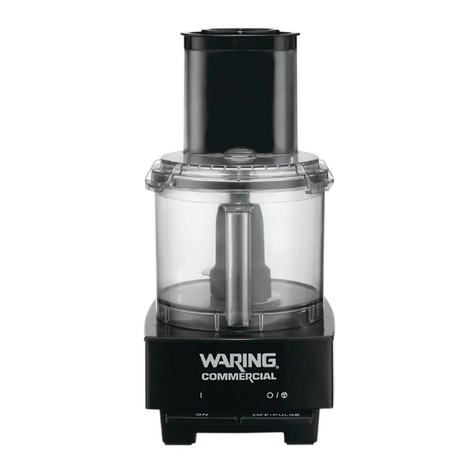
THE PARTS
This Waring®Commercial Food Processor consists of the
following standard parts and accessories:
1. Die-cast motor base with vertical heavy-duty shaft
2. Three control buttons
a. OFF
b. ON
c. PULSE
3. Safety interlock (not shown) prevents machine from operating
until cover is correctly in place
4. Sealed clear 3.75L work bowl
5. Sealed clear work bowl cover
a. Large feed tube for maximum use of cutting surface
b. Large pusher with full-size and reduced-size feed options
c. Small pusher used within the large pusher for smaller
vegetables, pepperoni, etc.
Note: This combination pusher allows use of the entire feed
tube for large foods and provides controlled processing for
small-diameter foods such as carrots, celery and
pepperoni.
6. Sealed S-blade (cutter blade) to chop, grind, purée, and mix;
locks in place for liquid processing and easy pouring
7. Adjustable slicing disc
8. Reversible shredding disc
9. Sealed whipping disc
10. Detachable disc stem for use with adjustable slicing disc and
reversible shredding disc

6
2.
4.
1.
5.
8.
7.
9.
6.
10.
5a.
5c.
5b.
a. b. c.

7
ASSEMBLY OF BATCH BOWL PARTS
We will use the terms work bowl, batch bowl and cutter bowl
interchangeably throughout this instruction book. They mean the
same thing.
Prior to first use:
• Clean and sanitize the motor base. Wash, rinse, and sanitize
the work bowl, cover, food pusher, food pusher insert and
accessories.
• Place base on a counter or table near an electrical outlet.
Position it so you look at the front of the unit and can see the
control panel. Do not plug in the cord until the processor is
completely assembled.
• Pick up the transparent work bowl, holding it in both hands with
the handle toward you.
• Place the bowl on the base, tting its central tube over the
motor shaft on the base and placing its handle slightly to the left
of center (at about a 7 o’clock position).
• Press the bowl down so the lower rim ts around the circular
platform. Turn the bowl counterclockwise as far as it will go. It
will lock into position with the tabs on the sides of the
platform.
Read this if assembling the batch bowl parts to use S-blade
(cutter blade) or whipping disc:
• Pick up the S-blade or whipping disc, noting the diagram on
the top of the plastic center. It matches the shape of the motor
shaft.
• Place the S-blade or whipping disc over the tip of the motor
shaft, lining up the inside of the hub with the shaft. Press it
down rmly, rotating the center hub until the blade or disc
assembly is fully seated. It should easily drop into place. Push
rmly to lock and seal S-blade or whipping disc hub in place.
Be sure it is pushed down as far as it will go. If it is not all the
way down, it may become damaged and any liquid may leak.
Push only on the center section (plastic part); never touch the
cutting blade, as it is extremely sharp.
• Check to be sure the blade or disc is all the way down by
turning it back and forth while gently pushing it down. If
properly installed and fully seated, the lower blade will be
positioned just above the inside bottom of the bowl.

8
• If processing food with the S-blade or whipping disc, now is the
time to add the food or liquid to the work bowl.
• Do not ll liquid over MAX LIQUID FILL LINE. If too much
liquid is used, it will overow. In this case, stop operation,
remove liquid to below MAX LIQUID FILL LINE and continue
processing.
Read this if assembling batch bowl parts to use accessory
discs in batch bowl:
To assemble the adjustable slicing disc (WFP16S10), you
must remove bowl cover. Position the disc stem over the drive
shaft securely. Next, select the desired thickness setting on your
adjustable slicing disc. There are 16 different positions ranging
from 1–6mm in thickness. Once you’ve set the thickness, position
the plastic receptacle over the disc stem securely. Do not turn on
the unit until the batch bowl is properly assembled with the cover
and large pusher in place.
To assemble the reversible shredding disc (WFP16S12), you
must remove bowl cover. Position the disc stem over the drive
shaft securely. Next, select the desired shredding blade size. Your
reversible shredding disc has ne shredding blades on one side
and medium shredding blades on the other. Be sure the desired
blade size is facing up, and position the disc on the disc stem
securely. Do not turn on the unit until the batch bowl is properly
assembled with the cover and large pusher in place.
NEVER ATTEMPT TO START THE FOOD PROCESSOR
WITHOUT THE COVER LOCKED INTO POSITION AND THE
LARGE PUSHER IN PLACE.
Two pushers for feed tube
There is a large food pusher and small food pusher. The large
pusher is for processing larger vegetables. The small pusher
nests in the large pusher and can be used for smaller vegetables,
guiding long thin vegetables for more precise cuts, or for jobs like
slicing pepperoni. Insert the small food pusher into the large food
pusher opening. Now you are ready to insert the large pusher into
the feed tube opening.
NOTE: There is a long pin on the front side of the large pusher.
The food processor will not operate until the pin is properly
actuating the interlock system.

9
DISASSEMBLY OF BATCH BOWL PARTS
ALWAYS UNPLUG THE CORD BEFORE DISASSEMBLING.
• Remove the large food pusher from the feed tube. Remove the
small pusher from the large pusher.
Disassembly when removing the S-blade or
whipping disc
• Remove the work bowl from the unit by rotating clockwise
to disengage the tabs on the bottom of the bowl platform
from the work bowl. When the bowl handle is on the left
(about 7 o’clock position), you can gently lift the bowl
straight up and out.
It is recommended that you remove the bowl from the motor
base before you remove the S-blade or whipping disc.
NOTE: REMOVE ALL FOOD AND LIQUID BEFORE REMOVING
S-BLADE OR WHIPPING DISC, OR BOWL WILL LEAK.
• To remove the blade or disc, keep a slight downward pressure
on the top center hub of the blade or disc while removing the
bowl from the motor base. This will form a seal to prevent food
particles from spilling into the center tube of the bowl and onto
the motor base or the work surface. Remove all contents from
the batch bowl. Then remove the S-blade or whipping disc
from the bowl by pulling upward to unlock the seal. Handle the
S-blade with caution; the blades are extremely sharp.
Disassembly when removing an accessory disc
• Do not remove the work bowl until the accessory disc is
removed.
• To remove an accessory disc, place your ngers on the outer
edge of two opposite sides of the disc and lift. The disc should
remove easily. To remove the detachable stem, hold the disc in
one hand with the stem facing away from your hand. Be careful
not to scrape your hand on any sharp edges.
• Remove the work bowl from the unit by rotating clockwise
to disengage the tabs on the bottom of the bowl platform
from the work bowl. When the bowl handle is on the left (about
7 o’clock position), you can gently lift the bowl straight up and out.

10
OPERATING THE CONTROLS
• Plug the machine into an electrical outlet.
• There are three control buttons on the base unit.
The three controls are: ON
OFF
PULSE
How they work: ON: Press the ON button to start the motor.
OFF: To turn the motor off, press the OFF
button.
Pulse: To pulse the motor, press the PULSE
button down, then release. The motor will
run as long as you hold the button down; it
stops when you release the button.
HOW TO USE
Continuous use
For continuous processing, use the ON button, which is located
in the middle.
Pulsing
• For rapid ON/OFF operation, use the PULSE. The motor runs as
long as you hold the button down; it stops when you release the
button.
• You control pulsing. You control the duration of each pulse by
the amount of time you hold the button down. You control the
frequency of pulses by the rate at which you press the button.
The interval between pulses must be long enough to allow
everything in the work bowl to fall to the bottom.
• Pulsing gives you greater control over consistency when
chopping, blending and mixing.
• Pulsing is also useful in processing hard foods. Pulse the food
a few times to break it up into smaller parts. Then proceed with
continuous use after the pieces are broken up and easier to
process.
• Always use the PULSE button for pulsing. Never move the
bowl and cover assembly on or off to control pulses. It is less
efcient and could damage the machine.

11
Turning off
Always turn the machine off with the OFF button and wait until
the blade or disc comes to a complete stop before removing
the pusher assembly. The motor stops within seconds after the
machine is turned off.
FOOD PREPARATION
• Prepare all food items to be processed by washing and peeling
as required. Remove pits, stones, and large seeds.
• Cut vegetables, meats, cheeses, etc. into sizes that will t
into either the small or large feed tube for processing with
accessory discs.
• Preparation for slicing: Produce that is long and cylindrical such
as carrots, cucumbers and celery should be cut at at both
ends. This will provide a consistent slice for all food processed.
RESETTING THERMAL PROTECTION
This food processor is equipped with an automatic reset switch
to protect the motor from overheating.
If your food processor stops running under heavy use, turn the
power switch off and unplug the power cord. Empty the work
bowl of all its contents and discard. Allow approximately 30
minutes for the motor to cool down.
Reassemble unit, plug the power cord back into the outlet and
run rst with the bowl empty. Put food into the bowl and continue
processing.
If your food processor does not function properly following this
procedure, discontinue use and contact your distributor.
USE INSTRUCTIONS FOR S-BLADE
(CUTTER BLADE)
• The sealed S-blade (cutter blade) is designed for chopping,
grinding, puréeing, blending, mixing or kneading.
• Assemble the bowl and blade as instructed in the section titled
“Assembly of Batch Bowl Parts” (page 7).

12
Chopping and mincing
• To chop or mince in the bowl, ll the bowl up to ¾ full.
• To chop or mince most effectively, use the pulse function. This
allows for better control over consistency. Continue pulsing until
the desired consistency has been reached.
• If chopped foods are processed continuously, the food could
be processed unevenly, i.e., food on the bottom will be nely
chopped and food on the top will be more coarse.
Chopping meat
Cut meat into 1-inch (2.5 cm) pieces to ensure an even chop.
Process no more than 2.25 lb. (1 kg) of meat at a time. Press the
PULSE button 3 or 4 times at a rate of 1 second on, 1 second
off. If the food is not chopped ne enough, let the processor
run continuously for a few seconds. If the machine has trouble
starting, reduce the amount of meat in the bowl and start again.
Chopping/grating hard cheese
To chop, put up to 2 lb. (910 g) of uniformly cut 1-inch (2.5 cm)
cubes of chilled cheese into the bowl and pulse. For grated
cheese, pulse until the cheese is in small chunks (pea size), then
allow the processor to run continuously until you have the degree
of grating desired. Cheese with high moisture content can ball up
if processed too long.
Chopping onions, celery, cabbage, etc.
Cut onions into quarters, and other vegetables into 1-inch
(2.5 cm) cubes. Put the cubed food into the work bowl up to the
top of the bowl’s inner tube, and pulse until you reach the desired
consistency.
Note: If you let the blade run too long, the ingredients on the
bottom will become puréed or give you uneven results.
Purée or Mix
To purée tomatoes, vegetables and fruits, make sauces, or mix
and blend ingredients, put the ingredients into the bowl, turn the
unit on and allow it to run continuously until you reach the desired
consistency. Do not let the machine run unattended. If too much
liquid is used, it will overow. In this case, stop operation, remove
liquid to below the MAX FILL LINE and continue processing.
Do not fill liquid past MAX LIQUID FILL LINE.

13
Turning the machine off with the OFF button.
• Always switch the food processor off by pressing and releasing
the OFF button. This assures that the power is not supplied to
the motor.
• Always switch the food processor off and wait until rotation
stops before removing the cover.
• While the safety interlock switch will turn the machine off if
the bowl is rotated clockwise or the cover or large pusher is
removed while running, this should not be the means of turning
the machine on or off.
• As a safety precaution, always make sure the machine is off by
pressing the OFF button before pushing down the lid.
ACCESSORY DISC SELECTION AND USE
The food processor disc accessories are made to perform a wide
variety of food processing tasks: slicing, whipping, shredding and
grating. Three (3) accessory discs are included.
As of this printing they are:
WFP16S10 – Adjustable Slicing Disc
WFP16S11 – Sealed Whipping Disc
WFP16S12 – Reversible Shredding Disc
SLICING OPERATION
• This food processor comes with an adjustable slicing disc.
The adjustable slicing disc allows you to slice foods anywhere
from 1 to 6mm thick using 16 different slicing positions! Prior
to mounting the disc onto the motor shaft (see page 8
for assembly instructions), use the knob to select desired
thickness. Once you have selected the thickness and mounted
the disc onto the unit, you may secure the sealed bowl cover
onto the batch bowl and remove the pusher.
• Prepare all food items to be processed by washing and peeling
as required. Remove pits, stones, and large seeds. Be sure the
food will t into the proper feed chute. Foods such as carrots,
cucumbers, etc., should be cut at at both ends to provide a
consistent slice throughout the whole product.
• With foods like cabbage, lettuce or any product that has an
undesirable core, the core should be removed. Medium-size
cabbage or lettuce heads may be cut into thirds to t in the
feed chute. Larger heads may need to be quartered.

14
• When food is ready for slicing, ll the chosen feed chute, and
put the pusher in place so that the pin is actuating the interlock
system. Turn the machine on and monitor the results.
• Never try to slice soft cheese. Use only hard cheese.
Mozzarella may be sliced only when well chilled.
• When the bowl reaches nearly full capacity, remove all sliced
food from the bowl.
• Do not ll food over MAX FILL LINE on the feed tube of
workbowl cover when processing with large pusher.
SHREDDING OPERATION
• This food processor comes with a reversible shredding disc.
Both sides on this disc produce a perfect shred, one ne, the
other medium. When inserting the shredding disc, note that the
side facing up will be the size shred produced. When the disc
is secured, cover with the sealed batch bowl cover and remove
the pusher.
• Prepare all food items to be processed by washing and peeling
as required. Remove pits, stones, and large seeds. Be sure the
food will t into the proper feed chute.
• Select which feed tube to use. Horizontal placement of foods
such as carrots and zucchini will result in a longer shredded
product. Using the smaller chute and small pusher with food
inserted vertically will yield a shorter shredded product.
• Never try to shred soft cheese. Use only hard cheese.
Mozzarella may be shredded only when well chilled; place
mozzarella in a freezer for 1 hour prior to shredding. Use
PULSE button when shredding cheese.
• When the bowl reaches nearly full capacity, remove all
shredded food from the bowl.
• Do not ll food over MAX FILL LINE on the feed tube of
workbowl cover when processing with large pusher.
SEALED WHIPPING DISC OPERATION
• This food processor comes with a sealed whipping disc. See
page 8 for assembly instructions to install the whipping disc.
Once assembled, you are ready to start adding in your favorite
ingredients!
• The whipping disc makes any whipping job easy and quick.
During the whipping process, air is added to the mixture. As air

15
is added, the mixture expands. Be sure that the mixture does
not expand beyond the MAX FILL LINE or it may leak through
the feed tube. If the mixture expands to the point where it leaks
out the feed tube, stop operation and reduce the contents of
the bowl to below the MAX LIQUID FILL LINE and continue
operation.
For whipped cream, simply add heavy cream and your choice
of avoring. Be sure the bowl is properly assembled with the
bowl cover. Press the ON button for continuous operation and
whip the cream until thick and uffy.
To make butter, add heavy cream and your choice of
seasoning into the batch bowl. Be sure the bowl is properly
assembled with the bowl cover. Press the ON button for
continuous operation and whip the cream until the moisture
has mostly separated from the cream.
For whipping cream do not use more than 6 cups of heavy
cream. If it overows, stop operation, remove liquid to below
MAX FILL LINE and continue.
GRATING OPERATION
Waring Commercial offers grating discs as an optional accessory.
For grating, use instructions below.
• Never try to grate soft cheese. Use only hard cheese.
Mozzarella may be grated only when well chilled, around 36°F.
• For grating cheese, it is recommended that a slight pulsating
pressure be applied with the pusher, alternating push/no push
until the cheese block is completely grated. Cheese grating
puts more strain on the food processor motor than other tasks
and may cause overheating if too much pressure is applied in a
continuous manner.
• You can typically expect to grate 10 pounds (4.5 kg) of cheese
in about ve (5) minutes.
• After ve (5) minutes of continuous cheese grating, allow the
machine to cool.
• It is recommended that you plan your food preparation in a
manner that will allow for ve minutes of grating, followed by
ve minutes of food preparation while the machine rests.
• When the bowl reaches nearly full capacity, remove all grated
food from the bowl.
• Do not ll food over MAX FILL LINE on the feed tube of work
bowl cover when processing with large pusher.

16
TROUBLESHOOTING
This section describes potential problems and the correct
solutions for them. Problems that cannot be solved with the
guidelines listed below should be referred to one of the Waring
Authorized Service Centers for assistance. A listing of authorized
service agencies is supplied with each Waring food processor.
Unit does not start when assembled correctly
• Pull the plug and try plugging into another outlet.
• Press ON button.
• Make sure the bowl is properly positioned on the motor base,
that the bowl cover and large pusher are attached properly,
and that the safety interlock tab on the cover has properly
engaged the safety interlock switch.
Unit stops running during processing
• The unit may have overheated. Refer to Resetting Thermal
Protection section (page 11).
• Turn unit off and unplug.
• Remove bowl attachment.
•
Remove food being processed from inside the bowl and discard.
• Allow unit to cool for 30 minutes.
• Reassemble unit, and run rst with the bowl empty, then put
food into the bowl and try again.
Unit jams or vibrates excessively
• Turn unit off and unplug.
• Disassemble the batch bowl/accessories.
• Make sure there is no food in S-blade hub (if applicable).
• Clean food off accessory discs (if applicable).
• Reassemble unit, and run rst with the bowl empty, then put
food into the bowl and try again.
Unit will not come up to full speed
• Bowl is overloaded – remove food being processed and reload
using smaller quantities.

17
If unit does not operate after you have followed
the above
• Check outlet to be sure there is current.
• Check to be sure circuit breaker is on.
• If there are fuses on this circuit, check to be sure the fuse is
not blown.
• Call local Waring service agency.
If food processor makes grinding noise
• Turn unit off, unplug, disassemble, check bowl and blade to
see if they have been rubbing together.
• If bowl and blade are rubbing, call your authorized Waring
service agency.
CLEANING AND MAINTENANCE
Clean the food processor and accessories prior to initial use and
after each use. Do not use harsh abrasive-type cleaners on any
part of the food processor. Cleaning must follow ETL sanitation
guidelines.
Wash the motor shaft with a small brush.
Wash, rinse, sanitize and dry the bowl, cover, small food pusher,
large food pusher, accessory discs, and S-blade prior to initial
use and after use, unless they will be used again immediately.
These items are all dishwasher safe, and may be cleaned and
rinsed in the dishwasher instead of manually in the sink.
Wash and rinse all of the above items after each use.
A stiff bristle brush will help to knock food particles out of the
crevices of the discs and blades before washing. Handle very
carefully as the blades are sharp.
For manual cleaning, it is recommended that you use washing
solutions based on non-sudsing detergents, and chlorine-based
sanitizing solutions that have a minimum chlorine concentration of
100 PPM. The following washing, rinsing, and sanitizing solutions,
or their equivalents, may be used:

18
To clean and sanitize the motor base
Clean and sanitize the motor base prior to initial use and after
each use. Unplug the unit, then wipe down the exterior surfaces
of the motor base with cloth or sponge dampened with a soluble
detergent. Next, wipe down with rinse water. Prevent liquid from
running into the motor base by wringing out all excess moisture
from cloth or sponge before using it.
NEVER IMMERSE THE MOTOR BASE IN WATER OR ANY
OTHER LIQUID.
Allow the unit to air-dry before using again.
Never use harsh, abrasive-type cleaners on any part of the
food processor.
*Ajax®is a registered trademark owned by the Colgate-Palmolive Company.
**Clorox®is a registered trademark owned by the Clorox Company.
SOLUTION PRODUCT DILUTION IN
WATER TEMPERATURE
Washing
*Ajax®
Sanitizer
Cleaner
Powder
¼ oz. per 2½ gallons Hot 115°F (46°C)
Rinsing Plain water Warm 95°F (35°C)
Sanitizing **Clorox®
Institutional 1 tablespoon per
gallon Cold 50–70°F
(10–21°C)

19
MEDIDAS DE SEGURIDAD
IMPORTANTES
Siempre que use aparatos eléctricos, debe tomar precauciones
básicas de seguridad, incluso las siguientes:
1. LEA TODAS LAS INSTRUCCIONES
2. Desconecte el aparato cuando no esté en uso, antes
de instalar o de remover piezas, antes de vaciar el bol y
antes de limpiarlo. Para desconectar el aparato, agarre
el cable por la clavija. Nunca jale el cable.
3. Desconecte el aparato antes de cualquier manipulación
o mantenimiento.
4. Las cuchillas son muy filosas. Manipular con sumo
cuidado.
5. Los niños o las personas que carezcan de la
experiencia o de los conocimientos necesarios para
manipular el aparato, o aquellas cuyas capacidades
físicas, sensoriales o mentales estén limitadas, no
deben utilizar este aparato.
Asegúrese de que los niños no jueguen con este
aparato.
6. Para reducir el riesgo de heridas, asegúrese de que el bol
esté debidamente ensamblado antes de instalar la cuchilla o
el disco.
7. Para reducir el riesgo de herida seria o de daño al aparato,
mantenga las manos y los utensilios alejados de la cuchilla
o del disco durante el funcionamiento. Se podrá usar una
espátula de goma, siempre que el aparato esté apagado.
8. Para reducir el riesgo de electrocución, no coloque la base
del aparato en agua u otro líquido.
9. Evite el contacto con las piezas móviles. Nunca introduzca
la mano en la boca de llenado. Siempre utilice el empujador.
10. Espere hasta que el motor se haya detenido completamente
antes de retirar la tapa.
11. No utilice este aparato si el cordón o la clavija estuviesen
dañados, después de que hubiese funcionado mal o que se
hubiese caído o si estuviese dañado. Regrese el aparato a
un centro de servicio autorizado para su revisión, reparación
o ajuste.

20
12. El uso de accesorios no recomendados o vendidos por
Waring Commercial presenta un riesgo de incendio,
electrocución o herida.
13. No lo utilice en exteriores.
14. No permita que el cordón cuelgue del borde de la encimera
o de la mesa, ni que haga contacto con supercies
calientes.
15. No intente forzar el mecanismo de seguridad de la tapa.
16. Asegúrese de que la tapa esté debidamente cerrada antes
de encender el aparato.
17. En caso de mal funcionamiento durante el uso, tire el
contenido del bol a la basura.
18. Asegúrese de que los niños no jueguen con este aparato.
19. Como todo electrodoméstico, su robot de cocina Waring®
Commercial debe usarse con mucha precaución. Aunque
no se necesita mucha preparación para operar este aparato,
sólo debería ser usado por personas responsables y
cuidadosas. No debería ser usado por o cerca de niños o
personas con alguna discapacidad.
20. Este aparato está homologado por ETL para uso
doméstico. Utilícelo únicamente con el propósito para el
cual fue diseñado, según se describe en este manual de
instrucciones.
21. Precaución: No utilice el sistema para cortar en cubitos
(WFP16S13) con los modelos europeos de 220–240V.
22. Tenga cuidado al verter líquidos calientes en el bol/
recipiente o la jarra; el vapor caliente puede provocar una
expulsión súbita del líquido fuera del bol/recipiente o de la
jarra. Cet appareil n’est pas conçu pour être utilisé avec des
aliments chauds.
GUARDE ESTAS
INSTRUCCIONES
This manual suits for next models
1
Table of contents
Languages:
Other Waring Food Processor manuals

Waring
Waring FP40 User manual

Waring
Waring WFP14SCE User manual

Waring
Waring WFP16SCD User manual

Waring
Waring WFP11S User manual

Waring
Waring WFP14SC User manual

Waring
Waring FPC14 User manual

Waring
Waring VCM1000SK User manual

Waring
Waring FP1000 User manual

Waring
Waring WFP14SW User manual

Waring
Waring WFP16SCDE User manual

Waring
Waring WFP14SK User manual

Waring
Waring FP2200 User manual

Waring
Waring WFP16SC User manual

Waring
Waring FP25 User manual

Waring
Waring WFP11SW User manual

Waring
Waring FP2200 User manual

Waring
Waring FP2200 User manual

Waring
Waring WFP14E User manual

Waring
Waring WFP16S User manual

Waring
Waring WFP7E/K User manual