4 5
PATIENT CRITERIA
Indications
Patients who meet the following criteria should be considered
for this system.
• Patients who are transtibial amputees.
• Patients who comment about lack of suspension or feeling
insecure in their current prosthesis.
• Patients who exhibit high cognitive function and are "in
tune" with prosthetic fit.
• Community ambulators whose activity level is at least
Level 2. (Level 2: The patient has the ability or potential for
ambulation with the ability to traverse low-level environ-
mental barriers such as curbs, stairs or uneven surfaces.
This is typical of the limited community ambulator.)
• Patients who prefer simple non-electrical solutions.
• Patients who could benefit from vertical shock reduction.
Contraindications
Patients with any of the following conditions should not be
considered for this system:
• Patients other than transtibial amputees.
• Patients who require the ability to turn o the vacuum
pump or greatly vary the vacuum level.
• Patients who need an audible indication of a leak in their
system.
• Patients who weigh less than 100 lb (45 kg), because they
will be unable to activate the pump
• Patients who weigh more than 330 lb (150 kg) for
U.S. Acitivity Level K2-K3, or more than 300 lb (135 kg)
for U.S. Activity Level K4.
FITTING INSTRUCTIONS
1. Attach the pump to the prosthesis (refer to page 5).
2. Adjust the spring stiffness (refer to page 7).
3. Adjust the vacuum level if desired (refer to page 9).
• For low vacuum mode, turn the 4 mm hex screw
counterclockwise until it comes to a stop
(approximately 3/4 of a turn). For the lowest
possible vacuum level, increase the spring stiffness.
• To return to high vacuum mode, turn the 4 mm hex
screw clockwise until it comes to a stop
(approximately 3/4 of a turn). For the highest
possible vacuum level, decrease the spring stiffness.
Overview Overview
Be sure to fully seat the gasket onto the inlet before
attaching the pump to the socket. Failure to properly
seat the gasket may result in leaks.
ASSEMBLY
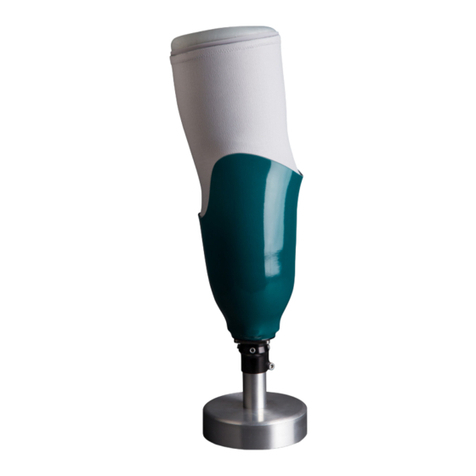
1. Fabricate a laminated socket using the LimbLogic 4-Hole
Adapter. Follow the fabrication instructions provided with
the adapter.
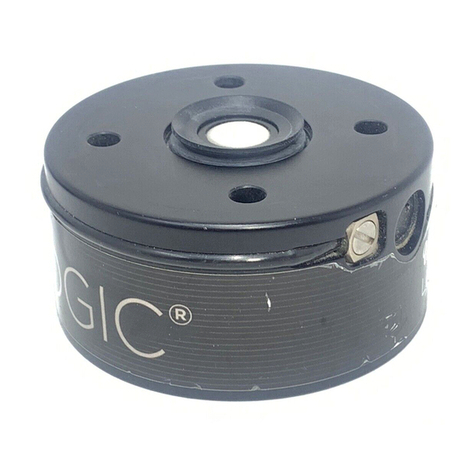
2. Apply the proximal gasket to proximal surface of the
pump.
proximal gasket
3. Using the four M6 x 50 mm
socket head screws provided,
attach the pump to the
socket with the logo facing
anterior.
The proximal end of the pump must be attached to
either the LimbLogic 4-Hole Adapter (LLV-01041) or
to the LimbLogic Vacuum Pyramid (LLV-01044).
4. Install the mating pyramid receiver component of your
choice onto the pyramid at the distal end of the pump.
Once alignment has been achieved, follow the torque and
threadlocker specifications provided by the manufacturer
of the pyramid receiver.
OR
If the prosthesis requires a hose
barb connection instead of a
direct mount, attach the pump
to a LimbLogic Vacuum Pyramid
(LLV-01044) using the four
M6 x 50 mm socket head
screws provided.
Apply Loctite 242 (or equivalent) and tighten the screws
to 9 ft-lbs (12 Nm).
You should be able to turn
the pump upside down
without the gasket falling
o. If the gasket falls o,
it was not properly seated
into the recess.