Page 4 Non-Sound Decoder MX618 - MX634 and Sound Decoder MX640 - MX648
2 Technical Information
Allowable Track voltage **) .......................................................................................minimum 10 V
MX620, MX640 (discontinued) .............................................................................. max. 24 V
MX600 …………………………………………………………………………………... max. 30 V
MX618, MX621, MX622, MX623, MX646, MX647, MX648, MX649, MX658 ......... max. 35 V
MX630, MX631, MX632, MX633, MX634, MX644, MX645, Digital or DC analog…. max. 35 V
MX630, MX631, MX632, MX633, MX634, MX644, MX645 with AC analog.... max. pulse 50V
Max. continuous motor current. MX618, MX620, MX621, MX649........................................... 0.7 A
MX600, MX622, MX623, MX648, MX658 .............................. 0.8 A
MX630, MX631, MX646 ........................................................ 1.0 A
MX633, MX634, MX640, MX642, MX643, MX644, MX645 …1.2 A
MX632 ................................................................................... 1.6 A
Adapter board ADAPLU or ADAMTC with decoder…………… 1.8 A
Peak motor current …MX600, MX620, MX621, MX623, MX646, MX648, MX649, MX658...….1.5 A
MX630 - MX634, MX640 - MX645 for @ 20 sec.……..……….…….….2.5 A
Maximum total function output, continuous *)………. MX620, MX621. MX646 - MX658 ....... 0.5 A
MX630 - MX634, MX640 - MX645........ 0.8 A
Maximum continuous current for LED outputs ....……MX640, MX642, MX644………..…... 10 mA ea
Maximum continuous total current (motor and functions)…… = maximum continuous motor current
Operating temperature ............................................................................................ - 20 to 100 oC
MX640 - MX658: Sound sample memory…….......…………………….. 32 Mbit (= 180 sec. at 22 kHz)
MX640 - MX658: Sample rate……depending on sound sample………………………..…11 or 22 kHz
MX640 - MX658: Number of independent sound channels …………………………………………… 6
MX640 - MX658: Sound amplifier output (Sinus)…. (MX640, MX646, MX648)... 1.1W, (others) 3 W
Loud speaker impedance………….......... (MX640, MX646- MX658) 8 Ohm, (all others) from 3 Ohm
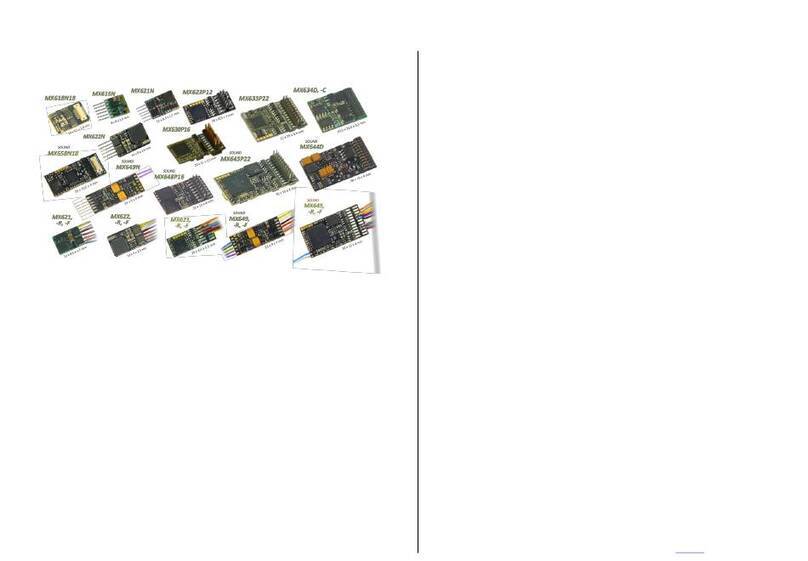
Dimensions (L x W x H) … ... MX600, MX600P12…..……………………………… 25 x 11 x 2 mm
MX618. ………………………………………………. 15 x 9.5 x 2,8 mm
MX620, MX620N (excluding pins) …...................... 14 x 9 x 2.5 mm
MX621, MX621N (excluding pins)………..……..….12 x 8.5 x 2.2 mm
MX622, MX622P16 (excluding pins) ..................... 16 x 9 x 2.5 mm
MX623, MX623P16 ……………….……….…..…. 20 x 8.5 x 3.5 mm
MX630, MX630P16 (height w/o pins) ................. 20 x 11 x 3.5 mm
MX631, MX631D, MX634, MX634D ................ 20.5 x 15.5 x 4 mm
MX632, MX632D ................................................ 28 x 15.5 x 4 mm
MX633, MX633P22……. …………………………….22 x 15 x 3.5 mm
MX646, MX646N .................................................. 28 x 10.5 x 4 mm
MX648 , MX648P16................................................. 20 x 11 x 4 mm
MX640 ................................................................. 32 x 15.5 x 6 mm
MX642, MX643, MX644, MX645 ............................ 30 x 15 x 4.5 mm
MX658.................................................................... 25 x 10.5 x 4 mm
Adapter board ADAPLU, ADAMTC w. decoder... 45 x 15 (26.5) x 4 (6) mm
*) The short circuit protection is carried out for the total current of all outputs. Use the “soft start” option (i.e. CV #125 = 52) to prevent
cold-start problems of light bulbs (in-rush current interpreted as a short circuit, which leads to the output being turned off)!
**) Note when operating with a DiMAX command station (Massoth): The DiMAX 1200Z command station is designed to keep the
track voltage at 24V (which would exceed the DCC normonly marginally). In reality however the voltage laid on the track varies with
the load (especially older command stations); starting at 30V at idle (dependent of mains voltage). Most ZIMO decoders are able to
deal with the excessive voltage. Lowering the track voltage to an allowable level by adding a “fake load” (about 0.5A) would be an ad-
vantage to the regulating circuit.
**) Roco Lokmaus Systems also tend to put excessive idle voltages on the track (although not as serious, @ 26V), which could present a prob-
lemfor the MX620 decoder. Other ZIMO decoder types would notbe affected.
The decoder type can be read out in CV #250: 199=MX600 200=MX82 201=MX620
202=MX62 203=MX63 204=MX64 205=MX64H 206=MX64D 207=MX680 208=MX690 209=MX69 210=MX640
211=MX630-P2520 212=MX632 213=MX631 214=MX642 215=MX643 216=MX647 217=MX646
218=MX630-P25K22 219=MX631-P25K22 220=MX632-P25K22 221=MX645 222=MX644 223=MX621
224=MX695-RevB 225=MX648 226=MX685 227=MX695-RevC 228=MX681 229=MX695N 230=MX696
231=MX696N 232=MX686 233=MX622 234=MX623 235=MX687 236=MX621-Fleischmann 237=MX633
238=MX820-RevA 240=MX634 241=MX686B 242=MX820B 243=MX618 244=Roco NextG 245=MX697
246=MX658 247=MX688 248=MX821 249=MX648-RevC,D 250=MX699 251=Roco 2067
252=Roco ICE 253=MX649 254=MX697-RevB
Software Update:
ZIMO DCC decoders can be updated by the user. An update device such as the ZIMO decoder up-
date module MXDECUP, from 2011 MXULF, system-cab MX31ZL or command station MX10 is
required. The update process is carried out by a USB stick (MXULF, MX31ZL / MX10) or by a PC
with Windows operating system and the program “ZIMO Sound Program” ZSP or the “ZIMO CV Set-
ting” tool ZCS.
The same hardware and software is also used for uploading sound projects into ZIMO sound de-
coders.
There is no need to remove the decoder or to open up the locomotive. Just set the locomotive on a
section of track connected to the update module and start the update with the computer or other
equipment mentioned above.
NOTE: Equipment inside the locomotive that is powered directly from the track (not through the de-
coder) can interfere with the update procedure. The same goes for energy buffers that are installed
without heeding the advice in the “Installation and wiring” chapter, section “Use of an external ener-
gy source” (regarding a choke coil).
See the last chapter in this manual for more information on updating decoders or www.zimo.at !
SW updates can of course be done through ZIMO or your ZIMO dealer for a small fee.
Overload and Thermal Protection:
The motor and function outputs of ZIMO decoders are designed with lots of reserve capacities and
are additionally protected against excessive current draw and short circuits. Cut-outs are encoun-
tered if the decoder is overloaded.
Even though the decoder is well protected, do not assume it is indestructible. Please pay attention to the
following:
Wrong decoder hook-up, connecting the motor leads to track power for instance or an overlooked connection be-
tween the motor brushes and rail pick-ups is not always recognized by the overload protection circuit and could
lead to damage of the motor end stage or even a total destruction of the decoder.
Unfit or defective motors (e.g. shorted windings or commutator) are not always recognized by their high current
consumption, because these are often just short current spikes. Nevertheless, they can lead to decoder damage
including damage to end stages due to long-term exposure.
The end stages of loco decoders (motor as well as function outputs) are not only at risk of high current but also
voltage spikes, which are generated by motors and other inductive consumers. Depending on track voltage,
such spikes can reach several hundred volts and are absorbed by special protection circuits inside the decoder.
All ZIMO decoders are equipped with temperature sensors to measure their own operating temperature.
Power to the motor will be turned off once that temperature exceeds 1000C. The headlights start flashing
rapidly, at about 5 Hz, to make this state visible to the operator. Motor control will resume automatically af-
ter a drop in temperature of about 200C, typically in about 30 seconds.