Veb- MN (Excell-MCDSe 400)#A(15-5-2007)(in).doc
2
This unit is manufactured by ALSA Apparecchi Medicali s.r.l. – via C. Bonazzi, no.16 – 40013 Castel Maggiore (Bologna - Italy), which is
responsible for its safety, reliability, and performances, but only if the additions, the recalibrations, the alterations or the repairs are carried
out by its authorized personnel who uses original spare parts, and only if the unit is installed according to the given instructions in an area
that meets the norms IEC/CEI.
On request, ALSA can provide the user with the electric diagrams and/or any further information which is necessary.
Keep this manual with the unit, read it carefully before using the equipment, and ask for it again in case of loss. If it is not
exhaustive for the specific needs of the application field, get in touch with the Manufacturer, directly or through the local
distributor, before using the apparatus.
According to the requirements of the European Directive for Medical Devices 93/42 CEE, and in compliance with the procedures of
the Company Quality System for the after-sale control of the production, the users are kindly invited to inform ALSA about any
problem, even the smallest one, related to the unit, in order to allow ALSA to intervene as soon as possible.
INTRODUCTION
In a biological tissue crossed by the electric current, three effects are usually generated: Thermal, Faradic, and Electrolytic.
By using high frequency electric current, higher than 300kHz, the faradic effect is almost completely eliminated, while the electrolytic one is
kept, even if with no practical result. So, the most used is the thermal one. When an electric current having such characteristics crosses with
sufficient density the cellular liquid of the tissues, it warms it and generates what follows:
1) a heating, which is so rapid that the vapour pressure into the cells breaks their membranes and provokes their division (pure cut);
2) a heating, which is slower, and which permits to the liquid to evaporate very slowly; in this way, the coagulating parts of the tissues can
coagulate (coagulation);
3) a process which is in the middle between the two phenomena described above (coagulating cut).
The use of the HF current presents also some risks that must be known, because their possible reduction depends also on users’ behaviour:
-undesired burns on the patient tissues (i.e. where the neutral electrode is placed because of non homogeneous / insufficient contact, or
in any other zone because of anomalous contacts / use of water mattresses / contacts of patient with the metallic parts of the operating
table )
-undesired burns on the operator tissues (i.e. into the hand, because of an insulation leakage into the coagulation monopolar forceps);
-interferences with the functioning of other equipments (i.e. video systems) or implanted devices (pace-makers);
-slight neuromuscular stimulations, notably with coagulation currents, both in the contact point of the active electrode and in the contact
point of the neutral electrode. These stimulations are felt by patients as “electrical discharges”.
DIRECTIONS FOR USE
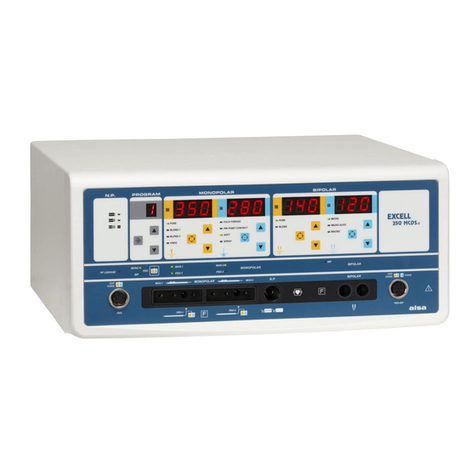
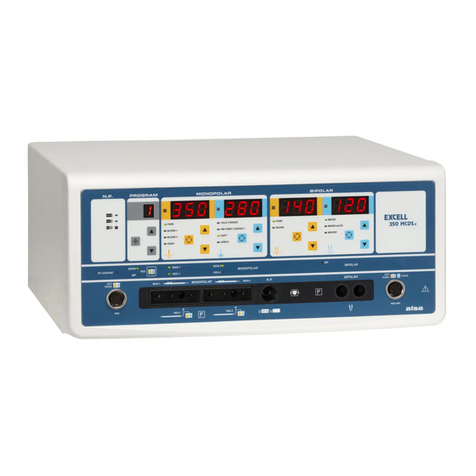
In the field of normal electro-surgery, with only the High Frequency currents, the Excell 400MCDSe allow to perform all kinds of
Monopolar Cut (Pure or Coagulating), Monopolar Coagulation (at low, medium, and high voltage), Bipolar Cut (Pure or Coagulating),
Bipolar Coagulation (Micro, Macro, sealing of vessels, etc.), during major and medium surgery interventions into the operating theatre (open
sky surgery, minimum invasive surgery, endoscopic surgery), or in any other similar place. The application medical fields of this model are
the following ones:
GYNAECOLOGY, HEART SURGERY, ORTHOPAEDICS, NEUROSURGERY, OTORHINOLARYNGOLOGY, UROLOGY,
MAXILLOFACIAL SURGERY, DERMATOLOGY, PLASTIC SURGERY, VASCULAR SURGERY, GENERAL and THORACIC
SURGERY, PAEDIATRIC SURGERY, EMERGENCY SURGERY, GASTROENTEROLOGY, VETERINARY, and OTHER.
GENERAL PRECAUTIONS – It is dangerous to ignore the following warnings!
1. Every electro-surgical unit has its own characteristics and therefore, before using it, it is advisable to check its functioning, without
taking into consideration the previous experiences with other devices only. Anyway, start always with very low powers, and then raise
them until the required one is reached;
2. It is extremely dangerous to use the device if the electrical plant and the installations of the operating theatre do not comply with the
current safety standards. Never use extensions for the mains cable and, if many devices are connected at the same time, ask for their
compatibility to the Technical Service;
3. It is extremely dangerous to use accessories or instruments which are not perfectly compliant with all the applicable technical or
legislative Rules, and which are not suitable for the working voltages of the device (approx. 7600Vpp “4000Vp” for the monopolar
currents with crest factors equal or higher than 2; 3600Vpp “1800Vp” for the monopolar currents with crest factors lower than 2;
approx. 1100Vpp “550Vp for the bipolar currents with crest factors equal or lower than 2). Moreover, the accessories and instruments
must not be old nor worn. Check always their status before the use, notably if for endoscopy. Bear in mind that:
-All the old/worn active electrodes, accessories and cables do not work properly, and do not guarantee the perfect insulation. In
addition, their unstable functioning can lead the operator to increase the output powers at dangerous levels;
-In the user manual, for each current, the maximum output voltage “Vpp” and its variation (see the curves) according to the output
power adjustment are specified. This allows the operators to choose the maximum output power that must not be overcome, in
order to not exceed the rated HF insulation voltage, which is possible for each accessory;
-The standard monopolar active electrodes for normal surgery have a stem with Ø 2.3mm (so, the standard electrode-holder handles
are suitable for the electrodes having stems with this diameter).
4. Do not activate the outputs before the active electrode is in contact with the tissues, as electrical arcs can be created. They burn the
tissues superficially and prevent the good effect ;
5. Keep the active electrode always clean, because otherwise it can provoke sparks or superficial carbonizations on the tissues. A dirty
active electrode, an electrode in bad conditions, or an electrode with connection defects causes a reduction of the output power, as it
does not have any good contact with the tissues;
6. Remember that, even if compliant with all the current standards about the electromagnetic compatibility, the unit can have interferences
with other electro-medical equipments;
7. Bear in mind that, when operating on patients with pace-makers or other implanted active devices, an interference with their
functioning can occur (fibrillations, etc.), and they can even be damaged (in this case, it is advisable to ask for a specific qualified
advice from the Cardiology Division);
8. Never use an electro-surgical unit in presence of flammable anaesthetic gases (i.e. oxygen and nitrogen protoxide, etc.), notably when
operating in cavities like thorax, abdomen, trachea, head, etc. Do not use any cleaning substances, disinfectants or flammable solvents;