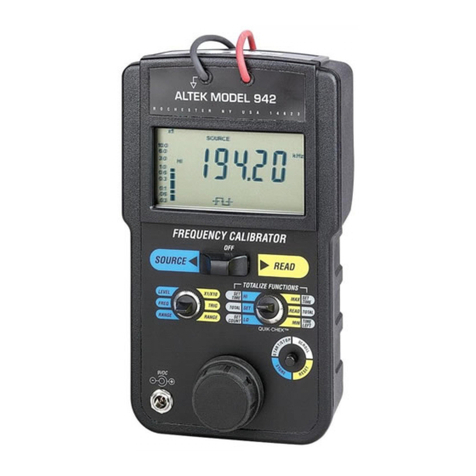
OUT OF RANGE SIGNALS
Frequencies above or below those available
for the currently selected range will be
indicated by OVER and UNDER on the
display (See OPERATING HINTS).
OPERATING INSTRUCTIONS
FREQUENCY OUTPUT (SOURCE MODE)
SOURCE
1) Move the POWER switch to SOURCE
2) Move the mode switch to RANGE and
repeatedly press or press and hold the
SCROLL/STORE pushbutton to change
tothedesiredfrequencyrange.Returnthe
mode switch to FREQ.
3) Move the mode switch to LEVEL (AMPLI-
TUDE) and turn the Digipot (Knob) until
the logrithmic bargraph on the display
reachesthedesiredlevel.Returnthemode
switch to FREQ.
4) Connect the Model 941 to the input termi-
nals of the instrument or meter to be
calibrated
5) Adjust the digital pot to the desired output
value or QUIK-CHEK with previously
stored frequency outputs (see below)
Whenever SOURCE mode is selected the
word SOURCE will appear on the LCD
display. Tochange theoutputvalue,turnthe
speed sensitive digital pot. Turning the pot
slowly will cause a gradual change in the
output. A faster change will occur when the
pot is turned faster. This function operates in
all three output positions (HI, SET & LO).
STORE
1) Switch to HI or LO
2) Turn the digital pot to desired value
3) Press the STORE/SCROLL pushbutton
The LCD will flash once to show that the
value was saved
If a value is in the SET position and you want
that value stored in HI or LO, press and hold
the STORE/SCROLL pushbutton while
movingtheswitchtoHIorLO.Thedisplaywill
flash once to indicate the value has been
stored. Then release the STORE/SCROLL
button.
Hint: Pressing the STORE/SCROLL pushbutton will disable the
Model 941's frequency generator. Releasing the pushbutton will
re-enabletheoutput.Thisisusefulforsynchronizingwithdisplaysfor
slow (< 1 Hz) signals.
ALTEK INDUSTRIES CORP
FREQUENCY COUNTER (READ MODE)
READ
1) Move the POWER switch to READ
2) Move the mode switch to RANGE and
repeatedly press or press and hold the
SCROLL/RESET pushbutton to change
tothedesiredfrequencyrange.Returnthe
mode switch to TRIG.
3) Switch the MODE switch to LEVEL
(AMPLITUDE)totogglebetweenx1&x10
attenuation (Use x1 for signals from 30
mV to 12 V p-p, x10 for signals from 12 V
to 240V p-p). Return the mode switch to
TRIG.
4) ConnecttheModel941totheoutputofthe
instrument or sensor to be measured.
5) Adjust the trigger level to obtain a stable
frequency reading by turning the Digipot
(knob). A bargraph on the display will
show the approximate trigger level.
6) Use the “QUIK-CHEK” switch to display
present reading, MAXimum or MINimum
frequency.
The word GATE will appear on the display
whenever the Model 941 is measuring the
frequency signal and will flash each time the
displayed reading is updated.
MIN/MAX
To read the Maximum or Minimum frequen-
cies since READ mode was entered, simply
switch to MAX or MIN. The value will appear
on the LCD along with the word MAX or MIN.
The MAX/MIN values are automatically
updated and may be viewed at any time
without disturbing the other values. Pressing
the RESET/SCROLL pushbutton will cause
the 941 to stop counting frequencies and will
display zeros. Upon releasing the RESET/
SCROLL the Model 941 will display GATE,
resumecountingfrequenciesandupdate the
MAX & MIN values as the measured
frequency changes.
CPM
CPH
PERIOD READINGS
Select Counts-per-Minute (CPM) or Counts-
per-Hour (CPH) to measure slow frequency
signals. Frequencies as low as 0.1 CPM
(0.001666 Hz) and 10 CPH (0.002777 Hz)
canbemeasured(SeeCPM/CPHCONVER-
SIONS for conversion factors).
TRIGGER LEVEL
The adjustable TRIGGER LEVEL is used in
measurements of noisy signals, AC signals
superimposed on DC levels and to select
Voltage threshold for all other signals.
The bargraph on the display shows the
approximatelevelfrom0toover12Vpositive
peak with the attenuator set at x1. This
bargraph should be read as 0 to over 120 V
positive peak with the attenuator set at x10.
Forquickestreadings, determineorestimate
thevoltageleveltobe detected and set the
ATTENUATOR and TRIGGER LEVEL to
match.
OVER
UNDER
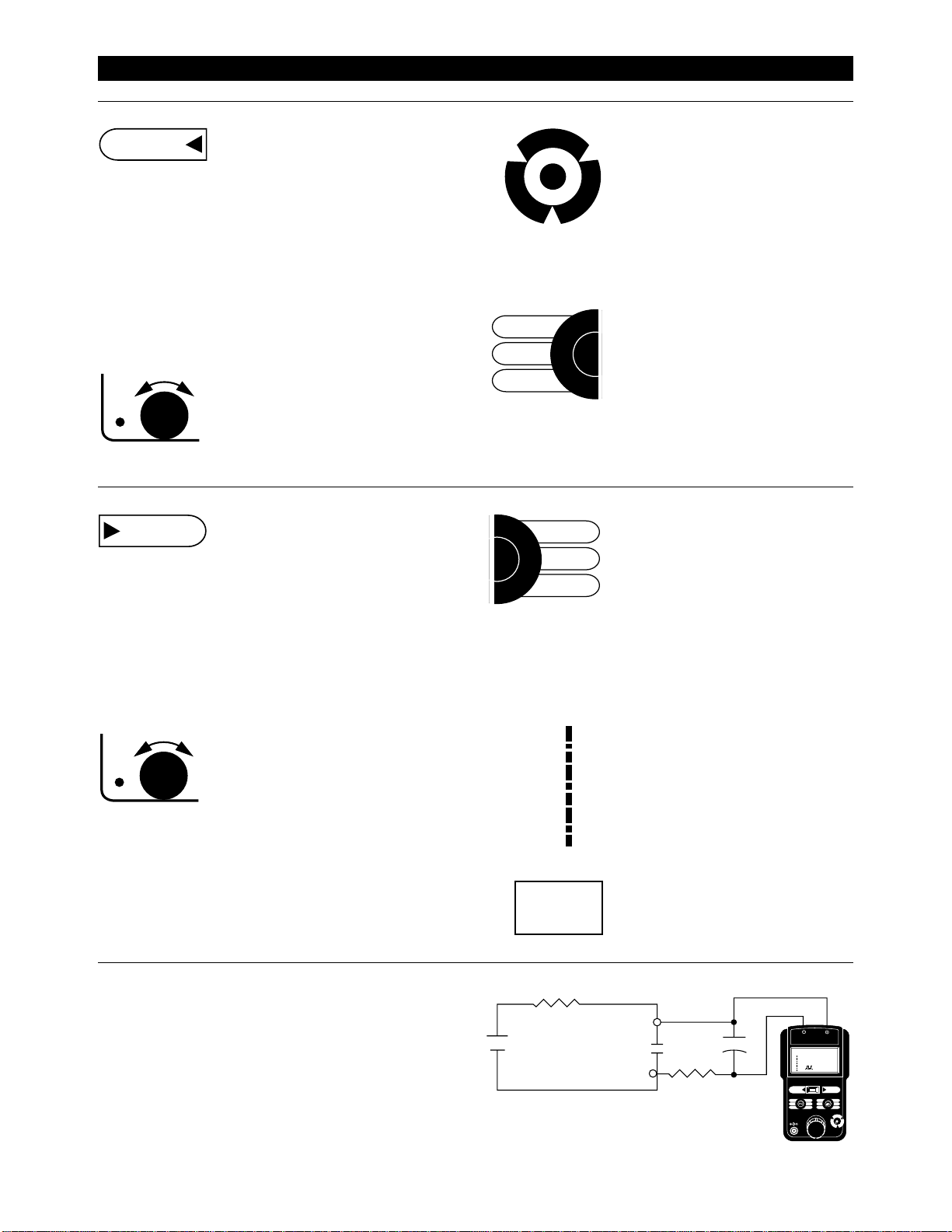
Isolated dry contact, open collector transis-
tor or opto-isolated frequencies may be
measured with the Model 941 with the
optional DRY CONTACT MODULE (Model
C-41) or with the circuit shown. In order
todetectcontactopeningorclosing,anexter-
nal battery or power supply, in series with a
5000 Ohm resistor, may be used. Select
connection polarity to provide desired signal
upon contact transfer. Relay or switch
contacts may require a resistor-capacitor
filter in order to eliminate contact bounce
errors. Typical filter values for mechanical
contactsare10KOhmsand0.1microfarads.
READING DRY CONTACTS
QUIK-CHEK
Any time you need a stored value just throw
the QUIK-CHEK switch. Any value in the
frequency range may be stored in HI & LO.
The Model 941 remembers the HI, LO and
SET values for all ranges (18 memories) for
you with the power on or off. Each time a
differentfrequencyrangeisselected,thelast
threeQUIK-CHEK valuesforthattypewillbe
recalled.
SOURCE
S
C
R
O
L
L
S
T
O
R
E
R
E
S
E
T
HI
SET
LOW
MAX
READ
MIN
ROCHESTER NY 14623
ALTEK MODEL 941
10.0
6.0
3.0
1.0
0.6
0.3
0.1
.06
.03
x1 SOURCE
485.3
CPM
FREQUENCY CALIBRATOR
SOURCE READ
OFF
LEVEL
FREQ
RANGE
X1/X10
TRIG
RANGE
HI
SET
LO
MAX
READ
MIN
S
C
R
O
L
L
S
T
O
R
E
R
E
S
E
T
9VDC
5000 Ohm
DRY
CONTACT
1 to 24 VDC 10 K
0.1
READ
›12
10.0
6.0
3.0
1.0
0.6
0.3
0.1
.06
.03
x10
H
L
U