IPC2 Power Charger User Manual, Part No 13130 issue 4 Page 5
mains plug if desired. If a standard UK domestic plug is used, it should be fitted with a 10 amp fuse.
Local regulations, or regulations applicable to the intended application of this product, may override or
impose additional requirements, which must be taken into account. Attention is drawn to the requirement for
residual current circuit breakers in some vehicular applications.
Output Connections
WARNING: Explosive gasses may be generated by a battery on charge. To prevent ignition, allow time for
gasses to disperse before attempting to connect this unit to the supply battery.
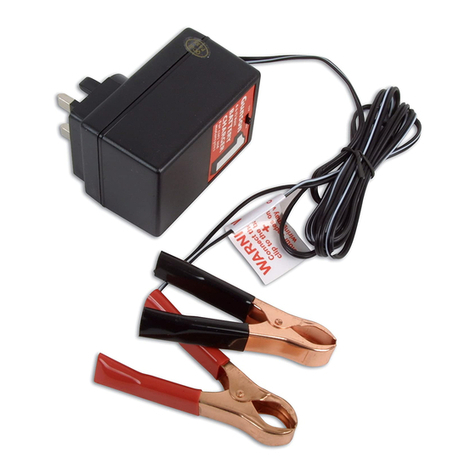
The Power Charger is normally supplied with two flying leads for the main power output. The heavy gauge
red lead is the connection to system positive, and the black lead to negative. Positive, negative or isolated
chassis circuits may be connected. Be sure to disconnect the input supply before making or removing the
connections to the battery. If the auxiliary 13.8 volt float output is fitted, it is accessible at the 6.3mm blade
terminal at the AUX OUTPUT. Its negative is shared with the main output negative.
In battery charging applications, both the positive and negative leads should ideally be routed directly to the
battery terminals. This ensures that the Power Charger system responds only to the battery conditions,
without being disturbed by other connected equipment. The unit is suitable for permanent connection to the
battery.
If a temporary connection is made to an automobile battery whilst in situ, proceed as follows:
Ensure that the AC input supply is disconnected.
Then connect the appropriate output conductor to the battery terminal which does not connect
to the vehicle chassis (normally positive on negative earth vehicles), then connect the other
output conductor to the battery terminal which connects to the vehicle chassis.
Connect the AC input supply.
To stop charging, disconnect the AC input supply then remove the battery connections in
reverse order.
The leads may be shortened if required.
If longer leads are required, the leads supplied can be replaced or lengthened, using suitable cable, up to a
maximum extended length of around 5 metres. Suitable cable sets can be supplied by Antares if required.
Note that Power Charger units can be supplied to order with customer specified mains or output cable
lengths and terminations.
OPERATION
The Power Charger system is fully automatic in operation.
Three panel lamps show the operating condition of the unit:
CHARGE: Green lamp - indicates that the battery is in the process of being fast charged.
INPUT: Green lamp - This lamp illuminates once fast charging is complete, indicating
that the battery is being held on float.
PROTECTION: Red indicates that the unit has shut down due to an external fault or internal
overheating. Recovery is automatic once the offending fault condition has been
cleared.
The Power Charger may be permanently connected to the battery, and continuously powered if required.
There is no reverse drain on the battery when mains is disconnected and the unit is comprehensively
protected from abuse or fault conditions. In vehicular applications, the engine may be started and run with
the Power Charger system connected.