TROUBLESHOOTING
Technical Support is available Monday through Friday, 7:00 a.m. to 5:00 p.m. CST, at
(800)334-6011. Use the guide on the following pages to help find and correct system faults.
Contact Technical Support before replacing the control or for additional troubleshooting.
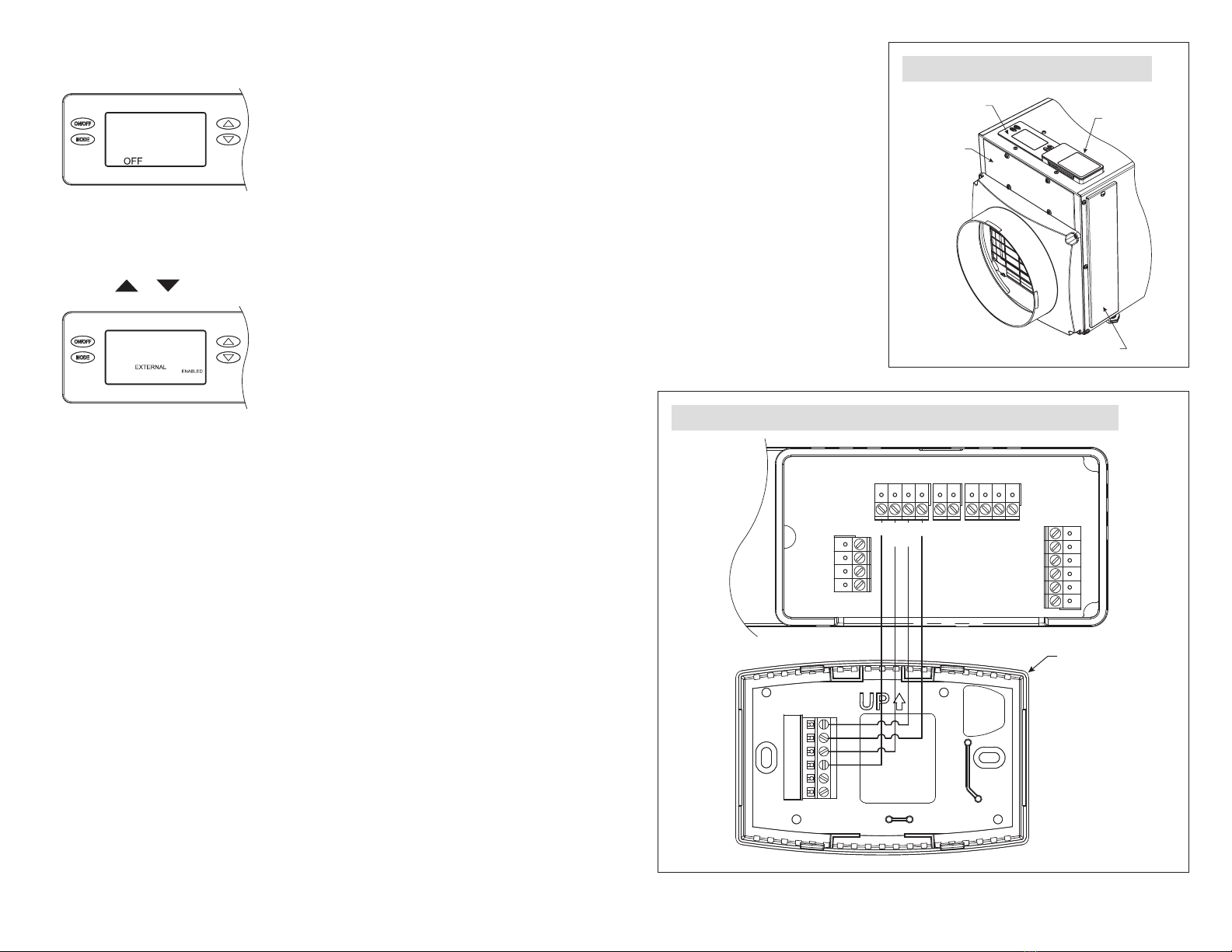
FIGURE 11 – EXTERNAL CONTROL
ERROR CODE SCREEN
FIGURE 12 – REMOTE CONTROL
ERROR CODE SCREEN
90-1645
90-1645
ERROR CODES
EXTERNAL CONTROL
When the control detects an internal error,
it will stop controlling, deactivate the
dehumidifier output, and the LCD will display
the Error Code. See FIGURE 11. The control
will attempt to recover from the error every
10 minutes. The Error Code will continue to be
displayed as long as the error condition exists.
Button presses are not registered when in
Error Mode. Cycling power to the control will
not clear the code and the control will need to
be replaced.
REMOTE CONTROL
When there is a dehumidifier or control
communication fault, all dehumidifier outputs
will turn off and the Model 76 LCD will display
an Error Code. See FIGURE 12 for an example.
The faults can either be critical or non-critical.
Any fault will result in all dehumidification
outputs turning off. A critical fault is cleared
by repairing the fault and cycling power using
the on/off switch on the dehumidifier. A non-
critical fault is cleared by repairing the fault
and cycling power to the dehumidifier is not
required. See TABLE 2 for the error codes and
required action.
TABLE 2 – ERROR CODES
Error
Code Failure Mode Action Reset
E1
Internal
Humidity or
Temperature
Sensor Open or
Shorted
1. Check the connection between the sensor board and control
board.
2. If connection okay, replace sensor board, Part No. 5460.
Cycle
Power
E2
High
Refrigeration
Pressure
1. Verify that the fan works, the backflow damper swings freely
and there is no blocked or restricted ductwork.
2. If the fault persists, call Technical Support.
Cycle
Power
E3
Model 76
Remote Control
Communication
Loss
1. Check connections between Model 76 and dehumidifier
control board. Terminals should be fully inserted and secured
in the control board and Model 76 control terminals.
2. If connections are correct and secure, turn off the
dehumidifier and remove the Model 76. Use a short section
of 4-wire cable to reconnect the Model 76 to the control
board. Turn the dehumidifier back on and increase the
dryness level setting on the Model 76. If the dehumidifier
turns on, the problem is with the wiring between the
dehumidifier and control.
3. If the dehumidifier does not turn on, call Technical Support.
Self-
Correcting
E4 Insufficient
Capacity
1. Check the frost sensor connection at the power board.
Terminal should be fully seated on the power board pins.
2. Remove the side access panel and verify that the sensor is
secured to the suction line.
3. If the sensor is connected and secured to the refrigeration
line proceed to the next step.
4. Reset the fault by cycling power to the dehumidifier.
5. Turn the humidity setting down (below room/home humidity
level) to make a dehumidification call.
6. Allow the fan and compressor to run for approximately
10-15 minutes and then enter diagnostic test mode by
simultaneously pressing the and MODE buttons for 3
seconds. The LCD will display the temperature measured by
the internal sensor while also displaying AIR SAMPLING and
ON, the humidity measured by the internal sensor while also
displaying %RH and ON, and the frost sensor temperature
while also displaying ON. Scroll through these values and by
using the buttons.
7. Record values and call Technical Support.
Cycle
Power
E5
High
Temperature
Thermistor
Failure
1. Check the high temperature sensor connection at the power
board. Terminal should be fully seated on the power board pins.
2. Remove the side access panel and verify the sensor is not
damaged and connected to the refrigeration line coming
from the compressor.
3. If the sensor is connected and secured to the refrigeration
line, contact Technical Support.
Cycle
Power
1716