installation &
operating instructions
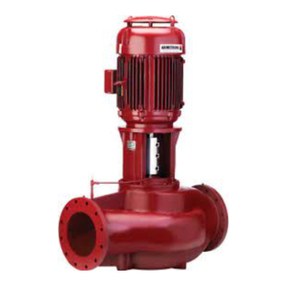
Design Envelope 4300 & 4380 Vertical
In-line pumping unit with ivs drive
8
Electric motor driven pumps should not be located in damp
or dusty location without special protection.
Airflow into the motor and/or motor fan should not be ob-
structed.
It is good practice to leave sucient space around equipment
for maintenance and service needs. If the ivs controls are
supplied with integral disconnect switches, 36"/1meter
clearance may be required in front of the controls to meet
local electrical codes.
1.2.2 installation
When installing vertical in-line pumps, an important
consideration to accrue full added-value from the pump
design is to ensure that the pump is pipe-mounted and free
to ‘float’ with any movement, expansion and contraction of
the piping. Should any vertical in-line pump use supports to
the structure it is imperative that no pipe strain is imposed
on the pump flanges. Tell-tale pieces of equipment such as
springs or ‘wae’ style neoprene isolation pads that distort
with pressure to indicate added piping weight, should be
used under pump supports should the pump not be truly
pipe mounted.
Design Envelope 4300 and Design Envelope 4380 cannot
be mounted with shafts in the horizontal position.
Various installation arrangements are detailed on pages 8–10
a Vertical In-Line pumps may be installed directly in the
system piping with no additional support. Pipe hangers
are simply sized for the additional weight of the pumping
unit. Many pumps are installed in this manner and can
be mounted at sucient height to take zero floor space.
(fig. 1.1)
b Piping in many mechanical rooms is hung close to the
ceiling and larger pumps are mounted near ground level
for ease of maintenance. fig. 1.2 illustrates such an
arrangement with the piping supported at the ceiling
and the vil unit installed with an Armstrong Suction
Guide and Flo-Trex valve. Many very large vil pumps are
installed in this manner.
c Should additional space saving be required the discharge
spool piece may be replaced by a long-radius elbow.
d fig 1.4 illustrates a similar arrangement to fig. 1.2 with
additional floor mounted pipe-stools isolated from the
structure by ‘wae’ style neoprene isolation pads under
the Armstrong Suction Guide and Flo-Trex valve.
e Floor mounted saddle supports (fig. 1.5) are typical for
condenser water pumps where cooling tower base is at
the mechanical room elevation.
fWhere required, additional floor support may be used as
shown in fig. 1.6. Note that the pump should not be rig-
idly attached to the column. Leave a small gap between
pump and column or install a wae isolation pad under
the pump. It is critical that piping be installed in such a
manner that the pump does not become a pipe support.
g fig. 1.7 illustrates stanchion plates at the pump inlet and
outlet ports that may be supplied for installation conve-
nience. Isolation pads must be used under the legs and
monitored as pipe hangers are adjusted to ensure the
pump flanges are not supporting the piping. Bolting to
the floor or housekeeping pad is not recommended. If the
stanchions are bolted down the bolts must be isolated
from the stanchion or an inertia base and flexible pipe
connectors used.
h fig. 1.8 illustrates installations with stanchion plates
for seismically active regions. Seismically rated isolation
pads or snubbers with bolts isolated from the stanchion
plates are installed to restrain the pump during a seismic
event. Pipe hangers carry the weight of the equipment
as seismic components are designed only to restrain the
equipment during a seismic event.
iMany Vertical In-Line pumps are piped successfully into
grooved piping systems. In-line pumps are supported
well by grooved piping however flange adapter locking
devices or a welded flange at the pump should be used to
prevent the possibility of pipe mounted pumps rotating in
the piping. Armstrong oers grooved suction guides with
cast-in outlet flanges and Flo-Trex valves with Armgrip™
fittings to prevent this possibility. (fig. 1.9)
jDo not support the unit by the motor eye bolts (fig.
1.10) or by any other part of the motor.
k Connecting the pump to a permanent rigid base (fig.
1.11) is not recommended unless isolated from the piping
by flexible connectors and the base isolated from the
building structure on an inertia base. (fig. 1.11 is gener-
ally acceptable when using plastic piping).
l The motor and integrated control assembly can be
rotated in 90° increments to meet installation spacing
requirements. Where applicable, remove the coupling
guard to access the motor bolts.Remove the motor bolts
to rotate the motor and integrated control assembly by
hand.Larger motors may need strapping and slight lifting
to break the contact with the pedestal.Care should be
taken that the controls are not damaged during lifting
and that the flushline, accessories and the coupling guard
removal/seal service window are not compromised fol-
lowing the turn (fig. 1.12).vil pumping units without
integrated controls can also be rotated in a similar man-
ner to facilitate access to the the motor terminal box.
mFor d1 and d2chassis ivs units (150 hp–350 hp), ensure
adequate space is available for the access door to swing
open. (fig. 1.13)