8
WARNING
ROAD SAFETY COMES FIRST!
Do not use a hand-held cellular terminal, satellite
phone or mobile when driving a vehicle, unless
it is securely mounted in a holder for speaker
phone operation. Before making a call with a
handheld terminal, satellite phone or mobile,
park the vehicle stationary. Please obey local road
laws for hands-free speakerphone operation.
Speakerphones (hands-free) must be installed
by qualied personnel. Faulty installation or
operation can constitute a safety hazard.
IMPORTANT
Cellular & Satellite terminals or mobiles operate using
radio signals and communication networks. Because
of this, the connection cannot be guaranteed at all
times or under all conditions. Therefore, you should
never rely solely upon any wireless device for essential
communications, for example emergency calls.
» International Commission on Non-Ionizing
Radiation Protection (ICNIRP) 1996
» Verband Deutscher Elektrotechniker
(VDE) DIN-0848
» United States Federal Commission, Radio
Frequency Exposure Guidelines (1996)
» National Radiological Protection Board of
the United Kingdom, GS 11, 1988
» American National Standards Institute
(ANSI) IEEE. C95. 1-1992
• Do not operate your satellite system when
a person is within 55cm of the external
antenna. A person or object within 55cm
of the external antenna could impair
call quality and may cause the phone
to operate at a higher power level than
necessary and expose that person to RF
energy in excess of that established by the
FCC RF Exposure Guidelines.
• As a precaution, please maintain the
maximum body distance possible from the
antenna during call transmission.
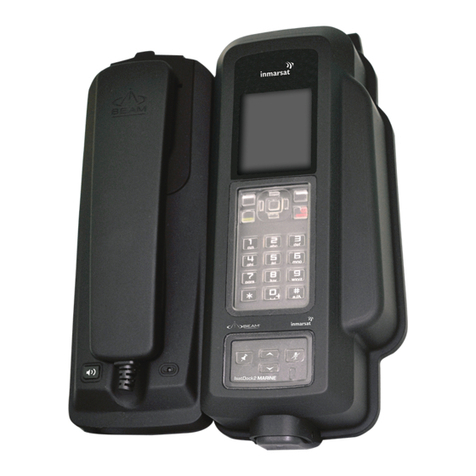
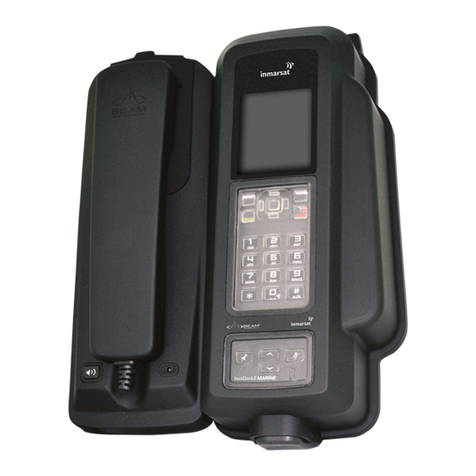
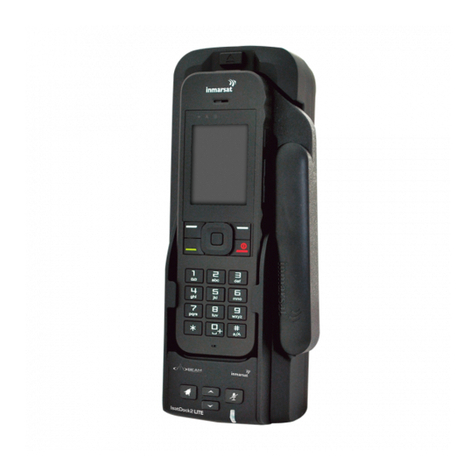
Safety Transceiver IsatPhone 2
Your handset is a low power radio transmitter
and receiver. When it is ON, it receives and
also sends out radio frequency (RF) signals.
(NOTE: Refer to Inmarsat IsatPhone 2 Manual
for additional Information)
• The Inmarsat IsatPhone 2 handset has an
in-built transceiver which is designed to
be used with an external antenna. This
antenna transmits RF energy. The BEAM
antenna (tted via an extension coaxial
cable to the cradle) must be located
more than > 55cm from the human body
(person) when in operation.
• International agencies have set standards
and recommendations for the protection
of public exposure to RF electromagnetic
energy. These standards are based on
extensive scientic review by scientists,
engineers, and physicians from universities,
government health agencies, and industry
groups They review the available body of
research to develop ANSI standard. These
ANSI standards are reviewed regularly for
research development.