ASIA • Printed in Germany • BA 1 609 929 C48 • AL 30 DV 1450 • OSW
English - 2
Observe correct mains voltage:
The voltage of
the power source must agree with the voltage
specified on the nameplate of the unit.
The charging process begins as soon as the
mains plug has been plugged into the socket and
the battery
6
has been inserted into the charging
compartment
5
.
For charging Bosch batteries without the
APT wall plug
1
, it will be necessary to use
the additional adapter
3
as well.
To remove the adapter
3
from the charging com-
partment
5
, press the unlocking button
2
.
The intelligent charging process automatically
detects the charging condition of the battery, al-
lowing it to be charged with the optimum charging
current depending on the battery temperature
and voltage.
This protects the battery, which always remains
fully charged when kept in the charger during
storage.
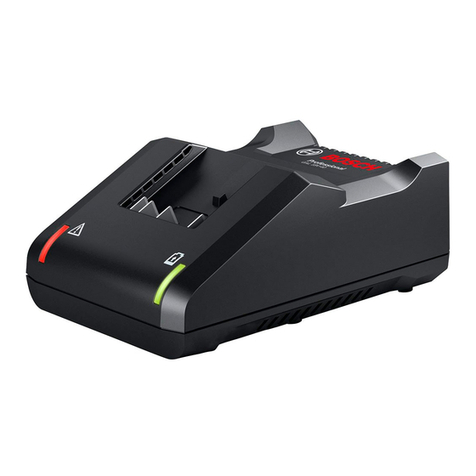
The LED charge indicator
4
signals the control of
the charging process:
Rapid charging process
The rapid-charging procedure is in-
dicated by
slow
flashing of the
charge control LED
4
(approx. 1x
per second).
The battery is fully charged as soon as the light of
the LED charge indicator
4
changes from blink-
ing to continuous. The battery can now be re-
moved and is ready for use.
☞
Rapid charging is only possible when the
battery temperature is between 0 °C and
45 °C.
Trickle charging process
The LED charge indicator
4
sig-
nals the trickle charging process by
a
continuous light
.
As soon as the battery is fully charged, the
charger will immediately switch to the trickle
charge mode. This will equalize the natural dis-
charge process of the battery.
Charging procedure possible only
with reduced charging current
The charging procedure with re-
duced charging current is indicated
through
short
double-lighting im-
pulses followed by brief interrup-
tions of the charge control LED
4
.
Possible causes of trouble are:
– The battery can not be charged with the maxi-
mum available rapid-charging current because
the battery temperature is not within the allow-
able temperature range (0 °C to 45 °C). There-
fore, the rapid-charging current is automati-
cally reduced.
➯
Corrective measure: Bring the battery tem-
perature once again within the allowable tem-
perature range (between 0 °C and 45 °C) by
cooling down or heating up the battery. As
soon as its temperature returns to the allow-
able temperature range, the battery charger
will automatically switch to rapid charging
mode.
☞
The charging time increases when
charging with reduced charging cur-
rent.
The charging process cannot
take place
If a different malfunction of the
charging procedure is present, this
will be indicated through
rapid
flashing (approx. 10x per second)
of the charge control LED
4
.
The charging process cannot begin and the bat-
tery cannot be charged. Possible sources of trou-
ble are:
– The battery contacts are dirty.
➯
Corrective measure: Clean the contacts
(f. ex. by plugging and unplugging the battery
several times) or, if need be, replace the bat-
tery.
– The battery is defective because there is no
electric current within it (individual cells).
➯
Corrective measure: Replace the battery.
Initial Operation
Charging Procedure
Fault Finding and Troubleshooting
AL 30 DV 1450.book Seite 2 Freitag, 22. Februar 2002 11:34 11
5 • 1 609 929 C48 • TMS • 18.02.02