English | 11
Bosch Power Tools 1 609 929 Y44 | (28.4.11)
Operation
fProtect the measuring tool against moisture and direct
sun light.
fDo not subject the measuring tool to extreme tempera-
tures or variations in temperature. In case of large var-
iations in temperature, allow the measuring tool to ad-
justtotheambienttemperaturebeforeswitchingiton.
In case of extreme temperatures or variations in tempera-
ture, the accuracy of the measuring tool and the display in-
dication can be impaired.
fUse or operation of transmitting systems, such as
WLAN,UMTS,radar,transmittermastsor microwaves,
in the close proximity can influence the measuring
function.
Initial Operation
Switching On and Off
fBeforeswitchingthe measuringtoolon, makesurethat
the sensor area 6 is not moist. If required, dry the meas-
uring tool using a soft cloth.
fIf the measuring tool was subject to an extreme tem-
perature change, allow it to adjust to the ambient tem-
perature before switching on.
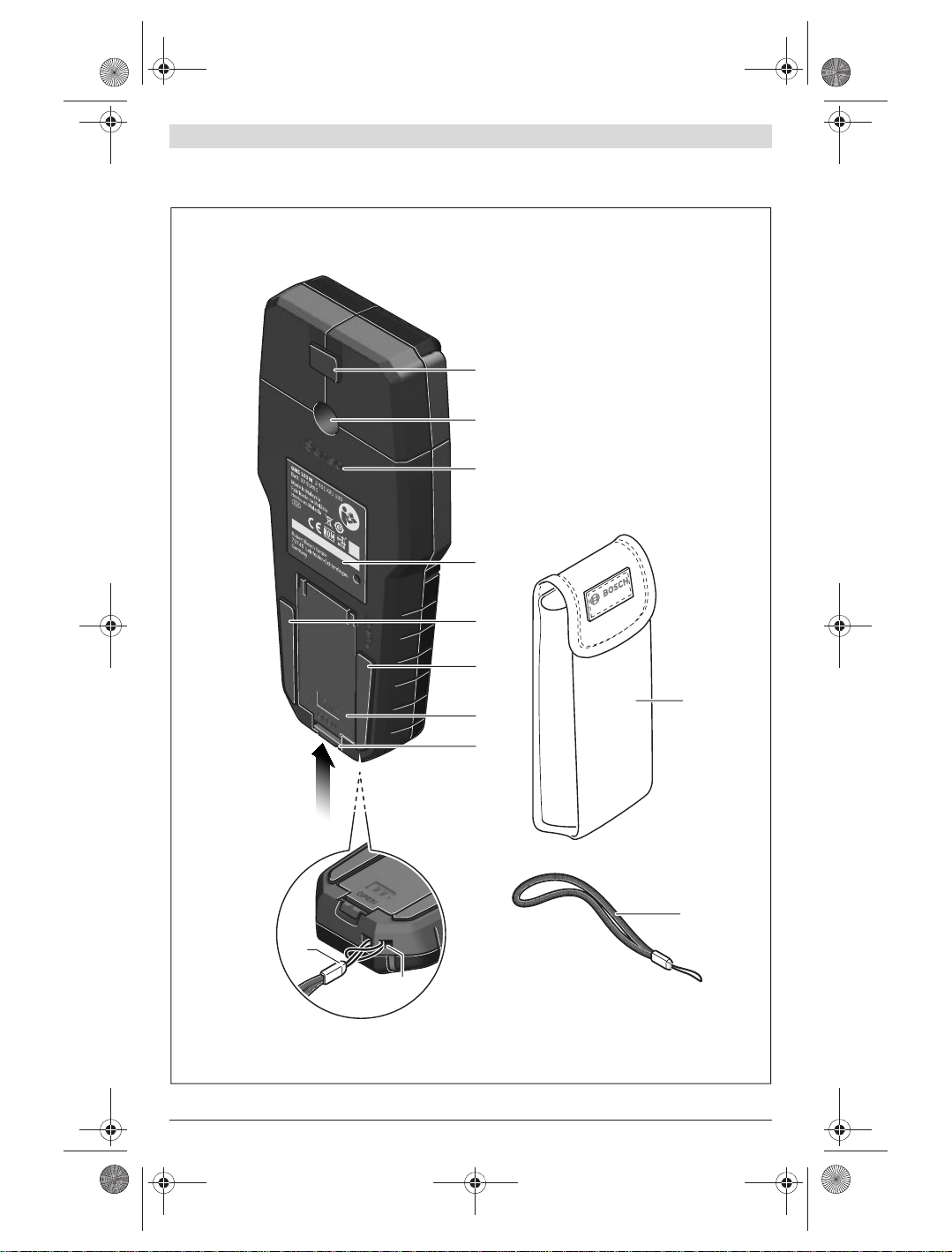
To switch on the measuring tool, press the On/Off button 4.
To switch off the measuring tool, press the On/Off button 4
again.
When no button on the measuring tool is pressed for approx.
5 minutes and when no objects are detected, the measuring
tool automatically switches off to save the battery.
Switching the Audio Signal On/Off
When the measuring tool is switched on, the audio signal can
beswitchedon oroffby pressingtheOn/Off button4forafew
seconds. When the audio signal is switched off, indication a
appears on the display.
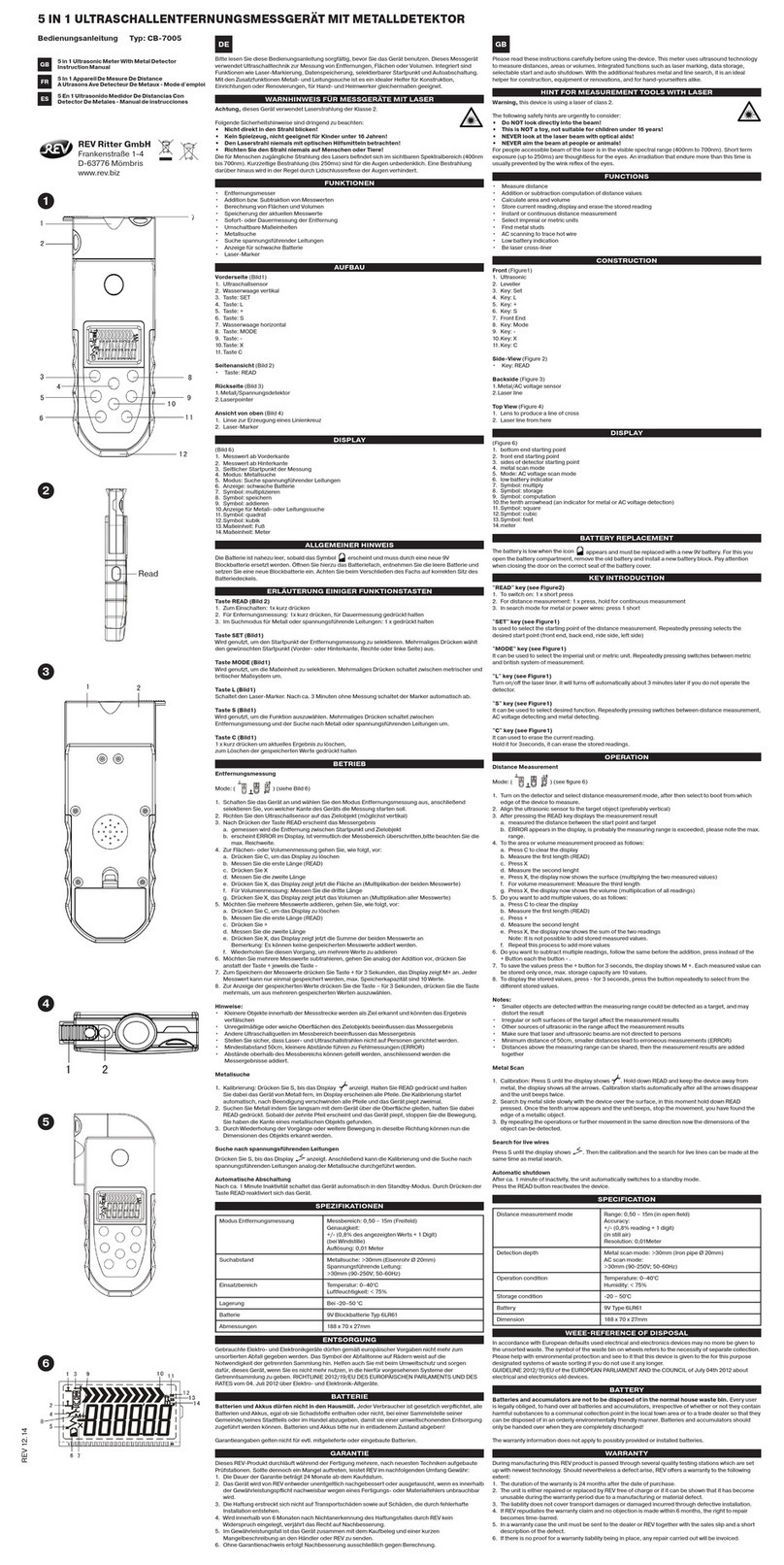
Method of Operation (see figures A–B)
The measuring tool checks the base material of sensor area 6
in measurement direction zto the max. detection depth (see
“Technical Data”). Objects are detected that differ from the
material of the wall.
Always move the measuring tool in a straight line over the sur-
face applying slight pressure, without lifting it off or changing
the pressure. During measurement, the contact pads 5must
always have contact to the surface.
Measuring Procedure
After switching on, the illuminated ring 1lights up green.
Position the measuring tool against the surface being detect-
ed and move it toward the x- and y-axis. When the measuring
toolcomescloser toanobject,the amplitudeinthe mainscale
hincreases and ring 1lights up yellow; when it is moved away
from the object, the amplitude decreases. The main scale h
indicates the maximal amplitude above the object; ring 1
lights up red and an audio signal sounds. For small or deeply
embedded objects, ring 1can continue to light up yellow,
while there is no audio signal.
fWide objects are not indicated by the illuminated ring
or the audio signal throughout their complete width.
As soon as the measuring tool has localised an object below
the centre of the sensor, the fine scale iis activated.
To localise the object more precisely, move the measuring
tool repeatedly (3x) back and forth over the object.
The fine scale iindicates a maximum amplitude when the ob-
ject is positioned precisely below the centre of the sensor, in-
dependent thereof how many bars are displayed in the main
scale h.
When very small or deeply embedded objects are being sought
and main scale hreacts only slightly, move the measuring tool
repeatedly over the object in horizontal (x-axis) and vertical
(y-axis) direction. Observe the amplitude of fine scale i.
fBefore drilling, sawing or routing into a wall, protect
yourself against hazards by using other information
sources. As the measuring results can be influenced
throughambientconditionsorthe wall material,theremay
be a hazard even though the indicator does not indicate an
objectinthesensor range (noaudiosignalorbeepand and
the illuminated ring 1lit green).
Metal
When the detected metal object is of magnetic metal (e.g.
iron), the symbol dis indicated on display 3. For non-magnet-
ic metals, the symbol cis indicated. In order to differentiate
between metal types, the measuring tool must be positioned
abovethedetectedmetal object(ring1islit redandfinescale
iindicates a high amplitude).
Note:Forreinforcement steelmeshandsteelintheexamined
base material, an amplitude is indicated over the complete
surface of the main scale h. For reinforcement steel mesh, it
is typical that the symbol dfor magnetic metal is indicated on
thedisplaydirectlyabovethe iron rods,whereasbetweenthe
iron rods, the symbol cfor non-magnetic metal will appear.
Power Cable
When a “live” conductor is detected, indication eappears on
the display 3. Move the measuring tool repeatedly over the
area to localise the “live” conductor more precisely. After
moving over the “live” conductor several times, it can be indi-
cated very accurately. When the measuring tool is very close
to the conductor, the illuminated ring 1rapidly flashes red
and the audio signal beeps swiftly.
Notes:
– “Live” conductorscanbedetectedeasierwhenpowercon-
sumers (e.g. lamps, machines) are connected to the
sought conductor and switched on.
–Undercertainconditions(suchas belowmetalsurfaces
orbehindsurfaceswithhigh water content),“live”con-
ductors cannot be securely detected. The signal
strength of a “live” conductor depends on the position of
the cable. Therefore, apply further measurements in close
proximity or use other information sources to check if a
“live” conductor exists.
– Voltage-free conductors can be detectedasmetalobjects.
This does not apply for stranded conductors (contrary to
solid conductors or cable).
– Static electricity can lead to inaccurate indication of elec-
tric lines, e.g., over a large range. To improve the indica-
tion, place your free hand flat on the wall next to the meas-
uring tool, in order to remove the static electricity.
OBJ_BUCH-1418-001.book Page 11 Thursday, April 28, 2011 9:54 AM