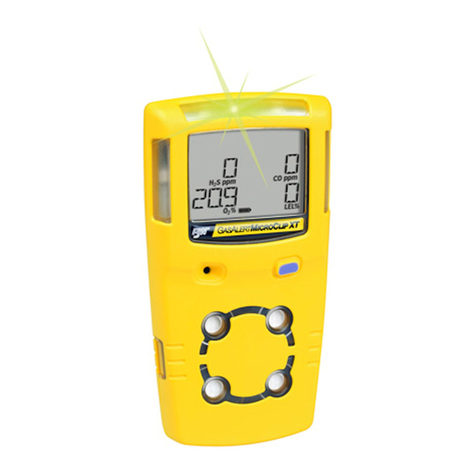
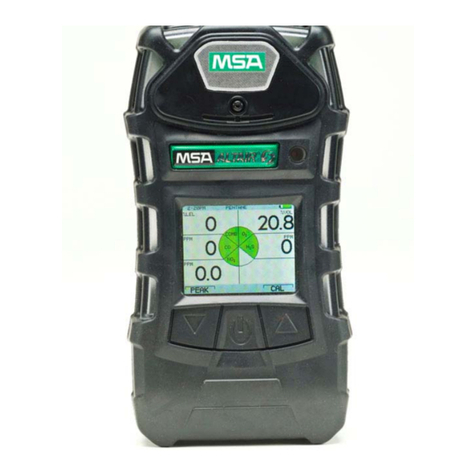
GasAlertMicro 5/PID/IR
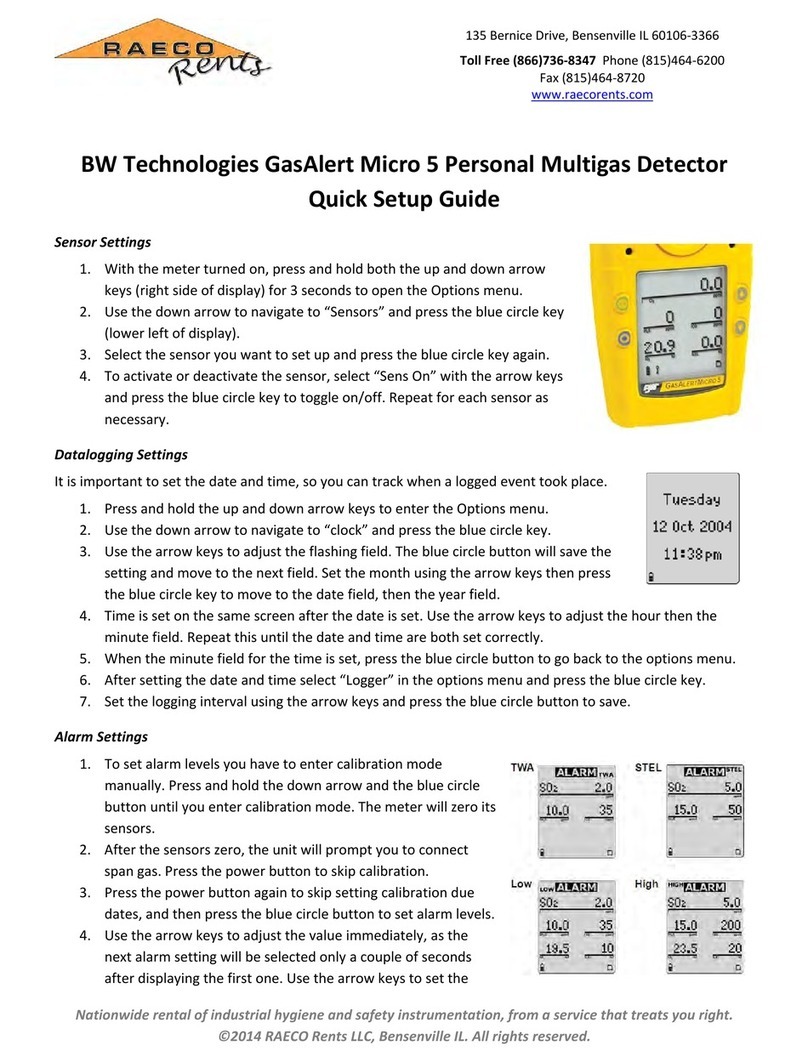
Quick Reference Guide
2
• BW recommends that the combustible sensor be
checked with a known concentration of calibration gas
after any exposure to contaminants/poisons such as
sulfur compounds, silicon vapors, halogenated
compounds, etc.
• BW recommends to bump test the sensors before each
day’s use to confirm their ability to respond to gas by
exposing the detector to a gas concentration that
exceeds the alarm setpoints. Manually verify that the
audible and visual alarms are activated. Calibrate if the
readings are not within the specified limits.
• For an additional bump test caution relating to the
European Regulations, refer to page 15.
• Calibrate the detector before first-time use and then on
a regular schedule, depending on use and sensor
exposure to poisons and contaminants. The sensors
must be calibrated regularly and at least once every
180 days (6 months).
• Calibrate only in a safe area that is free of hazardous
gas in an atmosphere of 20.9% oxygen.
• Only the combustible gas detection portion of this
instrument has been assessed for performance by CSA
International.
• The combustible sensor is factory calibrated to 50%
LEL methane. If monitoring a different combustible gas
in the % LEL range, calibrate the sensor using the
appropriate gas.
• Caution: High off-scale LEL readings may indicate an
explosive concentration.
• Protect the combustible sensor from exposure to lead
compounds, silicones, and chlorinated hydrocarbons.
Although certain organic vapors (such as leaded
gasoline and halogenated hydrocarbons) may
temporarily inhibit sensor performance, in most cases,
the sensor will recover after calibration.
• For use only in potentially explosive atmospheres
where oxygen concentrations do not exceed 20.9%
(v/v). Oxygen deficient atmospheres (<10% v/v) may
suppress some sensor outputs.
• Any rapid up scaling reading followed by a declining or
erratic reading may indicate a gas concentration
beyond the upper scale limit, which can be hazardous.
• Extended exposure of the GasAlertMicro 5,
GasAlertMicro 5 PID, or GasAlertMicro 5 IR to certain
concentrations of combustible gases and air may stress
the detector element that can seriously affect its
performance. If an alarm occurs due to a high
concentration of combustible gases, recalibration
should be performed or, if needed, the sensor replaced.
• The BW pump module (M5-PUMP) is certified for use
with the GasAlertMicro 5, GasAlertMicro 5 PID, and
GasAlertMicro 5 IR models only.
• Protect the PID sensor from exposure to silicone
vapors.
• When calibrating O3 and ClO2 sensors that are located
in the Toxic 2 position of the detector, a single gas
calibration cap must be used to ensure accurate
calibration.