3.05.3 Using smaller input cable or longer
length will greatly degrade the inverter peak
performance.
IMPORTANT NOTE FOR VEHICLE
INSTALLATION:
Do not use the vehicle
chassis as the negative return in place of a
return cable. Use the same size cable as the
positive connection and run directly to the
battery.
3.05.4 Install the wires at the battery,
inverter and then fuse holder. Make sure that
clean,tight connectionsaremade. Usecarenot
to touch the positive and negative wires to-
gether,aviolentsparkwillresultandcouldcause
exploding batteries and fire.
3.05.5 The battery input terminals are
locatedinthe wiringcompartment. A mounting
spark may result when connecting the battery
wire,duetoaninitialchargingoftheoftheinternal
input capacitor.
3.05.6
CAUTION:
Connecting the inverter
incorrectlytothebatterywillcausedamagethat
is not covered under warranty.
3.06 Remote Switch for Inverter
Operation - Fig. 1
3.06.1 All material used for the remote
switchshouldbeU.L.listedandinstalledperlow
voltage,Class2,wiringcode.A5ampin-linefuse
and a 18-gauge wire are recomended.
3.06.2 A remote switch may be connected
tothevioletwiremarked“RemoteSwitchHookup”
in the wiring compartment. You should first
removethis violetwire fromthe batterypositive
inputterminal;thenconnectthevioletwiretothe
load side of the remote switch. Fused, positive
battery voltage is connected to the line side of
the switch. The cable clamp strain relief should
be used to secure the field wires.
3.06.3 The switch should be mounted at
a convenient location in a listed outlet box with
approved strain relief.
3.06.4
NOTE:
A remote switch, if in-
stalled, will operate only if the local ON/OFF
of installation, regardless of suggestions in this
manual. All wires should be copper conductors.
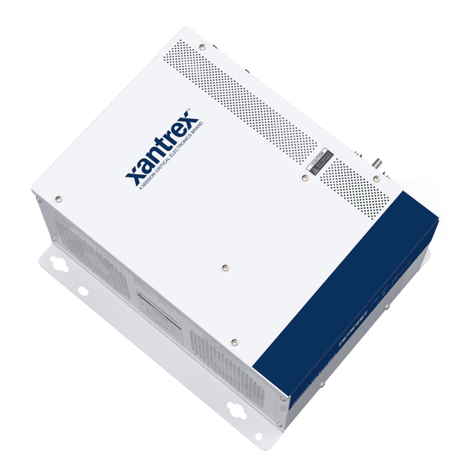
3.03 Mounting
3.03.1 Locate a suitable, secure vertical or
horizontalmountingsurfaceasclosetothebattery
as possible without being in the same air tight
compartment. The maximum recommended
distance between the mounting location and the
battery is 20 feet.
CAUTION: Mount the inverter on a vertical
surfacewiththefrontcontrolpanelpointingdown.
3.03.2 The location should provide ad-
equate ventilation and clearance to prevent unit
over-heatingduringoperation. Atleast1/2inchof
clearance is required on all sides.
3.03.3 Secure the unit with 1/4 inch screws
or bolts in the mounting slots on the flanges of the
chassis.
3.04 Chassis Bonding Lug - FIG. 1
3.04.1 Connect a #8 gauge or greater
copperwirebetweenthebondinglugontheinverter
and the earth grounding system or the vehicle
chassis.
3.05 Battery Wiring - FIG. 1
3.05.1
CAUTION:
Assure that hydrogen
gas does not accumulate near the battery by
keepingtheareawellventilated.Asparkmayresult
whenconnecting thefinalbatterywiringdue toan
initial charging of the internal input capacitor.
3.05.2 Use stranded copper wire between
the battery and inverter as indicated. A line fuse
must be installed between the battery and the
inverter. Codes require that the fuse be within 18
inches of the battery.
DC Input Wire Lengths (maximum)
and Fusing Guide
Distance(feet)
Model 1-10 11-15 16-20
12/800N 6 ga 4 ga 2 ga
12/1200N 4 ga 2 ga 1 ga
AWG: 6 4 2 1
Fuse: 150A 200A 250A 300A
Page 3