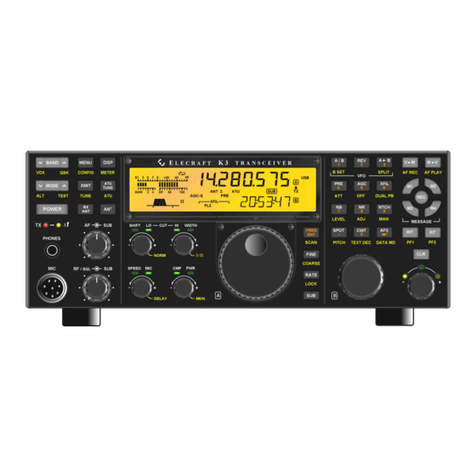
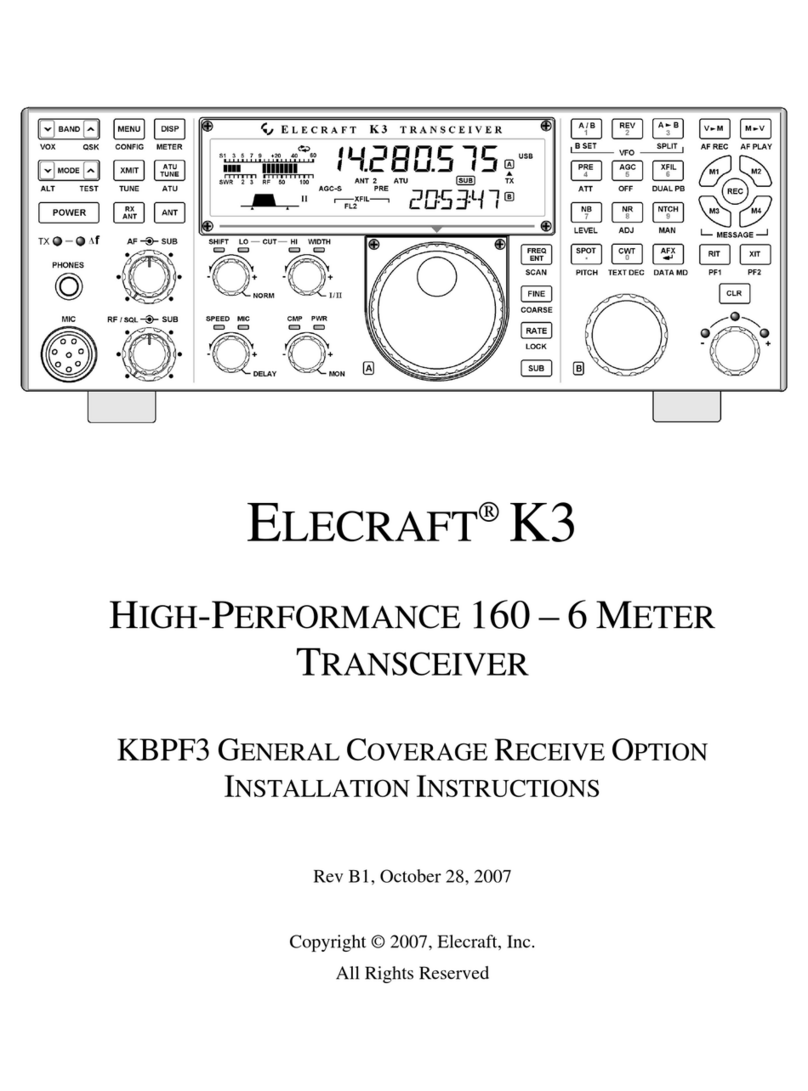
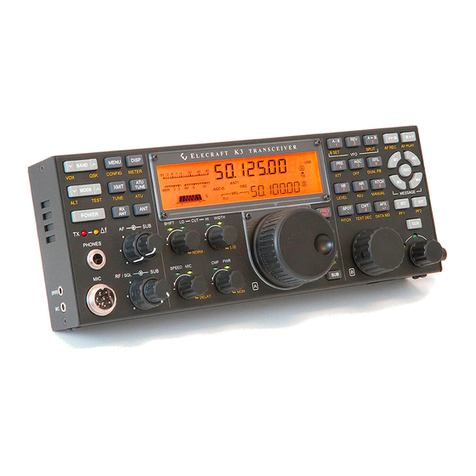
ELECRAFT K3S User manual

ELECRAFT K3S
HIGH-PERFORMANCE
160 – 6 METER TRANSCEIVER
KPA3A 100-WATT AMPLIFIER OPTION
INSTALLATION INSTRUCTIONS
Rev A, June 2, 2015
Copyright © 2015, Elecraft, Inc.
All Rights Reserved
E740267

2
Contents
Introduction ............................................................................................................................................... 3
Customer Service and Support ............................................................................................................................ 3
Technical Assistance ....................................................................................................................................... 3
Repair / Alignment Service ............................................................................................................................. 3
Preventing Electrostatic Discharge Damage ............................................................................................ 4
Choosing an Anti-Static Mat ............................................................................................................................... 4
Preparing for Installation .......................................................................................................................... 5
Tools Required .................................................................................................................................................... 5
Parts Included ...................................................................................................................................................... 5
Installation Procedure ............................................................................................................................... 7
Removing the KRX3A/KRX3 Sub Receiver Module ......................................................................................... 9
Removing the KNB3 Module ........................................................................................................................... 10
Installing the KPA3A Shield ............................................................................................................................. 11
Installing the KPAIO3A Interface Module ....................................................................................................... 12
Assembling the Fan Panel ................................................................................................................................. 14
Installing the KPA3A Amplifier Module .......................................................................................................... 16
Installing the Fan Panel ..................................................................................................................................... 16
Replacing the KNB3 Module ............................................................................................................................ 18
Replacing the KRX3A/KRX3 Module ............................................................................................................. 18
Replacing the Covers ........................................................................................................................................ 19
Configuring and Calibrating the KPA3A .......................................................................................................... 20
Circuit Description .................................................................................................................................. 21
KPAIO3A .......................................................................................................................................................... 21
KPA3A Fan Panel ............................................................................................................................................. 21
KPA3A Power Amplifier .................................................................................................................................. 21
Elecraft manuals with color images may be downloaded from
www.elecraft.com.

3
Introduction
This manual covers the installation of the KPA3A 100-watt amplifier option in your K3S or K3 transceiver.
Only a few basic hand tools are needed (see page 5) to perform the installation. No soldering or wiring is
required.
The KPA3A option consists of three subassemblies: the KPA3A power amplifier, a fan panel, and the
KPAIO3A interface module. More details about the KPA3A are provided under Circuit Description on page 21.
Customer Service and Support
Technical Assistance
You can send e-mail to [email protected] and we will respond quickly - typically the same day Monday
through Friday. Telephone assistance is available from 9 A.M. to 5 P.M. Pacific time (weekdays only) at
831-763-4211. Please use e-mail rather than calling when possible since this gives us a written record of the
details of your problem and allows us to handle a larger number of requests each day.
Repair / Alignment Service (We want to make sure everyone succeeds!)
If necessary, you may return your Elecraft product to us for repair or alignment. (Note: We offer unlimited email
and phone support to get your kit running, so please try that route first as we can usually help you find the
problem quickly.)
IMPORTANT: You must contact Elecraft before mailing your product to obtain authorization for the
return, what address to ship it to and current information on repair fees and turn around times. (Frequently we
can determine the cause of your problem and save you the trouble of shipping it back to us.) Our repair location
is different from our factory location in Aptos. We will give you the address to ship your kit to at the time of
repair authorization. Packages shipped to Aptos without authorization will incur an additional shipping charge
for reshipment from Aptos to our repair depot.
Elecraft's 1-Year Limited Warranty
This warranty is effective as of the date of first consumer purchase (or if shipped from factory, date product is shipped
to customer). It covers both our kits and fully assembled products. For kits, before requesting warranty service, you
should fully complete the assembly, carefully following all instructions in the manual.
Who is covered: This warranty covers the original owner of the Elecraft product as disclosed to Elecraft at the time of
order. Elecraft products transferred by the purchaser to a third party, either by sale, gift or other method, who is not
disclosed to Elecraft at the time of original order, are not covered by this warranty. If the Elecraft product is being
bought indirectly for a third party, the third party's name and address must be provided to Elecraft at time of order to
insure warranty coverage.
What is covered: During the first year after date of purchase, Elecraft will replace defective or missing parts free of
charge (post-paid). We will also correct any malfunction to kits or assembled units caused by defective parts and
materials. Purchaser pays inbound shipping to Elecraft for warranty repair, Elecraft will pay shipping to return the
repaired equipment to you by UPS ground service or equivalent to the continental USA and Canada. Alaska, Hawaii
and outside U.S. and Canada actual return shipping cost paid by owner.
What is not covered: This warranty does not cover correction of kit assembly errors. It also does not cover
misalignment; repair of damage caused by misuse, negligence, or builder modifications; or any performance
malfunctions involving non-Elecraft accessory equipment. The use of acid-core solder, water-soluble flux solder, or any
corrosive or conductive flux or solvent will void this warranty in its entirety. Also not covered is reimbursement for loss
of use, inconvenience, customer assembly or alignment time, or cost of unauthorized service.
Limitation of incidental or consequential damages: This warranty does not extend to non-Elecraft equipment or
components used in conjunction with our products. Any such repair or replacement is the responsibility of the customer.
Elecraft will not be liable for any special, indirect, incidental or consequential damages, including but not limited to any
loss of business or profits.

4
Preventing Electrostatic Discharge Damage
Sensitive components may be damaged by Electrostatic Discharge (ESD) simply by touching them or a circuit
board containing them unless you take specific steps to prevent such damage. Damage may occur with static
discharges far too little for you to notice.
A damaged component may not fail completely at first. Instead, the damage may result in below-normal
performance for an extended period of time before you experience a total failure.
Parts which are especially ESD-sensitive are identified in the parts list and in the assembly procedures.
We strongly recommend you take the following anti-static precautions (listed in order of importance) to ensure
there is no voltage difference between the components and any object that touches them:
Leave ESD-sensitive parts in their anti-static packaging until you install them. The packaging may be a
special plastic bag that allow static charges to flow harmlessly over their surface, or a component’s
leads may be inserted in conductive foam that keep them at the same potential.
Wear a conductive wrist strap with a series 1-megohm resistor that will constantly drain off any static
charge that accumulates on your body. If you do not have a wrist strap, touch a ground briefly before
touching any sensitive parts to discharge your body. Do this frequently while you are working. You can
collect a destructive static charge on your body just sitting at the work bench.
WARNING
DO NOT attach a ground directly to yourself without a current-limiting resistor as this poses a
serious shock hazard. A wrist strap must include a 1-megohm resistor to limit the current flow. If
you choose to touch an unpainted, metal ground to discharge yourself, do it only when you are
not touching live circuits with any part of your body.
Use a grounded anti-static mat on your work bench (see below).
If you pick up a pc board that was not placed on an anti-static mat or in an anti-static package, touch
first a ground plane connection on the board such as a connector shell or mounting point.
If you use a soldering iron to work on a circuit board, be sure your iron has an ESD-safe grounded tip
tied to the same common ground used by your mat and wrist strap.
Choosing an Anti-Static Mat
An anti-static mat must bleed off any charge that comes in contact with it at a rate slow enough to avoid a shock
or short circuit hazard but fast enough to ensure dangerous charges cannot accumulate. Typically, a mat will
have a resistance of up to 1 Gigaohm (109 ohms). Testing a mat requires specialized equipment, so we
recommend that you choose an anti-static mat that comes with published resistance specifications and clean it as
recommended by the manufacturer. Testing has shown that many inexpensive mats that do not specify their
resistance have resistance values much too high to provide adequate protection, even after they were cleaned
and treated with special anti-static mat solutions.
Suitable anti-static table mats are available from many sources including:
U-line (Model 12743 specified at 107 ohms)
Desco (Model 66164, specified at 106 to 108 ohms)
3MTM Portable Service Kit (Model 8505 or 8507, specified at 106 to 109 ohms)

5
Preparing for Installation
Tools Required
1. #0 and #1 size Phillips screwdrivers. To avoid damaging screws and nuts, a power screwdriver is not
recommended. Use the screwdriver that best fits the screw in each step.
2. Small diagonal cutters.
3. Needle-nose pliers.
4. Soft cloth or clean, soft static dissipating pad to lay cabinet panels on to avoid scratching.
The following tools are strongly recommended:
1. ESD wrist strap.
2. Static dissipating work pad.
Parts Included
The following parts should be included in your kit. Check to ensure you have them all. If any parts are damaged
or missing, contact Elecraft for replacements (see Customer Service and Support, page 3).
CAUTION
In addition to taking ESD precautions, be careful not to damage components on either side of the
circuit boards when handling them. This is especially true of the KPA3 module because of the
weight of the heat sink.
ILLUSTRATION DESCRIPTION QTY. ELECRAFT
PART NO.
KPA3A Module
ESD Sensitive. 1 E850673
KPAIO3A Interface Module
ESD Sensitive 1 E850679
Fan Panel 1 E100288

6
ILLUSTRATION DESCRIPTION QTY. ELECRAFT
PART NO.
Fan with short lead 1 E850293
Fan with long lead 1 E850294
Finger Guard 2 E980143
Circuit Breaker, 20A 1 E980128
Rear Shield 1 E100217
Screw, 4-40, 1/4” (6.4 mm) Zinc, Pan
Head 9 E700005
Screw, 4-40, 1/4” (6.4 mm) Black, Pan
Head 1 E700174
Screw, 4-40, 3/8” (9.5 mm) Black, Flat
Head 1 E700176
Screw, 4-40, 7/8” (22 mm ) Black, Flat
Head 8 E700179
Acorn Nut, 4-40 8 E700160
Standoff, 4-40, 5/16” (7.9 mm) long 1 E700121
Lock Washer, #4 Internal Tooth 4 E700183
Lock Washer, #4 Split 4 E700004
Nut, 4-40 1 E700011

7
Installation Procedure
K3S/K3 KIT BUILDERS: If you were directed here to install the KPA3A module as part of the
initial assembly, begin here to complete the installation. Skip over the steps indicated.
Disconnect power and all cables from your K3S/K3.
Remove the nine screws to free the top cover as shown in Figure 1. After the cover is open, lift it gently to
reach the speaker wire connector. Unplug the speaker and set the top cover aside in a safe place.
Figure 1. Removing K3S/K3 Top Cover.

8
CAUTION: Touch an unpainted metal ground or wear a grounded wrist strap
before touching components or circuit boards inside the K3S/K3. See Preventing
Electrostatic Discharge Damage on page 4 for more information.
On the rear of the K3S/K3, remove the large blank panel above the GND screw. This panel will not be used
again, but the screws will be needed to mount the cooling fans. (If you are installing the KPA3A as part of
building your K3S/K3 kit, this panel may not be installed.) The panel has a hole marked ANT3 for the antenna
connection to the optional K144XV 2-meter module. If you do not have the K144XV option, a plastic plug will
fill this hole. Remove the plug or the antenna connector. To prevent accidental short circuits, either tape the
metal end of the BNC connector or unplug the cable from the K144XV module and remove it entirely for now.
Turn the K3S/K3 upside down and remove the bottom cover(s) as shown in Figure 2. Note that, if you are
finishing the KPA3A installation after assembling your K3S/K3 kit, only the rear portion of the bottom cover
needs to be removed.
Figure 2. Removing the K3S/K3 Bottom Covers.

9
K3S/K3 KIT BUILDERS: If you are installing the KPA3A as part of the initial K3S/K3 kit
assembly, skip the following steps and resume with Installing the KPAIO3A Interface Module on page 12
Remove the stiffener bar that runs from side to side across the top of the chassis. This is the bar the center
three screws in the top cover thread into. The bar is held in place by a single screw at each side.
Removing the KRX3A/KRX3 Sub Receiver Module
If your K3S/K3 is equipped with the optional sub receiver, you must remove the sub receiver module to install
the KPA3A shield. The sub receiver module is the “L” shaped metal enclosure shown in Figure 3. The K3 in the
figure has a KPA3A 100 watt amplifier and shield installed showing how it fits next to the sub receiver module.
Remove the sub receiver module as follows:
Remove the chassis stiffener bar that runs across the top of the chassis and is attached to the side panels.
Remove the two 1-1/2” (38 mm) screws and lock washers shown in Figure 3. These screws extend all the
way through the sub receiver module and secure it to standoffs mounted on the main RF board that fills the
bottom of the K3S/K3.
Figure 3. Removing the Sub Receiver Module.
In the following steps you will handle small TMP coaxial connectors. These are friction-
fit connectors shown in Figure 4. Handle the connectors by the grips as shown. Do not pull
on the coaxial cable.
Figure 4. TMP Coaxial Connectors.

10
Hold the sub receiver module by the two brass knurled nuts on the top, and lift it straight up to gain access
to the small TMP coaxial connectors plugged into the module. There are two along the front. There may be one
at the back as well, depending upon the options installed. As you lift the module, it will unplug from two small
interface circuit boards. One is at the front and the other is at the rear. These small boards may come out with
the module or they may remain attached to the main RF board.
Unplug the TMP coaxial cables leading to the sub receiver module, then lift the module free and set it aside.
Locate the two small interface circuit boards that fit between the connectors on the sub receiver module and
the connectors on the RF board. Remove them and put them in a safe place.
Unplug and remove the loose TMP cables that were connected to the sub receiver module. If your K3S/K3
is equipped with a cable connected to a BNC connector at the rear panel AUX RF input, this cable will not
unplug. It is permanently attached to the BNC connector Wrap the metal TMP connector in insulating tape to
ensure it cannot short to any circuits.
CAUTION: You will apply power to make tests before reinstalling the sub receiver
module again. If the loose cables are not removed or insulated to prevent shorts as
described in the previous step, you may destroy circuits in your K3S/K3 when you apply
power.
Removing the KNB3 Module
KNB3 module must be removed to provide clearance needed to install the KPA3A shield in the following
section.
Remove the KNB3 module, the standoff, screw and washers from the RF board (see Figure 5). They will be
reinstalled later.
CAUTION: The KNB3 module is ESD sensitive. Put it in a safe place until you
reinstall it.
Figure 5. Removing the KNB3 Module.
Other manuals for K3S
6
Table of contents
Other ELECRAFT Transceiver manuals

ELECRAFT
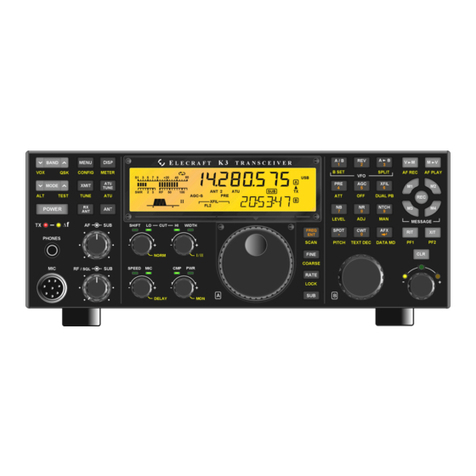
ELECRAFT K3S User manual
ELECRAFT
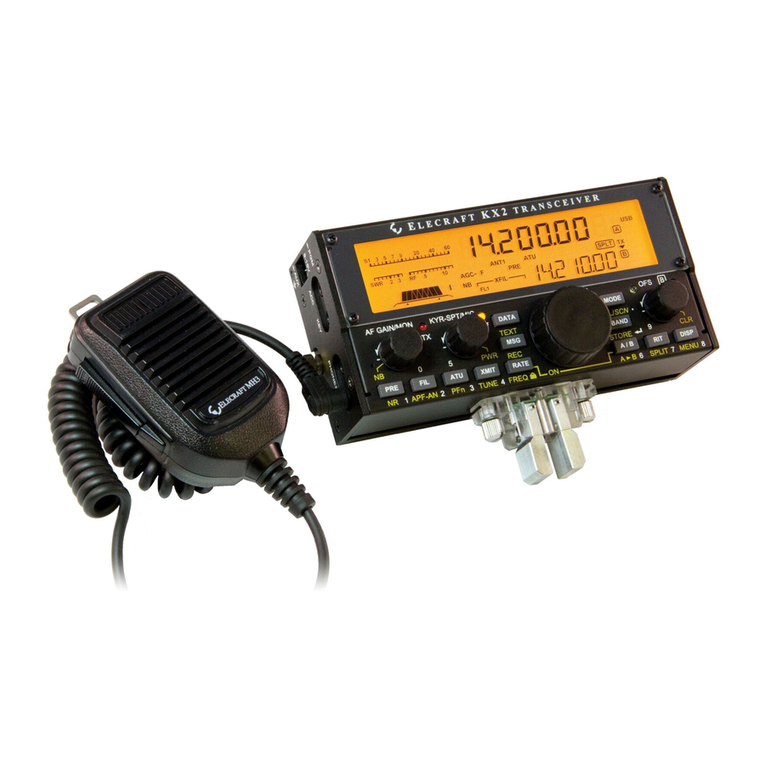
ELECRAFT K3 Owner's manual
ELECRAFT
ELECRAFT KX2 User manual
ELECRAFT
ELECRAFT KH1 User manual
ELECRAFT
ELECRAFT K3S User manual
ELECRAFT
ELECRAFT K4 Reference manual
ELECRAFT
ELECRAFT K2 User manual
ELECRAFT
ELECRAFT K3 User manual
ELECRAFT
ELECRAFT KPA3 User manual

ELECRAFT
ELECRAFT K3 User manual
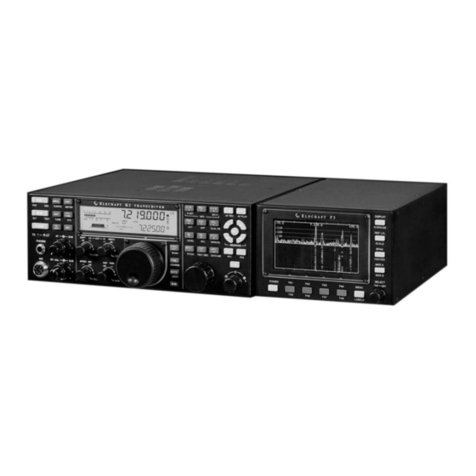
ELECRAFT
ELECRAFT P3 User manual

ELECRAFT
ELECRAFT K1 User manual
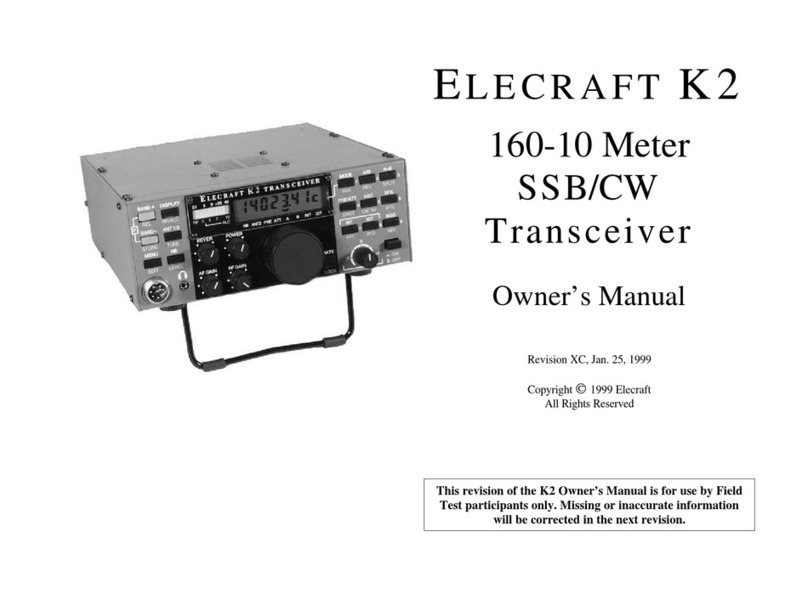
ELECRAFT
ELECRAFT K2 User manual

ELECRAFT
ELECRAFT K3 User manual
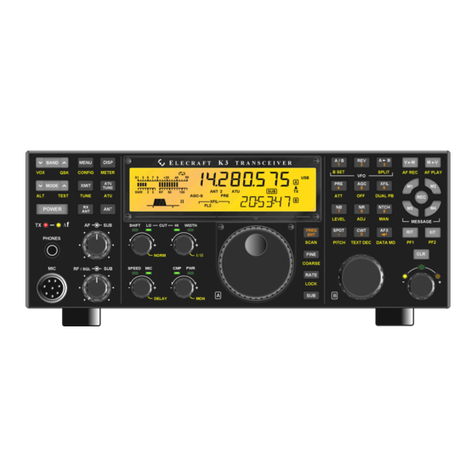
ELECRAFT
ELECRAFT K3 User manual
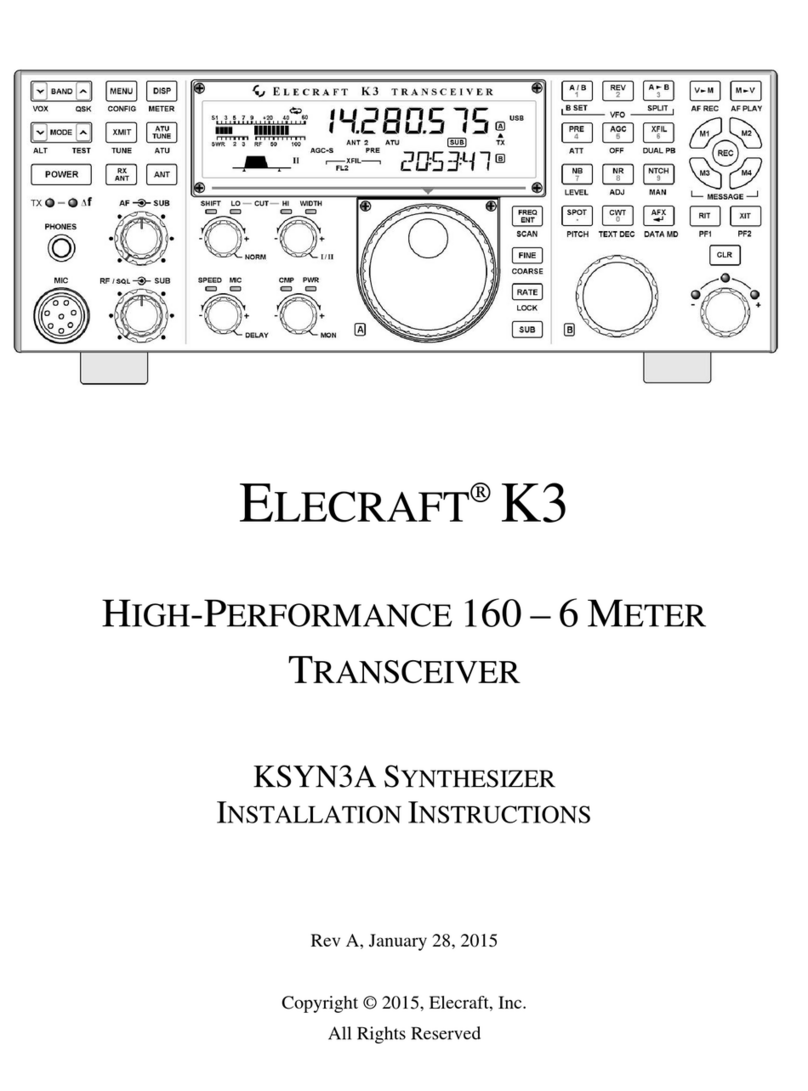
ELECRAFT
ELECRAFT K3 User manual
ELECRAFT
ELECRAFT K3 Quick start guide
ELECRAFT
ELECRAFT KX3-2M Supplement
ELECRAFT
ELECRAFT K3 User manual
ELECRAFT
ELECRAFT KX2 User manual