ELECRAFT 9
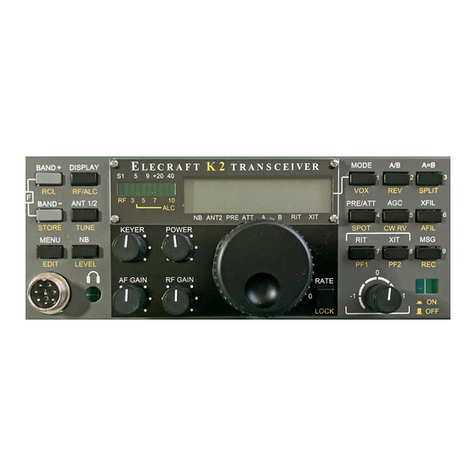
There are six steps in the K2 assembly process:
1. Control Board assembly
2. Front Panel Board assembly
3. RF Board assembly and test, part I (control circuits)
4. RF Board assembly and test, part II (receiver and synthesizer)
5. RF Board assembly and test, part III (transmitter)
6. Final assembly
This assembly sequence is important because later steps build on the
previous ones. For example, in step 3 you’ll put the modules
together for the first time, allowing you to try out the K2’s built-in
frequency counter. The counter will then be used in step 4 to align
and test the receiver and synthesizer on 40 meters. In step 5 all the
pieces will come together when you complete the transmitter and
filters, then align the K2 on all bands. The last few
details—speaker, tilt stand, etc.—will be wrapped up in step 6.
Unpacking and Inventory
When you open the kit you should find the following items:
!six chassis pieces (Figure 3-1)
!three printed circuit boards (Figure 3-2)
!FRONT PANEL board components bag
!CONTROL board components bag
!RF board components bag
!MISCELLANEOUS components bag (includes hardware)
!WIRE bag
!4-ohm Speaker, 5 small knobs, and large tuning knob
!plastic tube containing the latching relays
!an envelope (inside the manual back cover) containing the LCD
bezel, green LED bargraph filter, serial number label, thermal
insulators, and two very small self-adhesive rubber pads (round
or square)
Inventory
We strongly recommend that you do an inventory of parts before
beginning to assemble the kit. It is not necessary to inventory the
resistors, which are supplied attached to tape in assembly order.
Even if you don’t do an inventory, it is helpful to familiarize
yourself with the parts list, Appendix A. Additional information on
identifying capacitor, chokes, and resistors is provided below.
Identifying Capacitors
Small-value fixed capacitors are usually marked with one, two, or
three digits and no decimal point. If one or two digits are used, that
is always the value in picofarads (pF). If there are three digits, the
third digit is a multiplier. For example, a capacitor marked "151"
would be 150 pF (15 with a multiplier of 101). Similarly, "330"
would be 33 pF, and "102" would be 1000 pF (or .001 µF). All small
capacitors whose markings do not follow this convention are
described more specifically in the text and parts list.
Fixed capacitors with values of 1000 pF or higher generally use a
decimal point in the value, such as .001 or .02. This is the value in
microfarads (µF). Capacitors also may have a suffix after the value,
such as ".001J." In some cases the suffixes or other supplemental
markings may be useful in identifying capacitors.
Hard-to-identify capacitor values:
3.3 pF: These capacitors have pillow-shaped, dark-green bodies
about 1/8" (3 mm) square, with a black mark on the top. The "3.3"
label may be difficult to read without a magnifying glass.
150 pF: These are correctly marked "151" on one side, but the
other side is marked #21 ASD, where "#21" may look like "821."