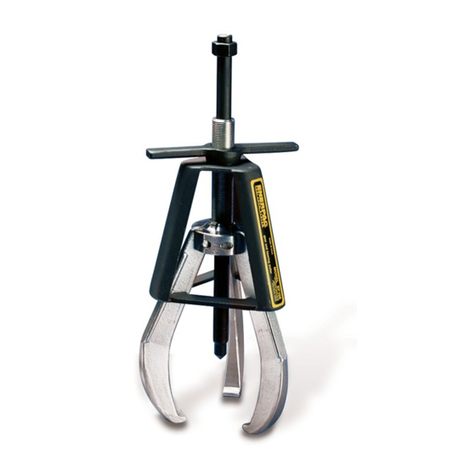
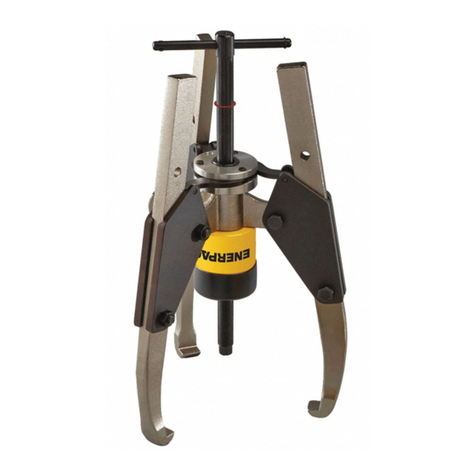
If the jaws appear to be coming out of the ball groove, release hydraulic pressure and
re-tighten the T-Handle by hand. This may be necessary when the puller is new to get
the jaws to properly seat in the cage.
5. Turn the T-handle clockwise to tighten the jaws firmly onto the component.
6. Make sure that the puller is square with the component to be pulled. Advance the
plunger until the ram point contacts the shaft to ensure correct alignment. (If necessary,
refer to the pump’s instruction sheet.) The center of the ram point should be aligned with
the center of the shaft. Continue to advance the plunger slowly to pull the component off
of the shaft. Do not re-tighten the T-handle during the pulling operation. Never exceed
the maximum torque rating of the pullers.
Maintenance
Always clean the puller after use and store in a clean, dry place.
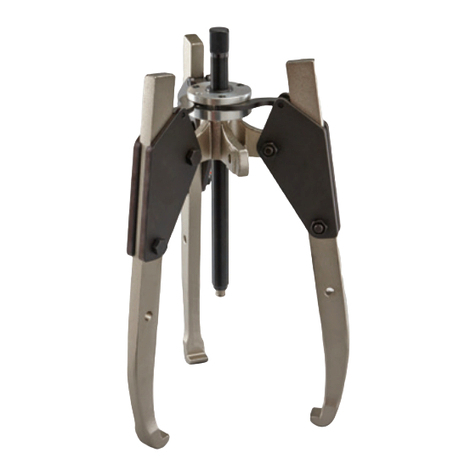
100-Ton Hydraulic Puller
WARNING
Do NOT stand on, under, or near puller while in use. Keep hands, feet and clothing
away from moving parts.
WARNING
When transporting puller, always place the puller in its lowest position and remove
ram extenders.
1. Make sure that all items being pulled are supported by a means other than the puller. Do
not use the puller for lifting or supporting objects.
2. Align the puller to the shaft to ensure a straight pull. (The puller’s lift cart can raise the
puller up to 5 feet. For distances beyond 5 feet, the puller can be removed from the cart.
See Removing Puller from Lift Cart.)
To raise the puller, place the cylinder control valve in the “Hoist Oil Supply” position,
open the puller hoist vertical control valve, and raise the puller by placing the remote
jog switch in the “On” position.
When puller has reached the desired height, release the remote jog switch and close
the vertical control valve.
To lower the puller, place the cylinder control valve in the “Hoist Lower” position, turn
the hoist vertical control valve counterclockwise, and close the hoist vertical control
valve after the puller has reached its desired height.
Note
The restrictor valve, located at the top of the hoist cylinder, is used to control the rate
of puller descent. This valve should be set at the desired rate and locked in place using
the nut on the valve shaft. (An appropriate starting point is one full turn from the closed
position This restrictor valve is only a one-way restrictor valve; it does not affect the rate
at which the puller is raised.)
WARNING
Always keep the puller hoist vertical control valve closed when not adjusting the
vertical position.
(5)