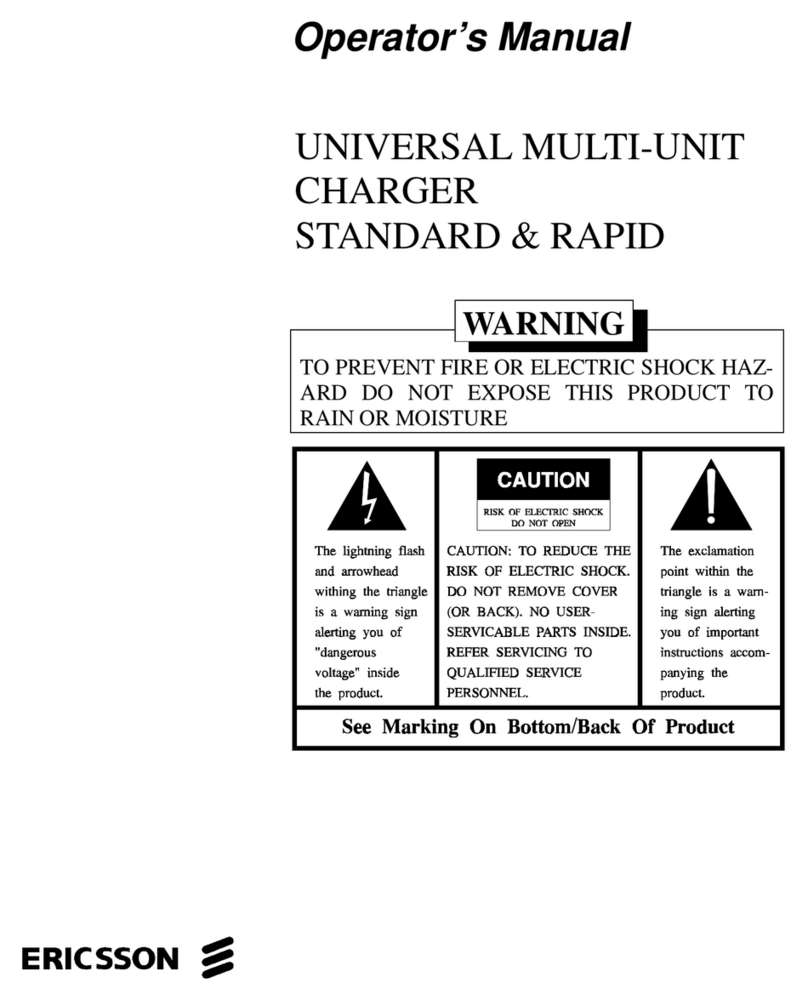
IMPORTANT SAFETY INFORMATION
b. That the extension cord is properly wired and in good
condition; and
c. That the wire size is large enough for the AC ampere
rating of the charger as specified in Table 1.
9. Do not operate charger with damaged cord or plug -
replace them immediately.
10. Do not operate charger if it has received a sharp blow,
been dropped,or otherwise damaged in any way; return it
to a qualified service shop.
11. Do not disassemble the charger; return it to a qualified
service shop when service or repair is required. Incorrect
reassembly may result in a risk of electrical shock or fire.
12. To reduce risk of electric shock, unplug the charger from
the outlet before attempting any maintenance or cleaning.
13. GROUNDING AND AC POWER CORD CONNEC-
TION - To reduce the risk of electrical shock use only a
properlygroundedoutlet.Thechargerisequippedwithan
electric cord having an equipment-grounding conductor
and a grounding plug. Be sure the outlet is properly
installed and grounded in accordance with all local codes
and ordinances.
14. DANGER - Never alter the AC cord or plug. If it will not
fitintheoutlet,haveaproperoutletinstalledbyaqualified
electrician. Improper connection can result in risk of an
electric shock .
15. The Rapid Charger 120 Vac line cord has a grounding
plug that looks like the plug illustrated in Figure 1. A
temporaryadapter,which looksliketheadapterillustrated
in sketches B and C, may be used to connect this plug to
a two-pole receptacle as shown in sketch B if a properly
grounded outlet is not available. The temporary adapter
should be used only until a properly grounded outlet can
be installed by a qualified electrician.
16. DANGER - Before using an adapter as illustrated, be
certain the center screw of the outlet plate is grounded.
The green- color rigid ear or lug extending from the
adapter must be connected to a properly grounded outlet-
-make certain it is grounded. If necessary, replace the
outlet cover plate screw with a longer screw that will
secure adapter ear or lug to outlet plate and make ground
connection to grounded outlet.
17. Care should be taken when placing the charger in service
to insure proper top and bottom ventilation. A minimum
of 1/4" is required between the bottom of the charger and
the surface on which it sits.
Figure 1 - Grounding Methods
Due to the temperature characteristics of nickel-cad-
mium batteries, the batteries will not accept a full
charge at temperature extremes. For maximum capac-
ity, recharge the battery pack at a room temperature of
65° to 85 ° Fahrenheit, whenever possible.
NOTE
NOTE: The Universal Chargers 344A3072P1 & P8 have
been tested and found to comply with the limits for a Class
B digital device, pursuant to part 15 of the FCC rules. These
limits are designed to provide reasonable protection against
harmful interference in a residential installation. This equip-
ment generates, uses and can radiate radio frequency energy
and, if not installed and used in accordance with the instruc-
tions, may cause harmful interference to radio communica-
tions. However, there is no guarantee that interference will
not occur in a particular installation. If this equipment does
cause harmful interference to radio or television reception,
which can be determined by turning the equipment off and
on, the user is encouraged to try to correct the interference
by one or more of the following measures:
•Reorient or relocate the receiving antenna.
•Increase the separation between the equipment and
receiver.
•Connect the equipment into an outlet on a circuit
differentfromthat to whichthereceiverisconnected.
Consult the dealer or an experienced radio/TV techni-
cian for help.
LBI-38707
4