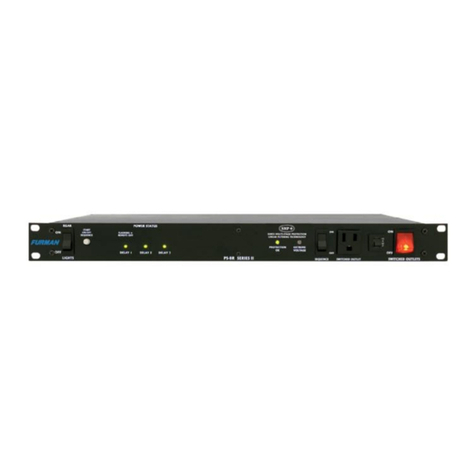
PS-8R - POWER CONDITIONER/SEQUENCER
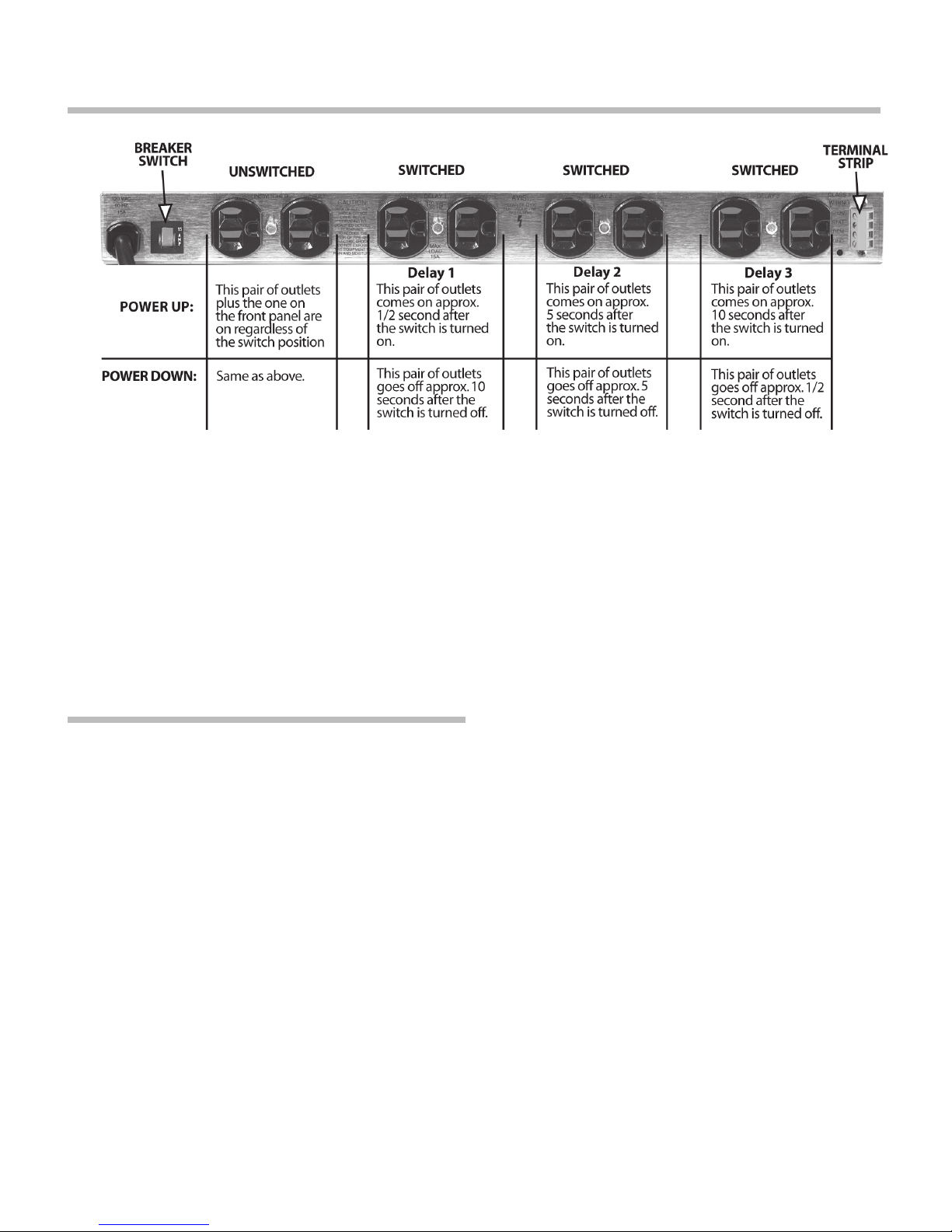
delayed outlets, a single front panel outlet and a
rear panel pair are unswitched. Power is available
at the unswitched outlets regardless of the posi-
tion of the front panel (or remote) switch. All rear
panel outlets are standard 120V, 15A duplex types.
In the event of a power outage, of course all
equipment plugged into a PS-8R will lose
power simultaneously. However, when power
is restored, the delayed outlet groups will again
turn on in the usual delayed sequence.
We recommend that power amps receive power
last — plug them all into Delay 3 or divide them into
two groups and plug one group into Delay 2 and
the other into Delay 3. Low level equipment such as
mixers and signal processors should use Delay 1.
Equipment incorporating clocks or timers such
as VCR’s, or equipment that must respond
to wireless remote actuation should use the
unswitched outlets. We suggest keeping
the front panel unswitched outlet free for
equipment that is only in use temporarily.
The overall capacity of the PS-8R is 15 amps. This
refers to the combined steady-state current drawn
by all devices plugged into all of its nine outlets.
If this combined current level exceeds 15 amps
at any time, the circuit breaker will trip, cutting off
power to your rack. If this occurs, you must reduce
the load by unplugging one or more units from
the PS-8R. Then push the button on the circuit
breaker (on the rear panel) down and in to reset it.
Although 15 amps is an absolute limit, the PS-
8R’s power sequencing capability will allow you
to come as close as possible to using the full 15
amps, because the risk of tripping the breaker
is greatly reduced. This is because the PS-8R
handles large but temporary inrush currents
in stages, rather than simultaneously, allow-
ing each stage to settle to its steady-state cur-
rent draw before the next stage is powered.
Power Conditioning Features
The PS-8R offers all basic power conditioning fea-
tures besides its sequencing capability. It provides
varistor spike and surge protection across all three
modes (line to neutral, line to ground, and neutral
to ground), responding in nanoseconds to clamp
excessive transient voltages to safe levels. There
is also a sophisticated multi-stage lter for blocking
radio frequency line noise. The lter works to prevent
noise from uorescent lights, certain dimmers, radio
transmitters, and similar sources of “electronic pol-
lution” leaking from the AC line into sensitive audio,
video, or computer circuits. Clean, ltered power is
provided at all 9 outlets, even the unswitched ones.
Despite its many protective features, you should be
aware that the PS-8R does not compensate if the AC
line voltage itself is high or low (i.e., it does not com-
pensate for brownout conditions). If you frequently
move your rack to different locations, derive power
from generators, use long extension cords, travel
internationally, or are in an area particularly prone
to brownouts, you may benet from the use of one
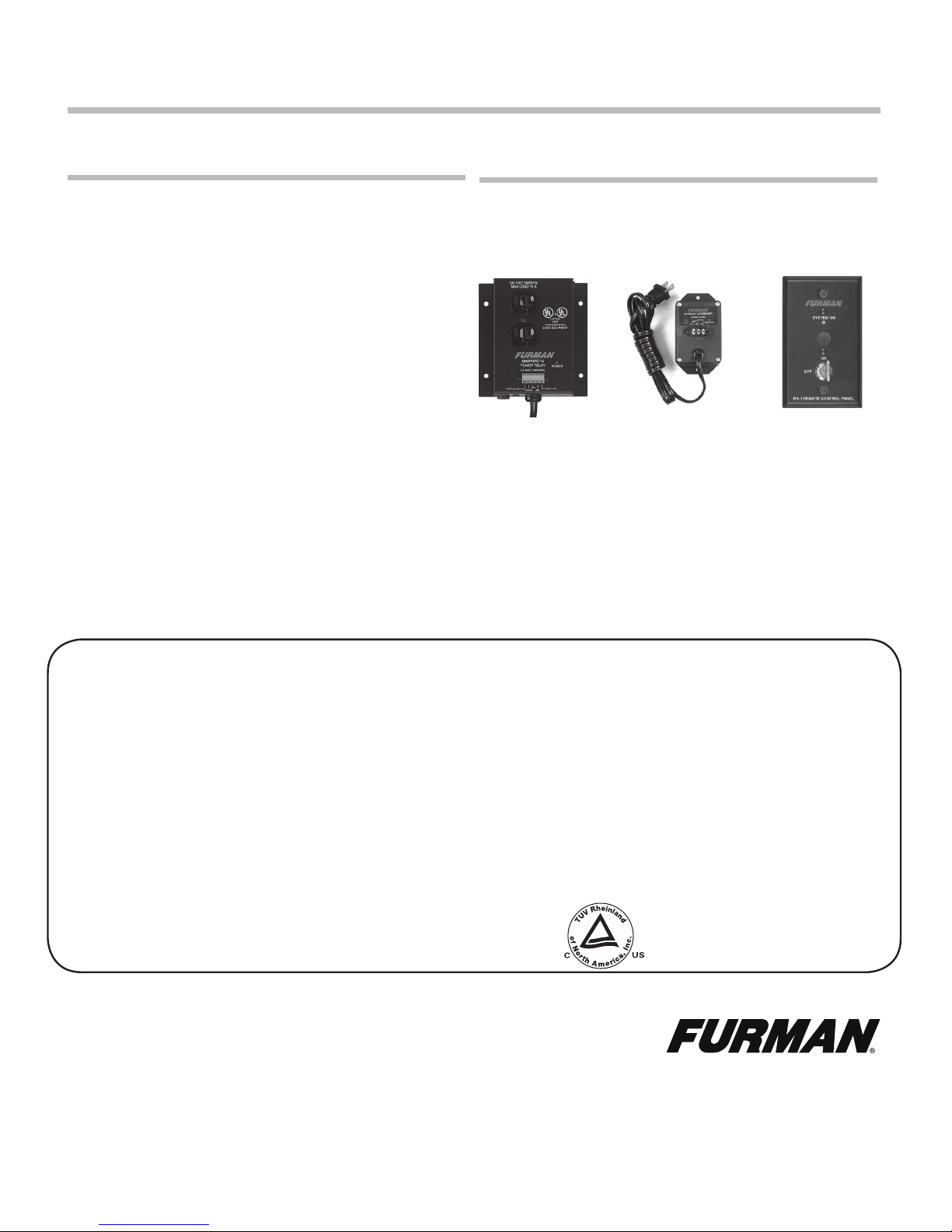
of Furman’s AC Line Voltage Regulators in addition
to the PS-8R. If you do use a voltage regulator, run
the raw power line into the regulator rst so that the
PS-8R receives a stabilized voltage to distribute.
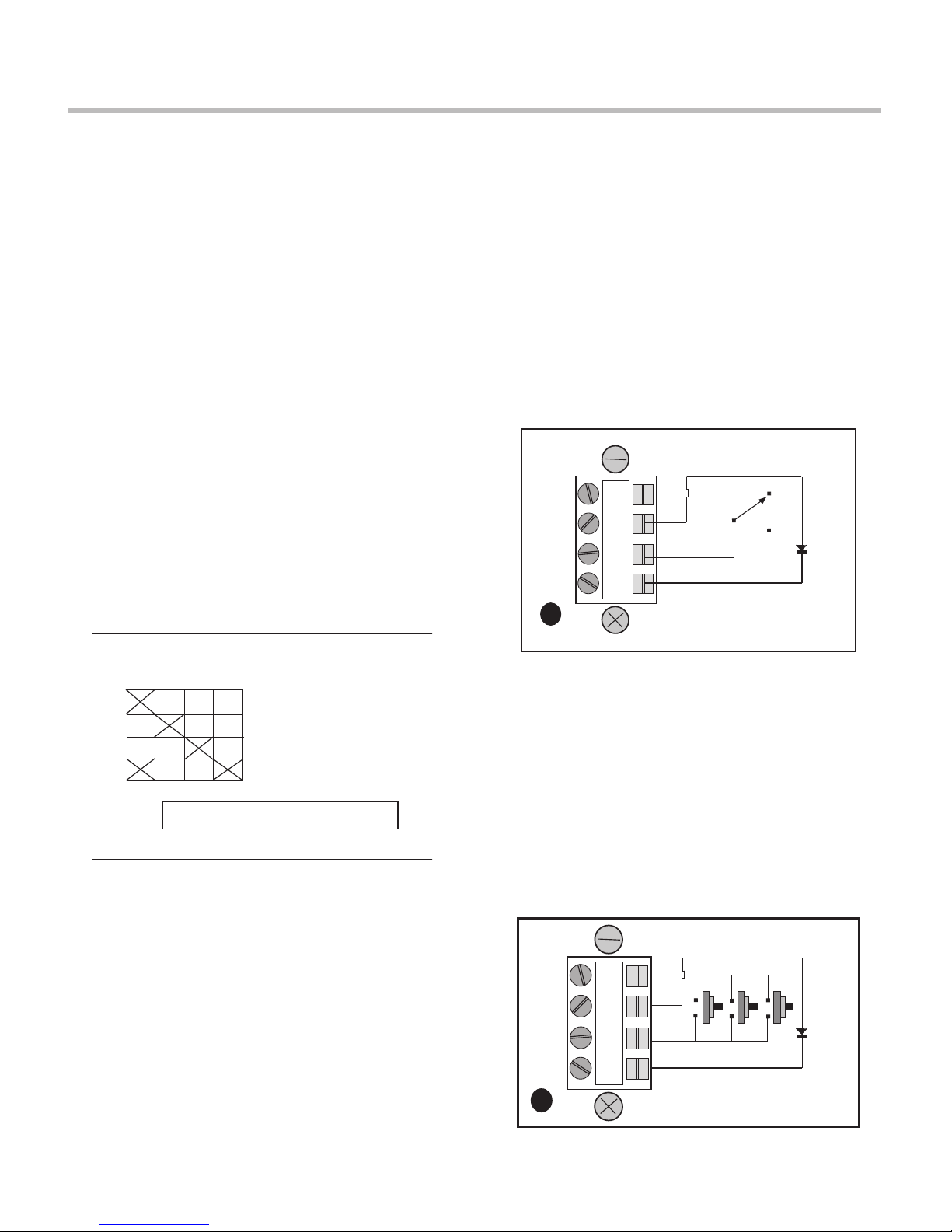
Mains wiring Fault analyzer
The PS-8R also assists in analyzing any faults that
may occur in the AC mains wiring. Two green and
one red neon indicators light in a specic pattern for
normal wiring and in different patterns for various
faults. When the AC wiring is correct, both green
indicators will be lit, but not the red indicator. If any
other pattern of indicators is lit, a fault is present. The
chart next to the indicators identies its exact nature.
Since any wiring fault presents a potentially serious
safety hazard, the assistance of a qualied electri-
cian should be obtained in correcting the problem.
adjusting the delay interval
The delay interval (the time between the turn-on or
turn-off of outlets 1 and 2, or 2 and 3 — not 1 and
3) is factory preset at approximately 5 seconds. It is
possible to lengthen or shorten the delay interval by
making an internal adjustment to the PS-8R. How-
ever, due to the risk of electric shock, this procedure
should only be done by a qualied technician.
Unplug the PS-8R and remove its top cover by
unscrewing the four top panel screws and one
2