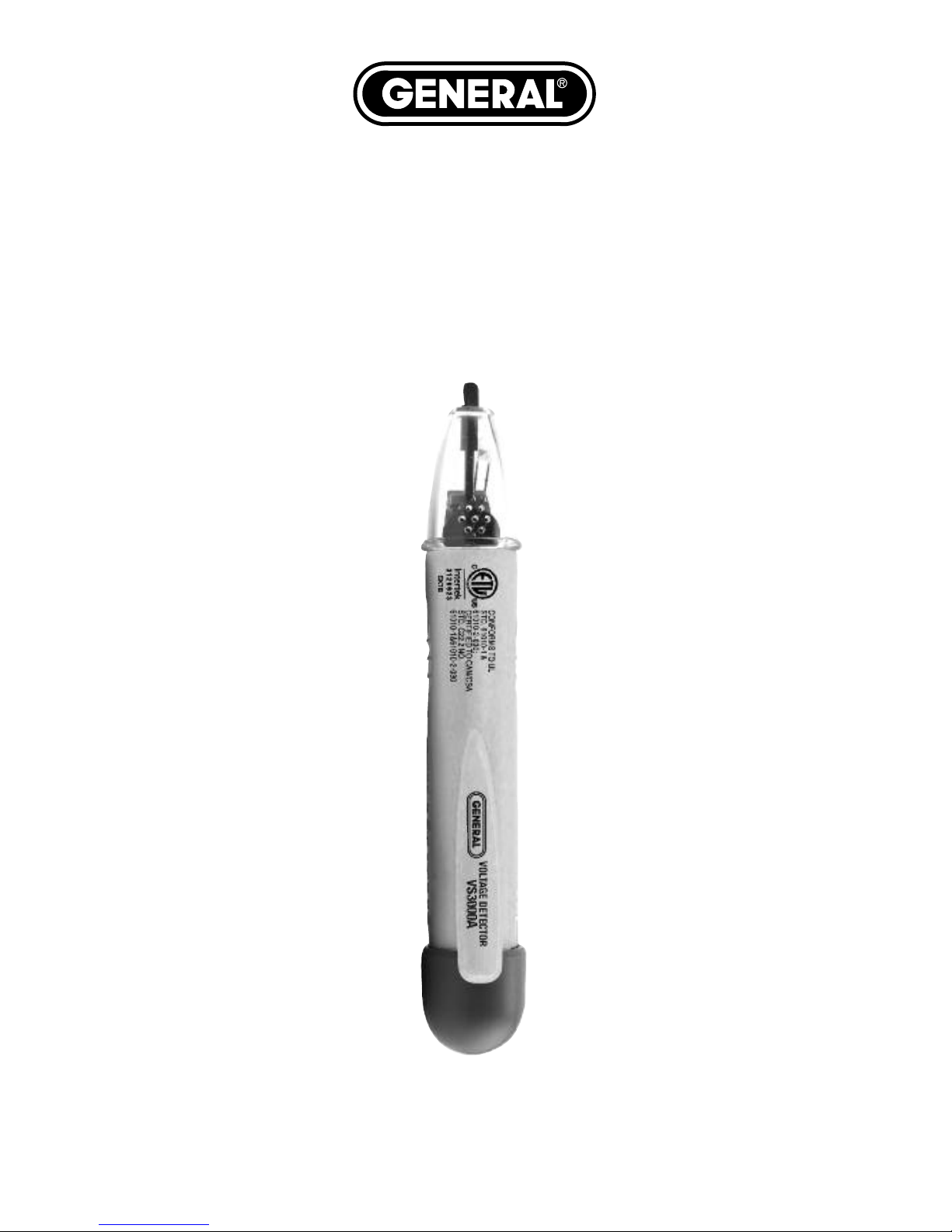
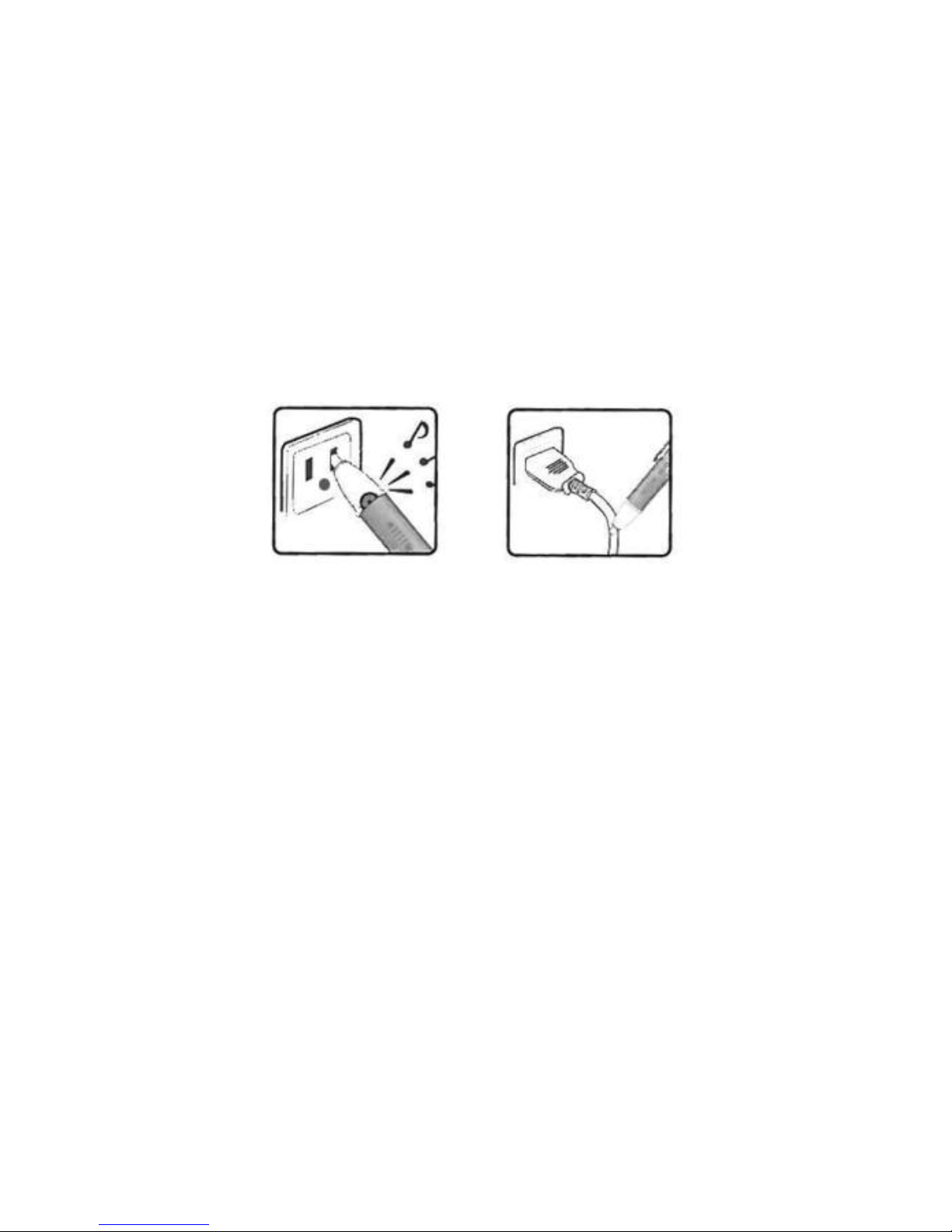
• The VS3000A indicates the presence of AC voltage with an
amplitude between 70V and 1000V. Accordingly, do not
assume that the absence of a positive indication means that
the circuit under test is de-energized (not “hot”). Although
they can cause shock and/or serious personal injury, voltages
below 70V may not be detected by the VS3000A. Whenever
you have reason to believe that a line or outlet is “hot”,
confirm your suspicion by measuring the voltage of the line or
outlet with a multimeter or clamp meter.
• To avoid electric shock, do not operate the unit without the
switch/battery compartment cover in place.
• Physically separate the multiple lines of 2-phase and 3-phase
circuits before testing them.
• Do not use the VS3000A if it appears to be damaged or
malfunctioning.
• Do not expose the tester to temperatures above 122°F,
relative humidity greater than 85%, or voltages higher than
1000V.
• Do not use the VS3000A to test for the presence of DC
voltage.
• Do not use the unit to test for the presence of AC voltage on a
shielded conductor, behind a wall or conduit, or under soil.
• Keep your hand behind the finger guard when performing a
test. Never touch any conductor with your hand or skin until
you have confirmed that it is not “hot”. To repeat: whenever
you have reason to believe that a line or outlet is “hot”,
measure its voltage with a multimeter or clamp meter.
• f the equipment is used in a manner not specified by the
manufacturer, the protection provided by the product may be
impaired.
5