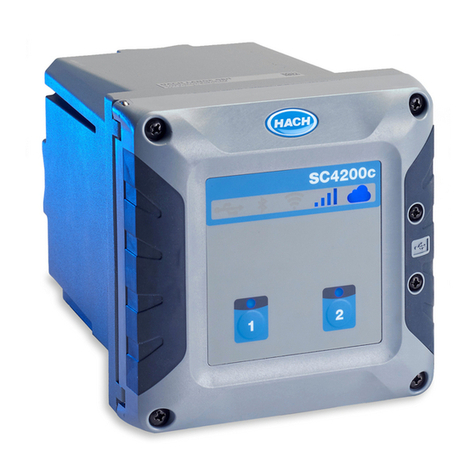
Hach SC4200c Quick manual

DOC023.97.90586
SC4200c
06/2019, Edition 7
Basic User Manual
Manual básico del usuario
Manuel d'utilisation de base
基本用户手册

English..............................................................................................................................3
Español.......................................................................................................................... 23
Français......................................................................................................................... 45
中文................................................................................................................................. 67
2

Table of contents
Specifications on page 3 Operation on page 20
General information on page 4 Maintenance on page 21
Installation on page 8 Troubleshooting on page 21
User interface on page 19 Replacement parts and accessories on page 22
Startup on page 20
Specifications
Specifications are subject to change without notice.
Specification Details
Dimensions (W x H x D) ½ DIN—144 x 144 x 192 mm (5.7 x 5.7 x 7.6 in.)
Weight 1.7 kg (3.7 lb) (Controller weight without optional modules)
Enclosure NEMA 4X/IP66 metal enclosure with a corrosion-resistant finish
Operating temperature –20 to 60 °C (–4 to 140 °F); Cellular version: –20 to 55 °C (–4 to 131 °F)
Storage temperature –20 to 70 °C (–4 to 158 °F)
Relative humidity 0 to 95%, non-condensing
Altitude 2000 m (6562 ft) maximum
Installation category II
Pollution degree 2
Protection class I, connected to protective earth
Power requirements 100–240 VAC ±10%, 50/60 Hz; 0.5 A (7 Watt sensor load)
Measurement Two device digital SC connectors
Relays high voltage Two relays (SPDT); Maximum switching voltage: 250 VAC; Maximum switching
current: 5 A (resistive only load); Maximum switching power: 1250 VA, 125 W
(resistive only load); Wire gauge: 0.75 to 2.5 mm2 (18 to 12 AWG)
Outputs (optional) Five 4–20 mA analog outputs on each analog output module1
Analog input (0–20 mA or 4–20 mA) on each analog input module
Digital communication Profibus DPV1 card1 (optional), Modbus TCP/IP
Network connection2LAN version: Two Ethernet connectors (10/100 Mbps), switch function, M12 female D-
coding connector; Cellular version (optional): SIM card (3G/4G); WiFi version
(optional)
USB port Used for data download and software upload. The controller records approximately
20,000 data points for each connected sensor.
Compliance information CE. ETL certified to UL and CSA safety standards (with all sensor types).
Warranty 1 year (EU: 2 years)
1Refer to the module documentation for additional information.
Note: Connect only one module to one of the available slots.
2The type of connection is dependent on controller configuration.
English 3

Expanded manual version
For additional information, refer to the expanded version of this manual, which is available on the
manufacturer's website.
General information
In no event will the manufacturer be liable for direct, indirect, special, incidental or consequential
damages resulting from any defect or omission in this manual. The manufacturer reserves the right to
make changes in this manual and the products it describes at any time, without notice or obligation.
Revised editions are found on the manufacturer’s website.
Safety information
N O T I C E
The manufacturer is not responsible for any damages due to misapplication or misuse of this product including,
without limitation, direct, incidental and consequential damages, and disclaims such damages to the full extent
permitted under applicable law. The user is solely responsible to identify critical application risks and install
appropriate mechanisms to protect processes during a possible equipment malfunction.
Please read this entire manual before unpacking, setting up or operating this equipment. Pay
attention to all danger and caution statements. Failure to do so could result in serious injury to the
operator or damage to the equipment.
Make sure that the protection provided by this equipment is not impaired. Do not use or install this
equipment in any manner other than that specified in this manual.
Use of hazard information
D A N G E R
Indicates a potentially or imminently hazardous situation which, if not avoided, will result in death or serious injury.
WARNING
Indicates a potentially or imminently hazardous situation which, if not avoided, could result in death or serious
injury.
CAUTION
Indicates a potentially hazardous situation that may result in minor or moderate injury.
N O T I C E
Indicates a situation which, if not avoided, may cause damage to the instrument. Information that requires special
emphasis.
Precautionary labels
Read all labels and tags attached to the instrument. Personal injury or damage to the instrument
could occur if not observed. A symbol on the instrument is referenced in the manual with a
precautionary statement.
This is the safety alert symbol. Obey all safety messages that follow this symbol to avoid potential
injury. If on the instrument, refer to the instruction manual for operation or safety information.
This symbol indicates that a risk of electrical shock and/or electrocution exists.
4 English

This symbol indicates the presence of devices sensitive to Electro-static Discharge (ESD) and
indicates that care must be taken to prevent damage with the equipment.
Electrical equipment marked with this symbol may not be disposed of in European domestic or public
disposal systems. Return old or end-of-life equipment to the manufacturer for disposal at no charge to
the user.
Certification
WARNING
Pacemaker precautions. If electromagnetic interference (EMI) occurs, it can either:
• Stop the stimulating pulses from the pacemaker that control the rhythm of the heart.
• Cause the pacemaker to supply the pulses irregularly.
• Cause the pacemaker to ignore the rhythm of the heart and supply pulses at a set interval.
Current research shows that cellular devices are not a significant health problem for most pacemakers
wearers. However, persons with pacemakers should use precautions to make sure that their device
does not cause a problem. Keep the device a minimum of 20 cm (7.9 in.) from the user.
CAUTION
Electromagnetic radiation hazard. Make sure that the antenna is kept at a minimum distance of 20 cm
(7.9 in.) from all personnel in normal use. The antenna cannot be co-located or operated in conjunction
with any other antenna or transmitters.
N O T I C E
This is a Class A product intended for use in an industrial environment. In a domestic environment this product
may cause radio interference in which case the user may be required to take adequate measures.
N O T I C E
Network and access point security is the responsibility of the customer that uses the wireless instrument. The
manufacturer will not be liable for any damages, inclusive however not limited to indirect, special, consequential
or incidental damages, that have been caused by a gap in, or breach of network security.
Regulatory RF Device Approvals: US and Canada
Contains RF Cellular Module:
FCC ID: RI7LE910NAV2 or FCC ID: RI7LE910SVV2
IC: 5131A-LE910NAV2 or IC: 5131A-LE910SVV2
(Equipment Class: PCS Licensed Transmitter (LTE Module), LE910-NA V2 or LE910-SV V2
Table 1 Power for Cellular Modem: US and Canada
FCC (IC) rule parts Frequency range (MHz) Output (watts)
24E (RSS-133) 1850.7 - 1900.0 0.219
27 (RSS-130) 779.5 - 782.0 0.201
27 (RSS-139) 1710.7 - 1745.0 0.209
Cellular Modem LE910-NA V2 or LE910-SV V2—Important FCC Grant Conditions:
Single Modular Approval. Power output listed is conducted. This device is approved for mobile and
fixed use with respect to RF exposure compliance, and may only be marketed to OEM installers. The
antenna(s) used for this transmitter, as described in this filing, must be installed to provide a
separation distance of at least 20 cm from all persons. Installers and end-users must be provided
with operating conditions for satisfying RF exposure compliance. Maximum permitted antenna
gain/cable loss: 6.94 dBi for 700 MHz; 6.00 dBi for 1700 MHz; 9.01 dBi for 1900 MHz.
English 5

Regulatory RF Device Approvals: EU
Contains RF Cellular Module: Telit LE910-EU V2
Dual-Band GSM/GPRS/EDGE EGSM900/DCS1800
Dual-Band WCDMA/HSPA FDD I / FDD VIII
Penta-Band LTE FDD 1 / FDD 3 / FDD 7 / FDD 8 / FDD 20 wireless module
Table 2 Power for Cellular Modem: EU
Standard Operating frequency bands Output power [dBm] Output power (watts)
ETSI EN 301 908-1 (-13) E-GSM/GPRS 900 33.5 2.2
ETSI EN 301 908-1 (-13) EDGE 900 28 0.6
ETSI EN 301 908-1 (-13) DCS/GPRS 1800 30.5 1.1
ETSI EN 301 908-1 (-13) EDGE 1800 27 0.5
ETSI EN 301 908-1 (-13) WCDMA FDD I/VIII 24.5 0.3
ETSI EN 301 908-1 (-13) LTE 1/3/7/8/20 24 0.3
Canada (IC)
Contains RF module: IC : 5131A-LE910NAV2 or IC : 5131A-LE910SVV2
This class (A) digital apparatus complies with Canadian ICES-003. This device complies with
Industry Canada license exempt RSS standard(s). Operation is subject to the following two
conditions:
(1) this device may not cause interference, and
(2) this device must accept any interference, including interference that may cause undesired
operation of the device.
Cet appareil numérique de la classe (A) respect toutes les exigences de la norme NMB-003 du
Canada. Le présent appareil est conforme aux CNR d'Industrie Canada applicables aux appareils
radio exempts de licence. L'exploitation est autorisée aux deux conditions suivantes:
(1) l'appareil ne doit pas produire de brouillage, et
(2) l'utilisateur de l'appareil doit accepter tout brouillage radioélectrique subi, même si le brouillage
est susceptible d'en compromettre le fonctionnement.
United States (FCC)
Contains RF Module: FCC ID: RI7LE910NAV2 or FCC ID: RI7LE910SVV2
Modifications not expressly approved by this company could void the user's authority to operate this
equipment (FCC section 15.21).
This equipment has been tested and found to comply with the limits for a Class A digital device,
pursuant to Part 15 of the FCC Rules. These limits are designed to provide reasonable protection
against harmful interference when the equipment is operated in a commercial environment. This
equipment generates, uses, and can radiate radio frequency energy and, if not installed and used in
accordance with the instruction manual, may cause harmful interference to radio communications.
Operation of this equipment in a residential area is likely to cause harmful interference in which case
the user will be required to correct the interference at his own expense (FCC section 15.105).
Telit RF Module FCC/IC Regulatory notices
Modification statement
Telit has not approved any changes or modifications to this device by the user. Any changes or
modifications could void the user's authority to operate the equipment.
Telit n'approuve aucune modification apportée à l'appareil par l'utilisateur, quelle qu'en soit la nature.
Tout changement ou modification peuvent annuler le droit d'utilisation de l'appareil par l'utilisateur.
Interference statement
This device complies with Part 15 of the FCC Rules and Industry Canada licence-exempt RSS
standard(s). Operation is subject to the following two conditions: (1) this device may not cause
6 English

interference, and (2) this device must accept any interference, including interference that may cause
undesired operation of the device.
Le présent appareil est conforme aux CNR d'Industrie Canada applicables aux appareils radio
exempts de licence. L'exploitation est autorisée aux deux conditions suivantes : (1) l'appareil ne doit
pas produire de brouillage, et (2) l'utilisateur de l'appareil doit accepter tout brouillage radioélectrique
subi, même si le brouillage est susceptible d'en compromettre le fonctionnement. Cet appareil est
conforme aux limites d'exposition aux rayonnements de la IC pour un environnement non contrôlé.
Product overview
D A N G E R
Chemical or biological hazards. If this instrument is used to monitor a treatment process and/or
chemical feed system for which there are regulatory limits and monitoring requirements related to
public health, public safety, food or beverage manufacture or processing, it is the responsibility of the
user of this instrument to know and abide by any applicable regulation and to have sufficient and
appropriate mechanisms in place for compliance with applicable regulations in the event of malfunction
of the instrument.
The SC4200c is a 2-channel controller for digital sensors. Refer to Figure 1.
The controller is configured and operated with a Mobile sensor management (MSM) software. The
MSM software is accessible through a web application on a customer-supplied device with an
internet browser that is connected to the internet. The controller connects to the MSM software with a
cellular network (optional), WiFi network (optional) or through LAN connection. The MSM software is
also referred as Cloud in this manual.
The controller is available with optional expansion modules. Refer to the expanded user manual for
additional information.
Figure 1 Product overview
1 Label for module installation 6 USB connection
2 Power indicator light 7 USB cover
3 SIM card38 Electrical connections and fittings
4 Expansion module49 Cover for module installation
5 Additional expansion module slots 10 High-voltage barrier
3Dependent on controller configuration. The SIM card is factory installed in cellular versions.
4Dependent on controller configuration.
English 7

Product components
Make sure that all components have been received. Refer to Figure 2. If any items are missing or
damaged, contact the manufacturer or a sales representative immediately.
Figure 2 Product components
1 SC4200c controller 8 Flat washer, ¼-inch ID (4x)
2 Mounting hardware 9 Lock washer, ¼-inch ID (4x)
3 Sealing gasket for panel mount, Neoprene 10 Keps hexnut, M5 x 0.8 (4x)
4 Vibration isolation gasket for pipe mount 11 Pan head screws, M5 x 0.8 x 15 mm (4x)
5 Vibration isolation washer for pipe mount (4x) 12 Pan head screws, M5 x 0.8 x 100 mm (4x)6
6 Bracket for wall and pipe mounting 513 Screwdriver, 2-mm wide blade
7 Mounting foot (mounting bracket inserts) (2x)
Installation
D A N G E R
Multiple hazards. Only qualified personnel must conduct the tasks described in this section of the
document.
5A bracket for panel mounting is available as an optional accessory. Refer to Replacement parts
and accessories on page 22.
6Used for variable diameter pipe mount installations.
8 English

Installation guidelines
WARNING
Electrical shock hazard. Externally connected equipment must have an applicable country safety
standard assessment.
N O T I C E
Do not install the controller in an environment with a caustic atmosphere without a protective enclosure. A caustic
atmosphere will cause damage to electronic circuitry and components.
N O T I C E
Do not install the controller outdoors in an environment that receives direct sunlight or UV radiation or damage to
the controller can occur. Install the optional UV protection screen with sunroof to prevent damage from UV
exposure when installed outdoors in direct sunlight.
Note: Make sure that your IT department has approval for the installation and commissioning of the device.
Administrator rights are not necessary. The email address "[email protected]" sends the setup email and
"[email protected]" sends the system notifications that are necessary for the installation. Add the two email
addresses to the safe senders list to make sure to receive mails from these senders. Hach does not send a request
to confirm that the sender is not a robot.
This instrument is rated for an altitude of 2000 m (6562 ft) maximum. Use of this instrument at an
altitude higher than 2000 m can slightly increase the potential for the electrical insulation to break
down, which can result in an electric shock hazard. The manufacturer recommends that users with
concerns contact technical support.
• Install the controller in a location where the power disconnect device for the controller is easily
operated.
• Attach the controller upright and level on a flat, vertical surface.
• As an alternative, attach the instrument to a panel, vertical pole or horizontal pole.
• Make sure that the device is in a location where there is sufficient clearance around it to make
connections and to do maintenance tasks.
• Make sure that there is a minimum of 16 cm (6.30 in.) of clearance for the enclosure doors to
open.
• Install the instrument in a location with minimum vibration.
• The optional holder for mobiles is recommended for all installations.
• The optional sunroof or the optional UV protection screen with sunroof is recommended for all
outdoor installations.
Mechanical installation
Attach the instrument to a wall
Attach the controller upright and level on a flat, vertical surface. Make sure that the wall mounting is
able to hold 4 times the weight of the equipment. Refer to the illustrated steps in Figure 3 and
Product components on page 8 for the necessary mounting hardware.
English 9

Figure 3 Wall mounting
Attach the instrument to a pole
Attach the controller upright to a pole or pipe (horizontal or vertical). Make sure that the pipe diameter
is 19 to 65 mm (0.75 to 2.5 in.) Refer to the illustrated steps in Figure 4 and Product components
on page 8 for the necessary mounting hardware.
10 English
Other manuals for SC4200c
4
Table of contents
Languages:
Other Hach Controllers manuals
Hach
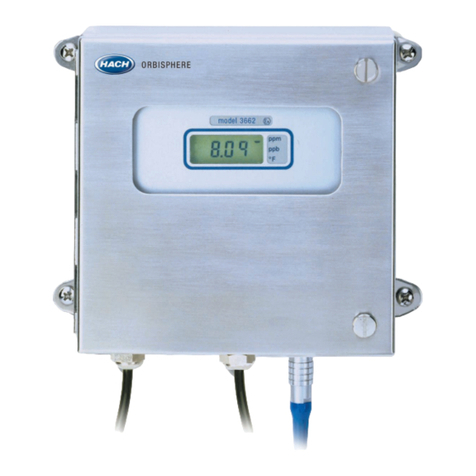
Hach ORBISPHERE 366 Series Quick manual
Hach
Hach sc200 Technical manual
Hach
Hach SC4500 Quick manual
Hach
Hach sc200 Quick manual
Hach
Hach sc200 User manual
Hach
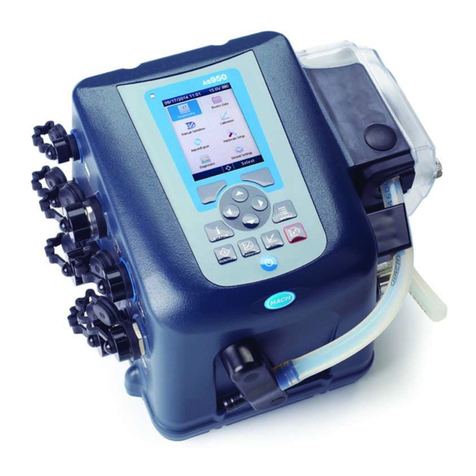
Hach AS950 AWRS Assembly instructions
Hach
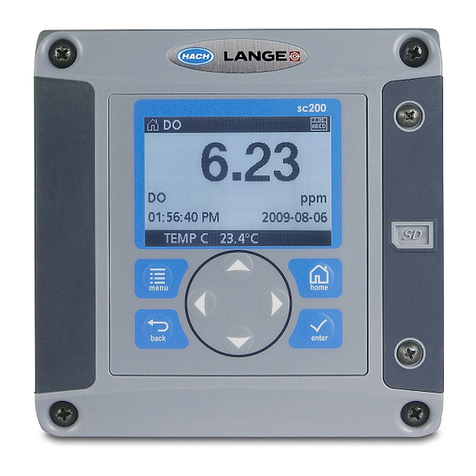
Hach sc200 User manual
Hach
Hach SC4500 User manual
Hach
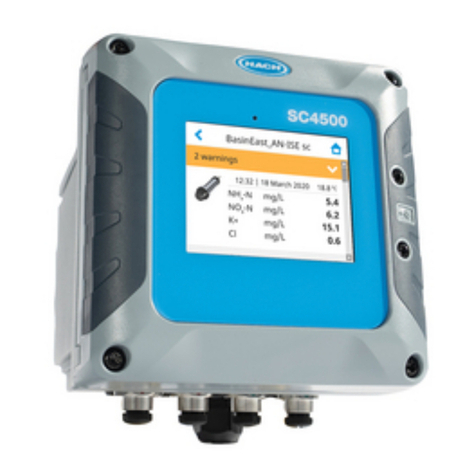
Hach SC4500 User manual
Hach
Hach SC4500 User manual


Popular Controllers manuals by other brands
Digiplex
Digiplex DGP-848 Programming guide
YASKAWA
YASKAWA SGM series user manual
Sinope
Sinope Calypso RM3500ZB installation guide
Isimet
Isimet DLA Series Style 2 Installation, Operations, Start-up and Maintenance Instructions
LSIS
LSIS sv-ip5a user manual
Rockwell Automation
Rockwell Automation 1769-L31 installation instructions