When the HT8 is disconnected from the power supply the
Multi-Speed control will reset to speed position 1 when it is
next connected to the power supply.
CAUTION: the HT8 is a powerful machine. Always
ensure that you have a firm grip before switching on.
6. Now walk slowly forward and at the same time release the
pressure on the handles to gently lower the HT8 so that the
sanding drum comes into contact with the floor.
7. Guide the floor sander in a straight line at a slow walking
pace. Do not force or hold the floor sander back. Allow the
machine to do the work and always move at an even pace.
8. At the end of the pass while still moving forward tilt the floor
sander back so that the sanding drum comes clear of the
floor. Now walking backwards lower the floor sander again
and pull it backwards over the area just sanded moving at a
steadily even pace. Take care to ensure that the power cable
is kept clear of the sanding drum at all times. At the end of the
sanding pass and while still moving backwards tilt the floor
sander back so once again the sanding drum comes clear of
the floor.
Move the machine over so that it overlaps the area just sanded
by approximately 50mm (2”) and start to sand the next pass
repeating the above technique.
Keep your body/legs close to handle as this will provide
better control and make it easier to smoothly raise and lower
the drum. If you operate the HT8 with your arms stretched out
in front of you, you will have less control of the floor sander.
CAUTION: to prevent damage to the floor surface, work
piece or machine follow these rules.
i. Always ensure that the floor sander is moving when in
operation and the sanding drum is in contact with the
floor.
ii. Never lift the back of the machine when sanding.
iii. Never apply pressure to try to increase the rate of
sanding. Damage to the floor and machine will occur.
iv. Never bounce or drop the floor sander on to the floor.
Always lower the machine gently.
v. Never dwell in one place, move steadily at all times.
vi. Never allow the power cable to come into contact with
the sanding drum.
9. When the dust in the dust bag reaches the ‘MAX’ line stop
sanding. Disconnect the power cable from the power supply
and remove the paper dust bag. Turn the top of the paper
dust bag over to stop the escape of dust and dispose of into a
suitable container. Dampen the dust bag down with water to
reduce the risk of spontaneous combustion. Never reuse the
paper dust bag or empty it or dispose of it into a fire. If a cloth
bag is used empty into a suitable container being careful to
contain the dust. Do not dispose of the contents into a fire.
10. Fit a new paper dust bag or refit the cloth bag. Reconnect the
floor sander to the power supply and continue sanding.
11. When taking a break from work disconnect the power cable
from the supply, remove and dispose of the paper dust bag, or
empty the cloth bag as detailed in 8. above. Never leave the
floor sander unattended with the dust bag in place containing
dust.
12. On completion disconnect the power cable from the supply.
Remove and dispose of the paper dust bag, or empty the
cloth bag as detailed in 8. above. Stow the cable on the
handle assembly and if required dismantle for transportation.
Carry out maintenance as recommended in Maintenance and
Servicing.
DANGER: never leave the floor sander unattended with
dust in the dust bag. Always remove the dust bag and
dispose of into a suitable container.
FLOOR SANDING TECHNIQUE
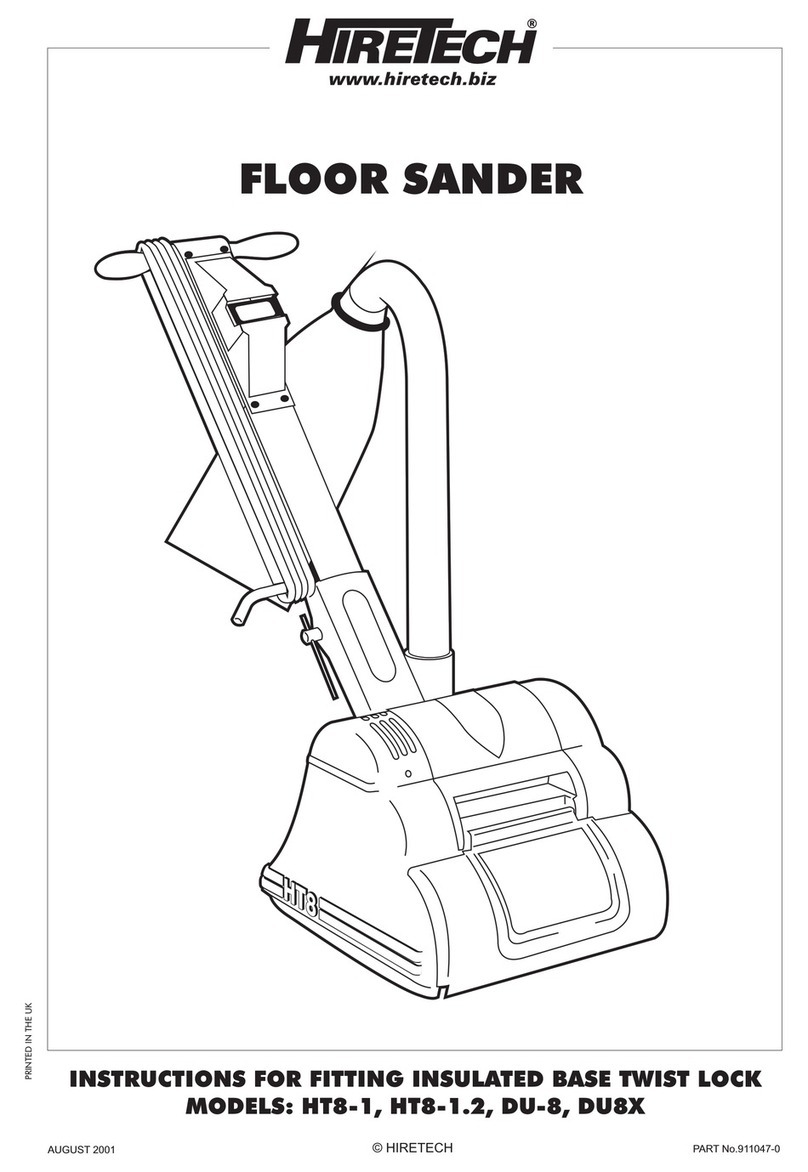
HT8 Drum Floor Sander - a powerful floor sander designed for the
rapid levelling and sanding of all types of wood flooring excluding
thin laminated or veneered floors. Load the sander with abrasive
making sure that it is skin tight around the drum. Loose sheets
will tear. Place the sander on the right hand wall (unless you are
making an angled cut on uneven floors) with about two thirds of
the floor in front of you. Start the sander with the drum off the floor
then walk forward at an even pace and ease the drum on to the
floor. As you near the end of the pass, gradually raise the drum
off the floor. Practice this technique before turning on the sander.
Cover the same path you made on the forward cut by pulling the
machine backwards and easing the drum to the floor as you begin
the backward pass until you reach the original starting point, then
ease the drum off the floor.
When two thirds of the floor is sanded, turn the floor sander around
and sand the remaining third in the same way. Overlap the one
third area by 0.6 to 0.9 meters (2 to 3 feet ) with the two thirds
area to blend the two areas together.
WARNING: never bounce the sanding drum or dwell in
one place as this will sand dips and hollows in the floor.
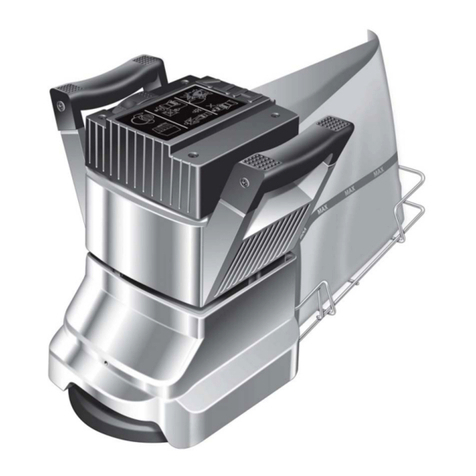
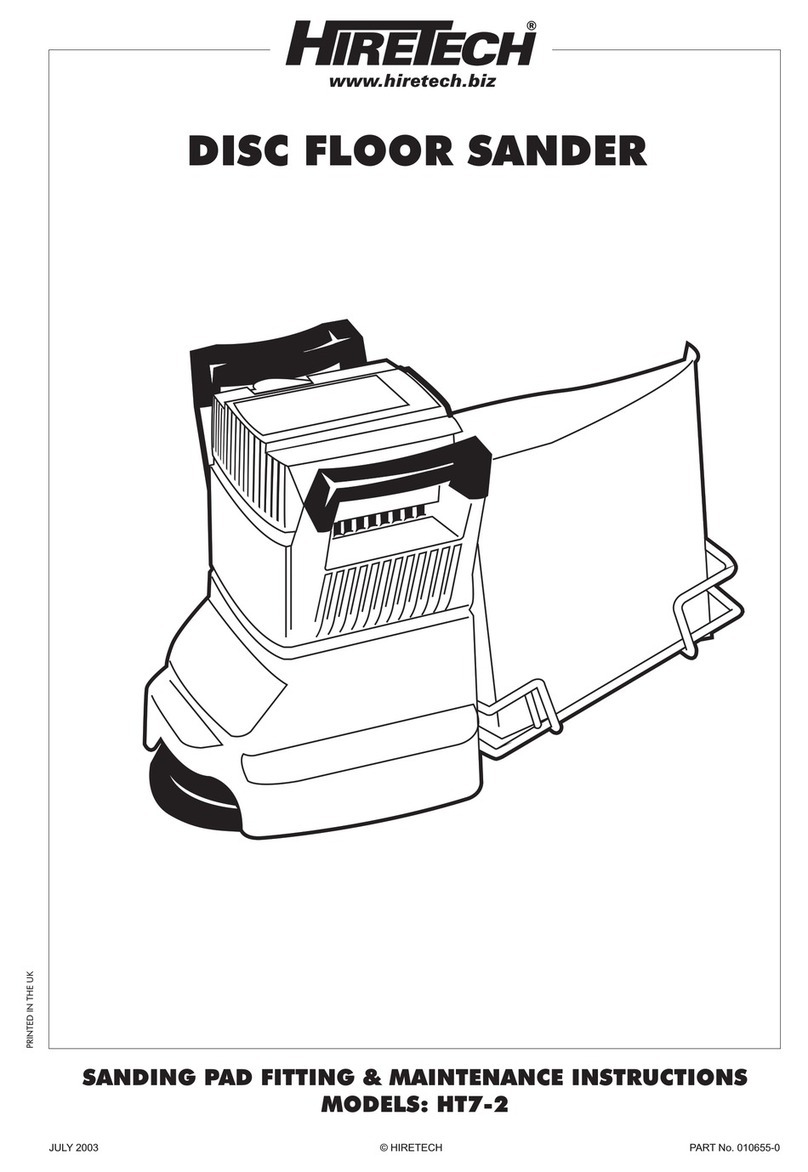
HT7 Disc Floor Sander (Edger) - a powerful disc floor sander
designed for sanding along the edges of a floor without damaging
the baseboards or mouldings. Also suitable for smaller areas
where the HT8-1.2 Floor Sander will not reach like stair treads and
closets load the abrasive disc making sure the retaining bolt is tight.
Start the edger with the disc off the floor then lower the disc to
the floor as you move the sander. Work progressively moving the
sander in a sweeping motion from side to side.
HTF Orbital Floor Sander - a orbital action floor sander designed
for re-finishing, sanding between coats of varnish and re-surfacing
floors in good condition. Load the abrasive sheet, pad or strip.
Start the sander, move immediately and sand in the direction of
the grain using the same technique as the drum floor sander. For
difficult to reach areas use the disc floor sander with a fine grit
abrasive, or sand by hand.
Hand Sanding - to sand difficult to reach areas scrape and sand
the floor by hand. Use a scraper to remove old finishes, always
scraping in the direction of the grain, and then sand by hand using
the same grit abrasive as you finished with when machine sanding.
See Floor Sanding Technique diagrams on page 5.
FLOOR TYPES
Plank & Strip Floors
Old floors in good condition - when the floor is in good condition
- no uneven edges, cupping or crowning of planks and strips - and
you want to re-surface the floor, sanding back to new wood, start
sanding in the direction of the planks or strips - with the wood grain.
Start with a medium grit abrasive. Complete the first cut with the
HT8-1.2 Floor Sander then sand up to the baseboards and door
4© Hiretech